Adjustable vs Fixed Dumbbells: Which Setup Is Better for Home?
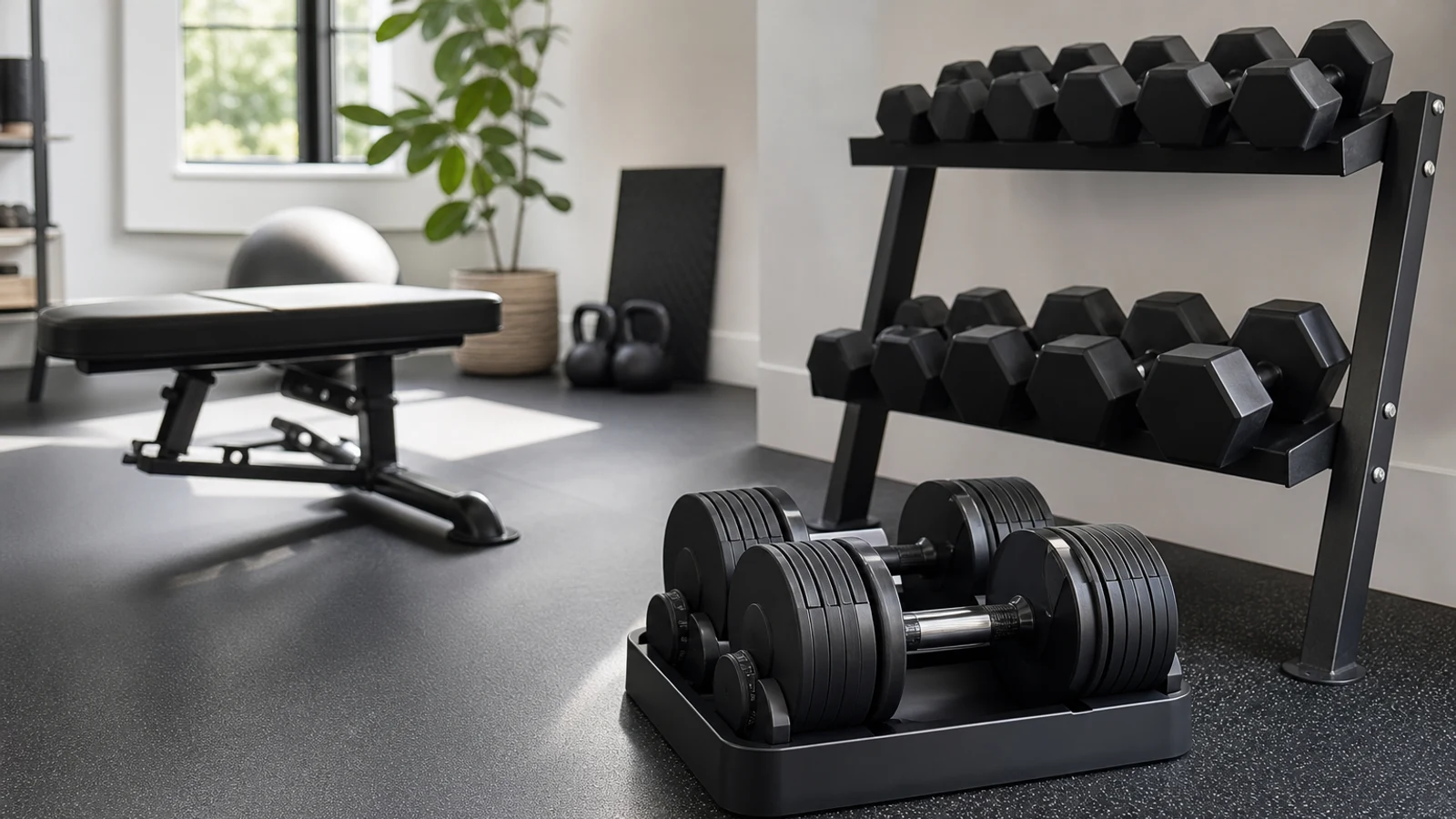
Adjustable Vs. Fixed Dumbbells At A Glance
| Decision Point | Adjustable Dumbbells | Fixed Dumbbells |
|---|---|---|
| Space | One pair can cover a broad range in a small storage area | Each weight requires its own dumbbell, usually with a rack |
| Weight Changes | Requires a dial, pin, lever, or plate adjustment | Pick up the next pair immediately |
| Workout Flow | Best for one-person, exercise-by-exercise training | Better for circuits, drop sets, and shared workouts |
| Durability | Depends on the selector and locking mechanism; avoid dropping | Solid construction generally tolerates heavier use better |
| Handling | May feel longer or less balanced at lighter settings | Consistent shape and balance at every weight |
| Weight Range | Broad range from one compact set, but with a fixed maximum | Can expand gradually by adding pairs |
| Storage Cost | Lower space requirement and usually fewer pieces | More storage, rack space, and equipment as the range grows |
Adjustable and fixed dumbbells can both support a complete home strength routine. The difference is not whether one type is capable of building strength; both can be used for presses, rows, squats, lunges, carries, curls, and many other movements. The real decision is how much space, setup time, durability, and weight variety you need around those exercises.
Adjustable dumbbells combine several resistance levels into one pair. Depending on the design, you change the load with a dial, pin, lever, or by adding plates. Fixed dumbbells have one permanent weight, so a broader training range means owning several pairs.
For a compact home gym, adjustable dumbbells are usually the easier first purchase. For a dedicated room with enough storage, fixed dumbbells offer the more familiar gym experience. Neither is universally better, and the answer can change as your training becomes heavier or more specialized.
How Adjustable Dumbbells Work
Most adjustable dumbbells are designed to rest in a tray or cradle while you select the desired weight. Selectorized models can change quickly between exercises, while plate-loaded models require more manual handling but may use a simpler construction.
A set such as the Bowflex SelectTech 552 Adjustable Dumbbells is aimed at replacing multiple individual pairs with one adjustable system. That makes the format appealing when the same room must also function as an office, bedroom, living area, or general-purpose workout space.
The compact footprint does not mean the dumbbells behave exactly like a small fixed pair. Some adjustable models become longer as more weight is selected, and the surrounding plates or housing can affect clearance during curls, rows, presses, and movements where the dumbbell passes close to your body. Handle comfort and balance matter as much as the listed weight range.
Where Adjustable Dumbbells Make The Most Sense
Small Or Shared Rooms
Adjustable dumbbells are especially useful when floor space is the limiting factor. One pair can cover several light and moderate training loads without filling a wall with equipment. You still need clear space to lift, but the storage footprint is much easier to control.
- Apartment, bedroom, or multipurpose-room gyms
- Workouts that use several different weights
- Users who need to store equipment in a closet or against a wall
- Beginners who are still learning which weights they will use most often
- Households where two people need different resistance levels at different times
Adjustable Dumbbell Trade-Offs
The main compromise is mechanical complexity. Selectorized models contain moving parts that must remain aligned and locked before lifting. Manufacturer instructions commonly warn users not to drop adjustable dumbbells, force the selector, lift the base with the handle, or use the handle as a support. That makes controlled placement and regular inspection part of normal ownership.
Adjustment time can also become noticeable during fast circuits, supersets, or drop sets. Even a quick selector change interrupts the rhythm more than simply reaching for another fixed pair. If your program changes weight repeatedly within a set, the convenience of compact storage may not outweigh the slower transitions.
Some adjustable dumbbells also have wider or less traditional shapes. That may be unimportant for rows or goblet squats but more noticeable during chest presses, shoulder presses, curls, or exercises where the handle needs to sit close to your torso. Before buying, check the handle design, minimum and maximum weight, increment sizes, and whether both dumbbells can be adjusted independently without leaving the tray.
Where Fixed Dumbbells Make The Most Sense
Dedicated Training Spaces
Fixed dumbbells become more attractive when you have a permanent workout area and know which weights you use regularly. A rack keeps the floor organized and lets you move between exercises without stopping to change a mechanism.
- Garage, basement, or dedicated home-gym space
- Circuit training, supersets, and drop sets
- Multiple people training during the same session
- Frequent use of a consistent series of weights
- Heavy training where equipment may receive more wear
Why Fixed Dumbbells Feel Better To Many Lifters
A fixed dumbbell has the same basic shape whether it weighs 10 pounds or 50 pounds. The handle, ends, and balance remain predictable, which can make repeated movements feel more natural. There are no plates to select and no locking mechanism to check before each set.
That simplicity is valuable in workouts built around speed. You can place one pair down and immediately pick up another. This is useful for alternating heavy and light movements, timed circuits, and drop sets where even a short adjustment can disrupt the intended sequence.
Fixed dumbbells also give you more flexibility at the top end. You can keep adding pairs as your strength increases, while an adjustable set has a defined maximum unless the manufacturer offers compatible expansion options. The downside is that every added weight consumes money, rack space, and storage capacity.
Fixed Dumbbell Trade-Offs
The cost and footprint rise with the range. A few pairs for basic full-body workouts may fit comfortably on a compact rack, but a complete progression from light isolation weights to heavier lower-body and pulling weights can occupy a substantial section of a room.
Fixed dumbbells also require more planning. If you buy only the weights you use today, you may outgrow the set as your strength changes. If you buy a broad range immediately, you may spend on weights that rarely leave the rack. Rubber, urethane, and metal finishes also differ in noise, floor protection, odor, and long-term maintenance.
A fixed setup is not automatically safer simply because it has no selector. Any free weight can be mishandled, and a rack must be stable and positioned so that weights can be returned without twisting or stepping around obstacles. A proper lifting surface and enough clearance remain important.
Compare The Decision By Workout Style
Strength Progression
If you are following a structured program and expect to increase resistance gradually, adjustable dumbbells can cover many early and intermediate stages without requiring a new purchase after every small increase. Check the actual increment pattern, because large jumps can make progression difficult for smaller movements such as lateral raises or triceps extensions.
Circuits And Metabolic Workouts,
Compare The Decision By Workout Style
If your sessions involve timed intervals, supersets, or frequent weight changes, fixed dumbbells usually keep the workout moving more smoothly. You can arrange the likely weights around the bench or mat and transition without adjusting a selector.
Heavy Presses And Lower-Body Work
For heavy presses, rows, split squats, and loaded carries, the maximum weight and physical dimensions matter more than the number of settings. An adjustable set can be a good compact solution, but make sure its top weight is high enough for your likely training horizon. If you already know you will need very heavy dumbbells, fixed pairs or a different strength-training setup may be more practical.
Space, Flooring, And Storage
Measure the storage area, not just the empty floor. Adjustable dumbbells need room for their tray and enough clearance to lift them out without bumping furniture. Fixed dumbbells need a rack or stable storage surface and sufficient access to return each pair safely.
The active workout area should be larger than the footprint of the weights. Account for the full range of motion of presses, lunges, rows, and carries, plus a clear path to set the dumbbells down. A cramped room can make either format frustrating, especially when a bench is added.
Floor protection is worth considering in apartments and upstairs rooms. Adjustable models should not be dropped, and fixed models can still damage hard flooring if they are set down forcefully. A suitable mat can reduce noise and protect the floor, but it does not replace controlled handling.
What To Check Before Buying
For Adjustable Dumbbells
- Maximum weight per dumbbell, not just the pair’s combined marketing number
- Smallest and largest adjustment increments
- Whether the mechanism must be changed while the dumbbell is in its tray
- Handle diameter, length, grip texture, and balance at different settings
- Locking instructions, maintenance requirements, and replacement-part support
- Whether the set is intended for controlled placement rather than dropping
- Storage tray dimensions and whether a stand is included or sold separately
For Fixed Dumbbells And Racks,
What To Check Before Buying
- The specific weights you use now and the next few likely progression steps
- Head shape and handle design for floor exercises and close-to-body movements
- Coating and noise characteristics for your room and flooring
- Rack width, height, stability, and available capacity
- Whether the rack leaves enough room to remove weights without hitting a wall
- How easily the setup can be expanded without replacing the rack
When A Hybrid Setup Is Better
You do not have to choose one format for every exercise. A hybrid arrangement can combine an adjustable pair for less frequently used weights with fixed dumbbells for the loads that appear in nearly every workout.
For example, someone might use adjustable dumbbells for rows, presses, lunges, and occasional accessory work, then add fixed pairs for common warm-up weights or the two heaviest settings. This reduces the number of fixed pairs while preserving fast access where it matters most.
A hybrid setup is also useful when two people train together. One person can use the adjustable pair while the other uses fixed weights, although the arrangement becomes less convenient if both lifters need the same load at the same time.
When Not To Buy Or Upgrade Yet
You may not need a full dumbbell collection if you are still establishing a routine. A modest pair, resistance bands, and body-weight movements can support a useful starting program while you learn which exercises and loads you perform consistently.
Hold off on upgrading if your current weights are not the limiting factor. Better programming, controlled repetitions, and regular training often matter more than adding equipment. Upgrade when you repeatedly reach the top of your available range, need smaller increments, or lose workout time because your current setup does not match your routine.
Also reconsider dumbbells altogether if your main goal requires equipment they cannot provide efficiently, such as very heavy barbell lifts, high-volume cardio, or specialized cable movements. Dumbbells are versatile, but they do not need to be the entire home gym.
Go Deeper Before You Choose
For more context, see home gym on a budget.
Relevant Product
One catalog product is directly relevant to this decision. It is shown as a reference point, not as a universal winner. Current price, seller and availability should always be confirmed on Amazon.

Bowflex SelectTech 552 Adjustable Dumbbells
Adjustable dumbbells that replace a full weight rack.
View on AmazonResearch References
These sources informed the factual background for this guide. BuyingView applies its own editorial judgment to the purchase decision.
Questions & Answers
Useful follow-up questions that often change the buying decision.
Are adjustable dumbbells good for beginners?
Yes. They can provide several useful weight levels without requiring a full rack, which is helpful while a beginner learns which loads fit different exercises. Choose a design with clear increments, comfortable handles, and a secure locking system, and start with weights that allow controlled technique.
Are fixed dumbbells safer than adjustable dumbbells?
Neither is automatically safe. Fixed dumbbells remove the selector mechanism, but all free weights require controlled lifting, adequate clearance, and proper storage. Adjustable models generally need extra care because many manufacturers warn against dropping them or forcing the adjustment mechanism.
Do adjustable dumbbells replace a full rack?
They can replace much of the function of a rack for one person, but not always the exact experience. They save space and offer multiple loads, yet they may adjust more slowly, have a different balance, and stop at a defined maximum weight.
What is better for drop sets: adjustable or fixed dumbbells?
Fixed dumbbells are usually more convenient because the next weight is already available. Adjustable dumbbells can still work for slower drop sets, but changing the setting between efforts may interrupt the intended pace.
Should I buy a pair or a single adjustable dumbbell?
A pair is more versatile for presses, rows, squats, lunges, and symmetrical movements. A single dumbbell can work for carries, one-arm rows, and unilateral exercises, but it is less flexible if your routine frequently uses both arms at once.
Is the Bowflex SelectTech 552 relevant to this decision?
It is a representative selectorized adjustable dumbbell for shoppers comparing a compact multi-weight system with fixed pairs. Evaluate its weight range, adjustment increments, dimensions, handling, and care requirements against your own exercises rather than assuming that any advertised replacement count will fit every workout.