Walking Pad Vs Treadmill: Which One Fits A Home Routine?
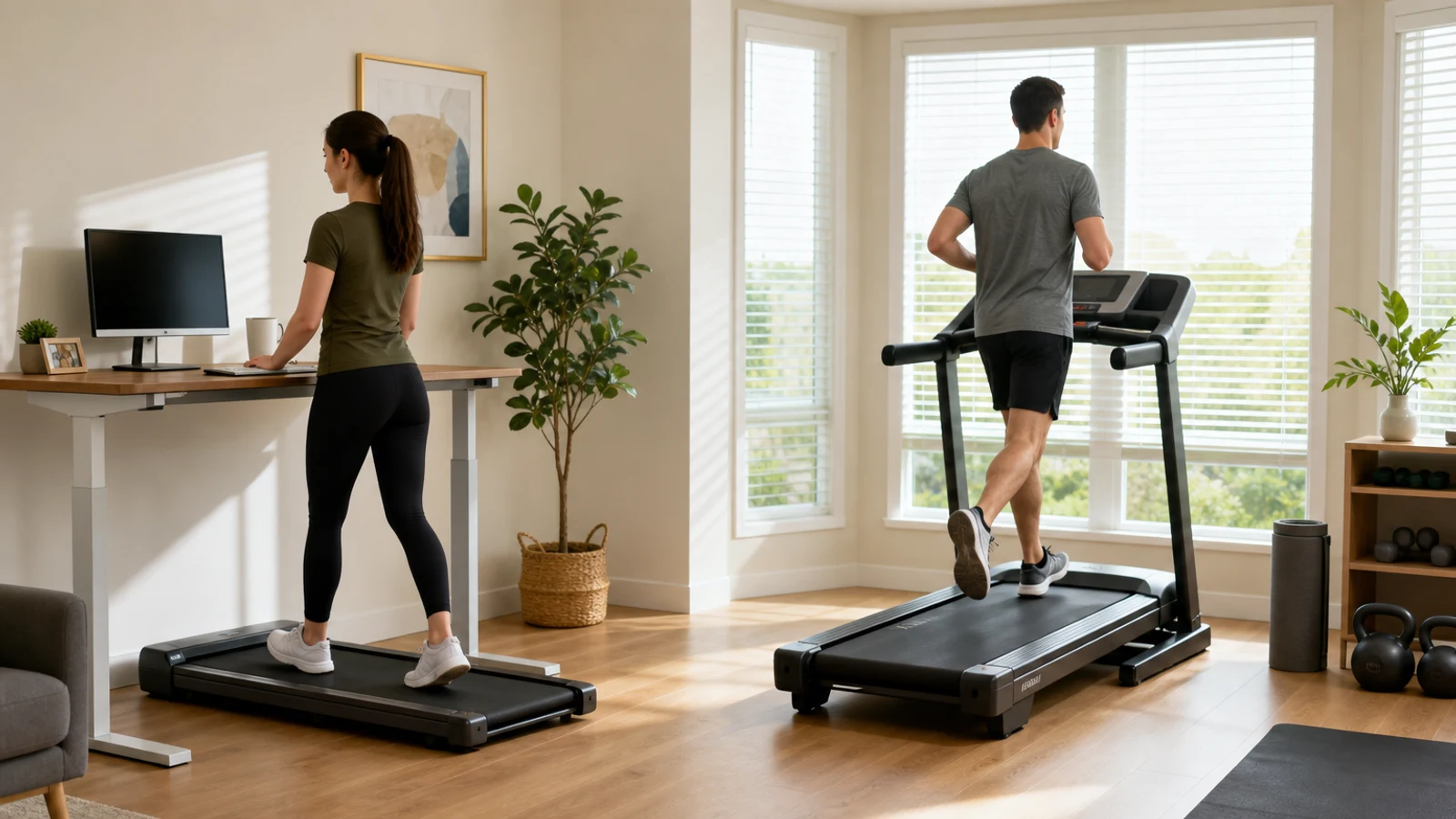
Walking Pad Vs Treadmill At A Glance
| Decision Point | Walking Pad | Traditional Treadmill |
|---|---|---|
| Best For | Desk walking, casual walking, small rooms, and convenient daily movement | Structured workouts, incline walking, jogging, running, and longer sessions |
| Footprint | Usually shorter, lower, and easier to store under furniture or against a wall | Usually larger and heavier, with more clearance needed around the machine |
| Support | Often no front handrail; requires more balance and attention to foot placement | Front and side rails provide more stability and easier access to controls |
| Workout Range | Typically optimized for walking speeds, though some models go faster | Broader speed range and more frequent incline options |
| Desk Compatibility | Designed for use beneath a compatible standing desk on some models | Usually impractical beneath a desk because of the console and rails |
| Storage And Setup | More likely to move or store between sessions, but still heavy enough to be awkward | Often stays in one location; folding does not eliminate its floor and clearance needs |
| Best Buyer | Someone prioritizing convenience, compact living, and low-friction use | Someone prioritizing versatility, stability, progression, and training performance |
The difference between a walking pad and a treadmill is not simply size. It is a difference in intended routine. A walking pad is built around making low-speed walking easy to fit into a room, workday, or short break. A traditional treadmill is built more like a home fitness machine, with a larger deck, handrails, stronger support, and a wider range of workout settings.
That distinction matters because the most convenient machine is not always the one you will enjoy using. A walking pad may be the better purchase for someone who wants to accumulate steps while answering emails or watching television. It may be the wrong choice for someone who expects to progress to incline walking, jogging, or longer, more demanding sessions.
The best decision is to start with the routine you are most likely to repeat, then check whether the machine’s belt, controls, safety features, storage requirements, and maintenance expectations fit that routine.
Choose A Walking Pad If Convenience Is The Main Goal
A walking pad makes the strongest case when the barrier to exercise is setup. Its lower profile and compact design can make it easier to keep near a desk, sofa, or television. Some models can be rolled or carried into storage, although they are not necessarily light enough to move casually several times a day.
The walking-pad format is especially useful for people who want short bouts of movement rather than a dedicated workout every time. Ten or twenty minutes between tasks can be more realistic than reserving a separate block for a full treadmill session. It can also suit apartments, spare bedrooms, and shared spaces where a full console and handrail assembly would dominate the room.
Choose a walking pad when most of these statements are true:• Your main activity will be walking, not running.• You want to use a standing desk or work surface.• You have limited floor space.• You prefer short, repeatable sessions.• You can walk confidently without relying on a front handrail.• You have a clear storage plan when the machine is not in use.
Choose A Treadmill If Your Routine May Expand
A traditional treadmill is usually the safer long-term choice when you want one machine to support several types of training. A larger deck gives you more room to adjust your stride, while handrails can make starting, stopping, and changing pace feel more controlled. Incline settings can add variety and increase the challenge without requiring a faster pace.
The extra size is not only a drawback. It can improve stability and make the machine feel less restrictive, particularly during brisk walking, interval sessions, or jogging. A treadmill is also more likely to remain useful if your goals change from general activity to structured cardiovascular training.
Choose a treadmill when these needs are important:• You want to jog or run.• You plan to use incline regularly.• You prefer handrails and a larger walking surface.• More than one person will use the machine.• You expect longer or more structured workouts.• You want controls and a display that are easy to reach while moving.
Belt Size And Stability Matter More Than The Product Name
A compact machine can look appealing in a listing photo, but the usable belt area determines how natural and forgiving it feels. Compare the actual walking surface rather than the overall product dimensions. A short belt may be adequate for slow, deliberate walking but feel restrictive as your pace or stride length increases. A narrow belt also leaves less room for correcting a misstep.
Body size, stride length, balance, and walking speed all affect the appropriate belt. Taller users and people who take longer strides should be especially cautious about choosing a compact deck solely because it fits a storage space. If you are buying online, look for the manufacturer’s belt dimensions, maximum user weight, minimum and maximum speed, and instructions for safe use.
A treadmill’s handrails provide another meaningful difference. They are not a substitute for good balance or medical advice, but they can provide useful support when stepping on, stepping off, changing speed, or recovering from a momentary loss of confidence. A walking pad without rails asks more of the user and may not suit anyone who feels unsteady.
Desk Walking Has A Different Workflow
A walking pad can work beneath a standing desk, but walking and computer work compete for attention. Slow walking may be compatible with reading, listening to calls, or routine computer tasks. More precise work, frequent typing, detailed visual tasks, and meetings that require concentration may be easier while standing still.
Desk height is part of the purchase. A treadmill that is too tall can force your shoulders upward or make your wrists bend while typing. The desk should remain stable, and the monitor should be positioned so you can look forward rather than down at an awkward angle. Cables, chair legs, and nearby furniture should not create a trip hazard when the pad is pulled out.
Think of a walking pad as a movement tool that can support work, not as a guarantee that every work task will be productive in motion. If your workday involves frequent calls, check the belt and motor noise in the actual room. Advertised noise figures may not reflect vibration transmitted through a hard floor or the sound of footfalls at faster speeds.
Space Planning Includes Clearance And Storage
Measure the machine in use, not only when folded or stored. A traditional treadmill can occupy a large footprint and needs open space around it for safe access. Consumer Reports advises allowing substantial clearance at the sides and rear of a treadmill, and the exact requirement should come from the manufacturer’s manual for the model you choose.
Walking pads reduce the footprint but do not remove the need for planning. You need enough room to pull the unit out, connect power, reach the controls, and step off without colliding with a desk, wall, bed, or table. Storing a pad under a sofa is useful only if you can remove it without repeated heavy lifting or damaging the power cord.
Before buying, mark the proposed footprint on the floor with tape. Then test the walking path around it. Include the open position of a folding desk, the swing of a door, access to outlets, and a place for the remote control. If the equipment must be moved before every session, be honest about whether that extra step will reduce use.
Safety And Build Quality Deserve Extra Attention
Any motorized walking surface can create fall, pinch, burn, and electrical risks if it is poorly designed, improperly maintained, or used in a crowded space. A front handrail, emergency stop or safety key, stable side rails where provided, clear instructions, and a responsive speed control are more important than a long list of app features.
On April 16, 2026, the U.S. Consumer Product Safety Commission warned consumers to stop using several Sperax walking pad and treadmill models after reports involving unexpected speed changes, abrupt stops, falls, overheating, and fires. That warning is a reminder to check the exact model number, manufacturer support, warranty terms, and current recall notices before buying or using a machine.
Use the machine on a level surface and follow the manual’s clearance and maintenance instructions. Keep children and pets away during operation, avoid loose clothing near the belt, and do not treat a walking pad without rails as a toy or general-purpose household surface. If you have balance concerns, a history of falls, or a medical condition affected by exercise, ask a qualified clinician what type of equipment and intensity are appropriate.
Maintenance Is Part Of The Ownership Decision
Both categories require more than plugging in and walking. Belts may need cleaning, alignment, tension checks, and lubrication according to the manufacturer’s schedule. Dust, pet hair, and debris can affect the motor area, while a machine placed on carpet may have different ventilation and cleaning requirements than one on a hard floor.
Walking pads often have fewer visible components, but their compact motors and lighter frames may be less tolerant of demanding use than a substantial treadmill. Do not assume a model marketed for occasional desk walking is suitable for multiple high-intensity sessions every day. Conversely, a large treadmill can be wasteful if you will only use it for a few slow walks each week.
Before purchase, confirm whether replacement belts, remotes, lubricant, and service support are available. A clear warranty and reachable manufacturer are practical signals of a more manageable ownership experience.
When Not To Buy Either One
A treadmill or walking pad is not automatically a good investment simply because walking is beneficial. Do not buy yet if you have not identified where the machine will live, how you will move it, or how it will fit around your work and household routine. A machine that becomes a storage obstacle can reduce activity rather than increase it.
You may also be better served by outdoor walking, a gym membership, or simpler home equipment if weather, safety, budget, or motivation makes a motorized belt unlikely to be used. If your main goal is strength training, neither machine replaces resistance equipment. If you specifically want running workouts, a walking pad advertised primarily for desk use is a poor substitute for a treadmill with an appropriately sized deck and support system.
For broader planning, a walking pad or treadmill can be one part of a modest home setup rather than the entire gym. Our guide to building a home gym on a budget can help you decide whether the floor space and budget should go toward cardio equipment or several smaller training tools.
A Practical Decision Process
Start by writing the routine in plain language: “I will walk for 20 minutes during two work breaks,” “I want three incline workouts each week,” or “I want to jog while watching television.” Then match the machine to that sentence rather than to the most impressive specification list.
Use this checklist before comparing models:• Define walking, brisk walking, jogging, or running as your primary use.• Measure the belt area and the complete operating footprint.• Check the user-weight limit with a meaningful margin rather than buying at the limit.• Confirm whether you need incline, handrails, a safety key, or a remote.• Consider vibration and footfall noise, not only motor noise.• Verify storage, outlet access, warranty, replacement parts, and maintenance requirements.• Check the model number against current safety notices and recall information.• Decide whether you will actually leave the machine ready to use.
The Bottom Line
A walking pad is the better fit for a compact, low-friction walking routine, particularly when desk use or easy storage is the priority. It can help turn small gaps in the day into movement, but its shorter belt, limited support, and narrower workout range make careful selection important.
A traditional treadmill is the more capable choice for incline walking, jogging, running, longer sessions, multiple users, and anyone who values a larger deck and handrails. Its footprint and cost in space are the trade-offs for that flexibility.
If your present goal is simply to walk more and you have a realistic storage and desk plan, a walking pad may be enough. If you are buying for future fitness goals or want one machine that can handle varied workouts, choose a treadmill with the deck size, support, and safety features that your routine actually requires.
Go Deeper Before You Choose
For more context, see home gym on a budget.
For more context, see home office essentials.
Research References
These sources informed the factual background for this guide. BuyingView applies its own editorial judgment to the purchase decision.
Questions & Answers
Useful follow-up questions that often change the buying decision.
Can You Run On A Walking Pad?
Some walking pads have higher speed limits, but the label alone does not make them suitable for running. Check the manufacturer’s intended use, usable belt length and width, stability, handrail design, motor guidance, and warranty. If running is a central goal, a purpose-built treadmill is usually the more appropriate choice.
Is A Walking Pad Quieter Than A Treadmill?
It may be quieter because it is smaller and generally used at lower speeds, but noise depends on the motor, belt, flooring, footfalls, and building structure. A dense equipment mat can reduce vibration, but it cannot eliminate all sound transmitted through a hard floor.
Are Walking Pads Safe Under A Standing Desk?
They can be, if the desk is stable, the screen and keyboard are positioned ergonomically, the walking surface is clear, and the user can step off safely. Start slowly and avoid tasks that require intense visual or manual precision until you know how walking affects your balance and concentration.
Does A Treadmill Burn More Calories Than A Walking Pad?
The machine category does not determine calorie use by itself. Speed, incline, duration, body size, and effort matter more. A treadmill may make higher effort easier through incline and faster speeds, while a walking pad may help some people accumulate more total movement because it is convenient to use.
Do Walking Pads Need Maintenance?
Yes. Follow the manual for cleaning, belt alignment, tension, lubrication, ventilation, and inspection. Keep dust and pet hair away from the motor area, and stop using the machine if the belt slips, changes speed unexpectedly, overheats, or makes a new grinding or electrical smell.
Should A Beginner Buy A Walking Pad Or Treadmill?
Choose based on the beginner’s actual needs. A confident walker in a small home may find a walking pad approachable because it is easy to keep nearby. Someone who wants handrails, incline, jogging capability, or extra stability may be better served by a traditional treadmill.