Is a Pet Water Fountain Worth It?
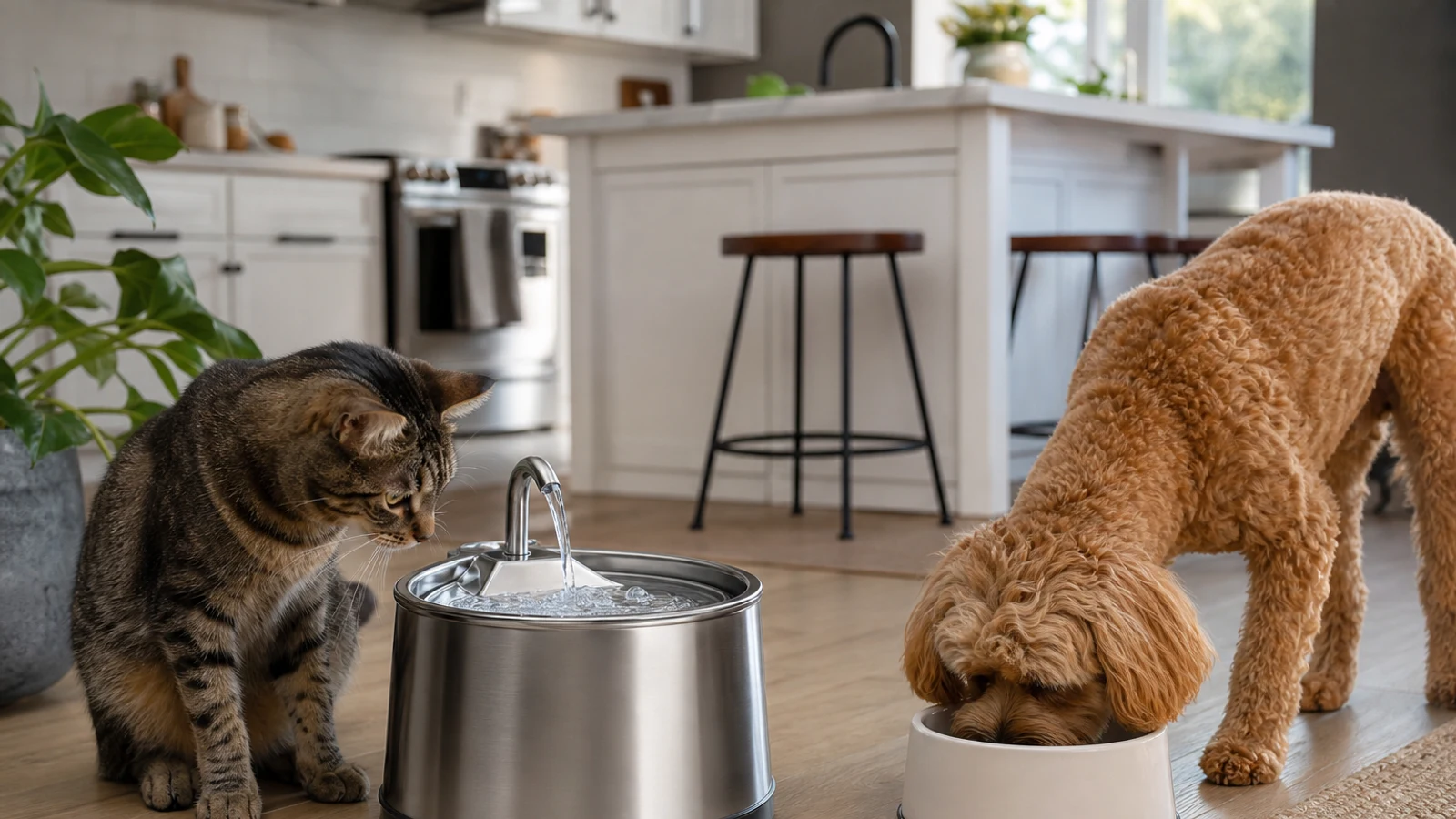
Pet Water Fountain Vs. Traditional Water Bowl
| Decision Point | Pet Water Fountain | Traditional Water Bowl |
|---|---|---|
| Best for | Pets attracted to moving water or owners who want a circulating reservoir | Pets that already drink reliably from still water |
| Hydration impact | May encourage some cats and dogs to drink more, but results vary by pet | Adequate when kept clean, filled, and placed where the pet can access it |
| Daily convenience | Often holds more water and can reduce frequent refilling | Simple to top up, with no pump or electrical connection |
| Cleaning | Requires washing the basin, pump, channels, and filter on a regular schedule | Usually faster to wash, with fewer hidden areas |
| Ongoing cost | Replacement filters, electricity, and possible pump replacement | Usually limited to the cost of the bowl and cleaning supplies |
| Failure risk | Can stop circulating during a power outage, clog, or pump failure | Continues working without power |
| Space and noise | Takes more counter or floor space and may produce a hum | Usually quieter, smaller, and easier to move |
Pet water fountains are one of those pet products that can feel either genuinely useful or completely unnecessary. The answer depends less on the marketing claim that running water is automatically healthier and more on your pet’s habits, your household setup, and how willing you are to maintain another appliance.
For some cats, a fountain makes water more noticeable and appealing. It can also give a multi-pet household a larger shared supply or provide a reservoir that does not evaporate as quickly. For other pets, the pump noise, unfamiliar movement, or shape of the fountain is enough to make them avoid it. A fountain that sits untouched is not improving hydration.
The practical question is not whether every pet needs one. It is whether a fountain solves a specific problem better than a clean, well-placed bowl. If your pet already drinks normally, has several accessible water sources, and you can refresh the water daily, a traditional bowl may remain the better value.
What A Pet Water Fountain Actually Does
Most pet fountains use a small pump to circulate water through a basin, spout, or bubbler. Many also use a replaceable filter intended to catch hair, food particles, and some debris. The circulation can keep the water moving and may make it easier for a pet to notice the drinking area.
That does not mean a fountain purifies water or removes every contaminant. A filter is not a substitute for washing the unit, replacing the water, or following the manufacturer’s maintenance instructions. A dirty fountain can accumulate slime, hair, food residue, mineral deposits, and bacteria in areas that are easy to overlook, especially around the pump and narrow channels.
The main potential benefits are behavioral and logistical rather than guaranteed medical effects: your pet may prefer the movement, the water may remain more appealing between refills, and the reservoir may hold more than a small bowl. Those advantages only matter if the pet actually uses the fountain and the owner keeps it clean.
When A Pet Water Fountain Is Worth It
Your cat prefers faucets or dripping taps. Cats are individual, but a cat that repeatedly seeks running water may be a reasonable candidate for a fountain. The moving stream can make the drinking area more engaging than a still bowl. Introduce it alongside the existing bowl rather than removing the familiar option immediately.
Your pet drinks reluctantly from a bowl. If your veterinarian has ruled out health problems and your pet simply seems uninterested in a bowl, a fountain is one experiment worth trying. It is not the only option: a second bowl, a different material, a wider shape, fresher water, wet food, or a new location may work just as well.
You have multiple pets. A larger reservoir can reduce how often you refill the water, although it does not eliminate the need to monitor the level and cleanliness. In a household where one pet guards or blocks access to another, adding more water stations may be more useful than buying one large fountain. Put stations in separate, low-traffic areas rather than forcing every pet to share one location. • Consider a fountain if your pet already drinks from a hose, faucet, or moving stream. • Consider a fountain if you are away from home for several hours and need a larger water supply, while still providing backup water. • Consider a fountain if your pet’s bowl is frequently contaminated by food, litter, hair, or debris. • Keep a regular bowl available during introductions, maintenance, and power outages.
When A Traditional Bowl Is The Better Choice
Your pet already drinks well. If your dog or cat consistently drinks from a clean bowl, there is no universal health requirement to upgrade. A bowl is simpler, cheaper, quieter, and easier to replace. You can also test the value of moving water by refreshing the bowl more frequently or adding a second bowl before buying a powered device.
You do not want recurring maintenance. Fountains often have more parts than expected: the reservoir, lid, tray, filter housing, pump, impeller cover, intake screen, and sometimes tubing. If you are unlikely to disassemble and clean those parts, the fountain may create a hygiene problem rather than solve one.
Your pet is noise-sensitive or cautious. Some pumps are quiet, but “quiet” is not the same as silent. A faint vibration or motor hum may bother a nervous pet, especially if the fountain is placed near a sleeping area. A timid pet may also avoid a fountain with bright lights or a forceful stream. • Choose a bowl if your pet ignores moving water. • Choose a bowl if electrical cords would be difficult to secure. • Choose a bowl if you need an emergency-proof option that works during outages. • Choose a bowl if you want the fastest possible daily cleaning routine.
Cats And Dogs May Have Different Use Cases
Cats are often the more compelling fountain candidates because some show a strong interest in faucets or moving water. Hydration can also be a recurring concern in feline care, particularly when a cat eats mostly dry food or has a medical condition that affects fluid balance. Even so, a fountain is only one tool. Wet food, adding water to food when appropriate, and providing multiple clean water locations may be equally or more effective for a particular cat.
Dogs vary widely. Some dogs enjoy drinking from moving sources, while others are perfectly content with a bowl. A fountain can be convenient for a small dog, a dog that leaves food particles in the water, or a household that wants a larger indoor reservoir. For a large dog or several dogs, check the drinking area and capacity carefully; a compact cat fountain may be awkward, easy to tip, or empty quickly.
Do not interpret a sudden change in drinking as a shopping problem. A pet that suddenly drinks much more or much less than usual, urinates differently, vomits, seems lethargic, or shows signs of dehydration should be discussed with a veterinarian. A fountain should not be used to mask a possible illness or delay an examination.
The Maintenance Is The Real Trade-Off
A fountain is worth buying only if its maintenance fits your routine. Refreshing the water does not replace cleaning the unit, and rinsing the visible bowl does not clean the pump. Follow the manufacturer’s instructions, but expect to wash the reservoir and removable parts frequently, inspect the pump, and replace filters on the recommended schedule.
The exact schedule depends on the design, number of pets, food type, water hardness, and how quickly hair or slime accumulates. In practice, households with multiple pets or pets that eat wet food may need more frequent cleaning than a single-pet household. If the fountain begins to smell, becomes slimy, makes unusual noises, or develops reduced flow, treat that as a maintenance signal rather than simply adding more water.
Look for a model that comes apart without tools, has few narrow channels, offers easy access to the pump, and uses parts that are dishwasher-safe only if the manufacturer explicitly says so. Replacement filters should be easy to find and reasonably simple to install. A low purchase price can become less attractive if the filter design is proprietary, difficult to source, or expensive over time.
What To Look For Before Buying
Material and design. Stainless steel or ceramic surfaces can be appealing when durability and easy cleaning are priorities. Plastic can be lighter and less expensive, but inspect it for scratches, seams, and hard-to-reach areas where residue can build up. The best material is still the one you will clean consistently.
Capacity and footprint. Bigger is not automatically better. A large fountain takes more space, may be harder to carry to the sink, and can encourage owners to leave the same water in place longer. Choose enough capacity for your pet’s size and household routine, but prioritize cleanability over the biggest advertised reservoir.
Pump access and noise. A removable or accessible pump is easier to inspect and clean. Look for a stable base, a cord that can be routed safely, and a flow setting that allows a gentle stream. If your pet is easily startled, avoid assuming that a motorized fountain will be acceptable without a gradual introduction period.
How To Introduce One Without Creating A Hydration Problem
Place the fountain near the existing bowl while the pump is off or set to its lowest flow, depending on the model. Let your pet investigate it without pressure. Keep the regular bowl filled with fresh water until you have seen consistent fountain use for several days.
Once your pet shows interest, turn on the fountain and observe whether the noise or stream changes the response. Some pets prefer a bubbler, some prefer a shallow flow, and some prefer still water even when a fountain is available. Do not force a pet’s face toward the water or remove all alternatives during the transition.
For cats, avoid placing the fountain directly beside a litter box or in a cramped corner. For dogs, use a stable base and enough clearance for the pet’s muzzle. In either case, a non-slip mat can protect the floor from splashing and make cleanup easier. If the pet never uses the fountain, return to the bowl rather than treating non-use as a training failure.
Ways To Improve Hydration Without Buying A Fountain
A fountain is not the only upgrade available. Start with the least complicated change that addresses the problem. Fresh water in a clean bowl may be enough, especially if the current bowl is narrow, dirty, tucked into a busy walkway, or placed beside food that frequently falls into it.
You can try wider or shallower bowls, multiple water stations, a different material, more frequent refilling, or moving the bowl away from noisy appliances. For some cats, wet food or adding a veterinarian-approved amount of water to food is a more reliable way to increase fluid intake than changing the drinking vessel. Dogs may respond to cooler water, a second station, or water added to meals when appropriate.
If a veterinarian has recommended increased fluid intake because of kidney, urinary, gastrointestinal, or other health concerns, ask which strategies are appropriate for your pet. The right approach depends on the diagnosis, diet, medications, and overall hydration status.
The Bottom Line
A pet water fountain is worth it when it solves a visible problem: your pet prefers moving water, drinks unreliably from a bowl, shares water with other animals, or benefits from a larger and more noticeable drinking station. Cats are often the most promising candidates, but no fountain can guarantee increased drinking.
It is probably not worth it when your pet already drinks well, you dislike recurring filter costs, or you know that pump cleaning will be neglected. A clean bowl in the right location is not a second-rate solution; for many pets, it is the simplest and most dependable one.
If you buy a fountain, select it for easy disassembly, safe placement, stable construction, accessible replacement parts, and a noise level your pet can tolerate. Keep a clean bowl as backup, monitor actual use, and treat unusual drinking behavior as a veterinary question rather than a product-comparison question.
Go Deeper Before You Choose
For more context, see automatic feeder buying guide.
For more context, see dog harness versus collar guide.
Research References
These sources informed the factual background for this guide. BuyingView applies its own editorial judgment to the purchase decision.
Questions & Answers
Useful follow-up questions that often change the buying decision.
Do pet water fountains really make pets drink more?
Sometimes, but not reliably for every pet. Cats and dogs that already prefer faucets, dripping taps, or moving water may use a fountain more enthusiastically. Other pets may ignore it or dislike the sound. A fountain should be viewed as an experiment in preference, not a guaranteed hydration solution.
Are pet water fountains better than bowls?
Neither is universally better. Fountains can offer moving water, larger reservoirs, and a way to catch some debris, but they require more cleaning, filters, electricity, and pump maintenance. Bowls are simpler, quieter, cheaper, and easier to keep available during power outages.
How often should a pet water fountain be cleaned?
Follow the product instructions, but expect frequent washing of the reservoir and removable parts, with special attention to the pump and hidden channels. Water may need refreshing daily, while filters and deeper components require replacement or cleaning on their own schedules. Multi-pet homes and pets that eat wet food may need more frequent attention.
Can a pet fountain prevent kidney disease or urinary problems?
No. A fountain may help some pets consume more water, but it cannot prevent or treat every kidney or urinary condition. If your pet has a diagnosed condition or shows a sudden change in drinking or urination, consult a veterinarian about an appropriate hydration plan.
Should I leave a water bowl out if I buy a fountain?
Yes. A bowl provides a familiar backup during introductions, cleaning, pump failure, or a power outage. Multiple water stations can also help in multi-pet homes where one animal may block another’s access.
What is the best material for a pet water fountain?
Stainless steel and ceramic are common choices for owners who prioritize durability and easy-to-clean surfaces. Plastic can be lighter and less expensive, but inspect any fountain for scratches and difficult-to-clean seams. Regardless of material, consistent cleaning matters more than the label alone.