Is a Countertop Dishwasher Worth It for a Small Kitchen?
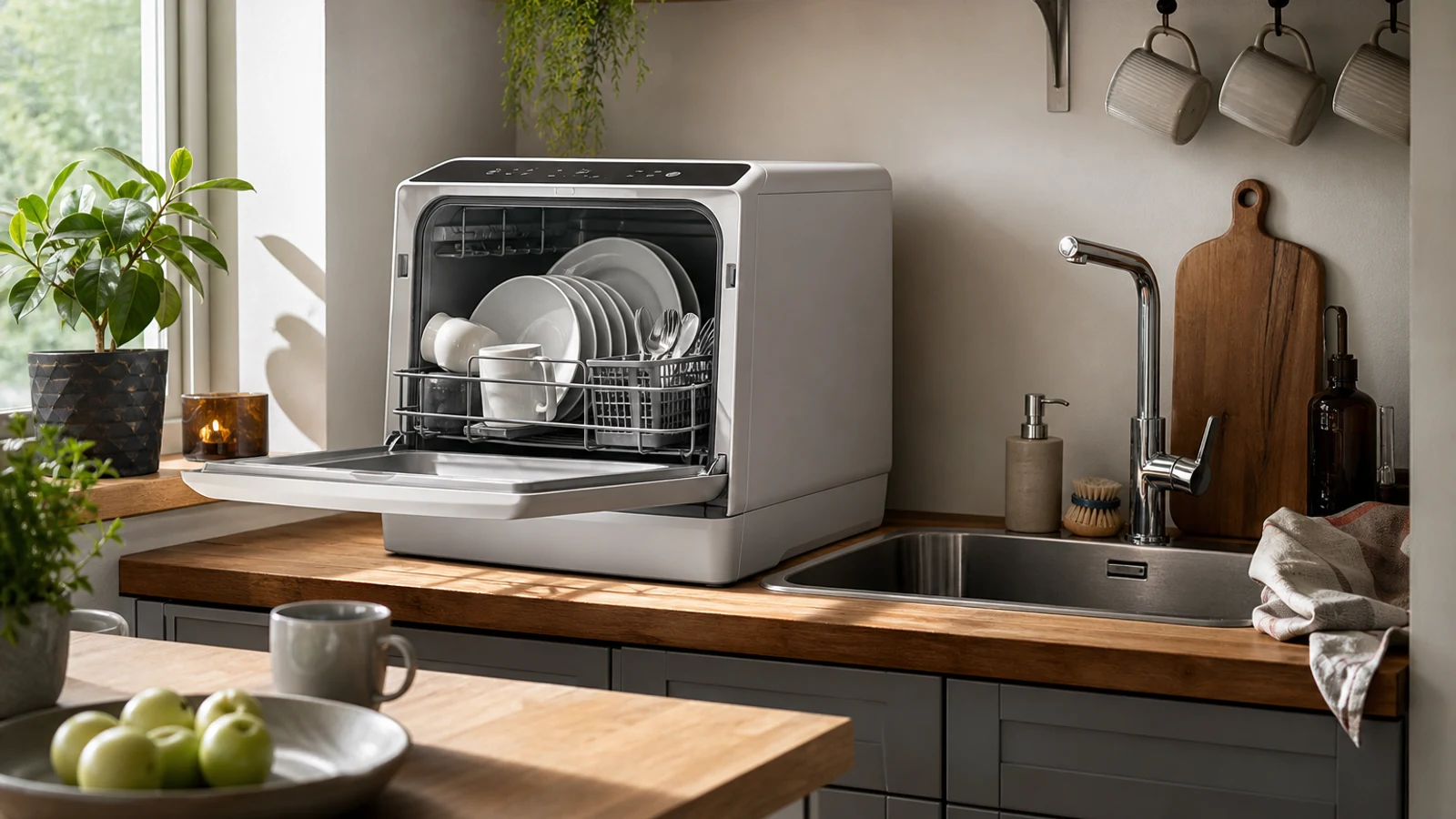
A countertop dishwasher solves a specific problem: you want automatic dishwashing but cannot, or do not want to, install a full-size appliance. For renters, studio apartments, older kitchens, and households of one or two people, that can be a meaningful convenience rather than a novelty.
The catch is that a countertop model does not eliminate kitchen compromises. It occupies work surface, usually handles only a partial load, and may require a faucet connection or several manual water refills. Whether it is worth buying depends less on the appliance category and more on your daily workflow.
The simplest test is this: if dirty dishes regularly pile up because hand-washing is the task you avoid most, a countertop dishwasher may earn its space. If your main problem is occasional cleanup after cooking, the machine may become another object to move, fill, unload, and maintain.
When A Countertop Dishwasher Is Worth It
The strongest case is a small household that generates a steady stream of plates, bowls, cups, utensils, and food containers. A compact machine can take over the repetitive part of cleanup while leaving only oversized cookware and awkward items for the sink.
Dishwashers generally use a fairly consistent amount of water and energy per cycle, so the practical efficiency advantage comes from running reasonably full loads rather than starting the machine for a few items. In a one- or two-person home, that may mean waiting until evening or running the dishwasher every day, depending on how much you cook.
A countertop unit is particularly attractive when it replaces a task that is expensive in time or mental effort. The value is not simply cleaner dishes; it is a clearer sink, fewer unfinished chores, and a more predictable kitchen reset. Consider it if: • You wash dishes by hand at least once most days.
- You live alone or with one other person.
- Your kitchen has no practical built-in dishwasher location.
- You rent and cannot modify cabinetry or plumbing.
- You can leave the appliance near the sink during its cycle.
- You commonly use standard plates, bowls, mugs, glasses, and utensils.
- You are willing to unload it and wipe it down regularly.
When It Is Probably Not Worth It
The biggest reason not to buy one is lack of usable counter space. A countertop dishwasher is not just the width of its cabinet. You need room for the appliance itself, clearance for the door, access to the controls, hose routing, and enough surrounding space to load dishes without constantly rearranging the kitchen.
It may also disappoint households that cook with large pots, sheet pans, stockpots, Dutch ovens, or oversized dinner plates. Compact dishwashers are designed around smaller place settings, so they can reduce the daily dish pile without replacing all hand-washing.
Think twice if: • Your remaining counter is your only serious food-preparation surface.
- You cook large meals and most of your dishes are cookware.
- You already wash small loads quickly and do not mind doing so.
- You travel or move often enough that setup and storage would be burdensome.
- Your faucet has an unusual shape or a nonstandard aerator connection.
- You cannot safely route the drain hose into the sink.
- You expect built-in-dishwasher capacity from a compact appliance.
- You would need to place it far from the sink or on an unstable surface.
Counter Space Is The Real Cost
Price is easy to notice, but counter space is often the more important cost in a small kitchen. A machine that gives you cleaner dishes but removes your only prep area may make the room less functional overall.
Before shopping, measure the intended location in three dimensions. Measure width and depth, then check the height under cabinets, the door swing, hose reach, outlet position, and whether the countertop can support the appliance when filled with water and dishes. Do not rely only on a product listing’s headline dimensions; account for connectors and the open door.
Also decide whether the dishwasher will stay in place or be stored between uses. Moving a water-filled or recently used appliance is inconvenient, and frequent setup creates friction that can undermine the convenience you bought it for. A small rolling cart or nearby shelf may solve the storage problem, but it also adds cost and takes floor space.
Water Supply: Faucet Hookup Or Built-In Tank
Countertop dishwashers generally use one of two water arrangements. Faucet-connected models draw water through a hose and drain into the sink. Tank models are filled manually with a pitcher and can operate without a permanent faucet connection.
A faucet hookup is usually the better workflow if the adapter fits your faucet and you can leave the machine beside the sink. It avoids repeated pouring and is more practical for frequent use. The trade-off is that the faucet may be occupied while the dishwasher runs, and compatibility can be an issue with pull-down, filtered, or nonstandard faucets.
A built-in tank offers greater placement flexibility, which can help renters or kitchens with incompatible faucets. The trade-off is manual filling for every cycle, plus the need to store and clean the pitcher or funnel used to fill it. Some models support both options, which can be useful if you expect to move or change your kitchen setup. Choose the water system that creates the fewest extra steps in your normal routine—not simply the one that is easiest to install.
What A Compact Dishwasher Can And Cannot Wash
Capacity labels can be misleading if you picture a countertop dishwasher as a smaller version of a full-size machine. Many compact models are built around a single rack and a limited number of place settings. That can be enough for everyday dishes from one or two people, but it is not a substitute for washing every item used during a cooking-heavy day.
Standard dinner plates may fit in many models, but you should verify the maximum plate diameter if you use large or coupe-style plates. Check the rack layout for bowls, stemware, travel mugs, and containers. A compact dishwasher may also have limited clearance for tall items under the spray arm.
Expect to hand-wash some categories: • Large pots, pans, skillets, and Dutch ovens.
- Baking sheets and oversized cutting boards.
- Tall pitchers, blenders, and unusual containers.
- Delicate items or anything the manual excludes.
- Heavily baked-on cookware if the compact cycle lacks sufficient space or heat.
- Items that block the spray arm or prevent the detergent from dissolving properly. The right question is not whether the machine washes everything. It is whether it removes enough routine dishwashing to make the remaining work acceptable.
Cleaning Performance, Cycles, And Drying
Look for a normal cycle, a heavier cycle, a shorter cycle, and a rinse or refresh option. A delay-start feature can be helpful if you prefer to run the machine after dinner or during off-peak hours, but it is less important than usable rack space and a dependable water connection.
Energy Star certification is a useful screening tool for efficiency, but it does not guarantee that every countertop model will suit your dishes or cleaning expectations. The federal EnergyGuide label can help you compare estimated energy use and operating cost where a model provides one. Check the actual model documentation rather than assuming that every compact dishwasher has the same rating or water consumption.
Drying is another area where expectations matter. Compact models may use heated drying, residual heat, ventilation, or a combination. Plastics may remain damp even when plates and glassware are mostly dry. If you plan to put dishes away immediately, prioritize a design with a drying feature you understand and enough internal ventilation. If you are comfortable leaving the door ajar after a cycle, drying performance may matter less.
Noise, Leaks, And Daily Maintenance
A countertop dishwasher operates in the same room where you cook, work, watch television, or sleep. Noise can therefore matter more than it would in a closed kitchen. Compare the manufacturer’s stated sound level when available, but remember that cabinet placement, countertop vibration, and the sound of water draining affect the experience.
Leak prevention deserves equal attention. Keep the appliance level, inspect hose connections, use the supplied washers, and make sure the drain hose cannot slip out of the sink. Never place a water-connected appliance where a small leak could run unnoticed into electronics, wood cabinetry, or flooring.
Maintenance is manageable but not optional. Wipe the door seal, remove food debris from the filter, clean mineral buildup according to the manual, and leave the interior ventilated when appropriate. If your water is hard, scale buildup may become a recurring issue. A machine that is easy to access and clean is more likely to remain useful than one that requires awkward disassembly.
Countertop Dishwasher Vs. A Compact Built-In
If you own the home or are planning a kitchen renovation, compare the countertop appliance with an 18-inch built-in dishwasher before committing. A compact built-in usually offers a cleaner permanent installation, greater capacity, and no loss of work surface. It also costs more to install and may require cabinetry, plumbing, electrical work, and a longer commitment to the layout.
For renters or people who need a reversible solution, countertop models have a clear advantage. They can be removed without redesigning the kitchen and may work in spaces where a built-in cannot. The convenience is strongest when the appliance can remain set up near the sink.
If a built-in installation is realistic, ask whether the additional cost buys enough improvement in capacity and workflow to justify it. If not, a countertop model may be the more sensible temporary or long-term compromise. For broader kitchen planning, a guide to kitchen upgrades can help you weigh this purchase against storage, prep space, and other high-impact changes.
How To Choose One For A Small Kitchen
Start with your workflow, then compare models. Capacity and footprint should come before cosmetic features or smart controls.
Use this checklist before buying: • Measure the exact counter location, including height under cabinets.
- Confirm the door can open fully without blocking the sink or walkway.
- Check the maximum plate diameter and rack clearance.
- Decide whether you prefer a faucet hookup, a tank, or both.
- Verify faucet-adapter compatibility before ordering.
- Check the drain-hose length and how it must be positioned.
- Look for an EnergyGuide label and Energy Star certification where applicable.
- Compare the noise rating if the kitchen is near a bedroom or living area.
- Read the detergent, rinse-aid, and filter-cleaning instructions.
- Confirm the return policy in case the machine does not fit or the faucet connection fails.
- Make sure replacement filters, hoses, and other wear parts are reasonably available. Avoid paying extra for features that do not solve your constraint. A compact dishwasher with a larger usable rack, straightforward filling, and easy maintenance is generally more valuable than one with app controls you will rarely use.
The Bottom Line
A countertop dishwasher is worth it for a small kitchen when it removes a frequent, disliked chore without destroying your usable workspace. It is especially sensible for one- or two-person households, renters, and people who need help with daily plates, bowls, cups, and utensils but accept that cookware will still be washed by hand.
It is not an automatic upgrade for every small kitchen. If counter space is already scarce, if you cook mainly with oversized cookware, or if you can install an 18-inch built-in dishwasher, another option may fit better. The best purchase is the one that improves the whole kitchen routine rather than simply adding automation.
Before you buy, place a box or appliance-sized placeholder on the proposed counter for a few days. Load and unload it as if it were real, check whether the faucet and sink remain usable, and notice how much prep space is left. That simple test often reveals whether the dishwasher will become a daily helper or an obstacle.
Go Deeper Before You Choose
For more context, see kitchen upgrades that are worth prioritizing.
Research References
These sources informed the factual background for this guide. BuyingView applies its own editorial judgment to the purchase decision.
Questions & Answers
Useful follow-up questions that often change the buying decision.
Do countertop dishwashers use less water than hand-washing?
They can use less water than wasteful hand-washing, but the result depends on how you wash by hand, how full the machine is, and the model’s cycle. Running a nearly empty load reduces the practical efficiency advantage. Use the EnergyGuide label and manufacturer specifications for a closer comparison.
Can a countertop dishwasher wash pots and pans?
Some compact models can handle small pans or lightly soiled cookware, but most cannot replace hand-washing large pots, skillets, baking sheets, or Dutch ovens. Check rack clearance and the manual before assuming an item will fit.
Is a water-tank model better than a faucet-connected model?
Neither is universally better. A tank model is more flexible when faucet compatibility or permanent setup is a problem. A faucet-connected model is usually more convenient for frequent use because it avoids manually filling the machine.
How many people can a countertop dishwasher serve?
Most are best suited to one or two people, depending on cooking habits and how often you run the machine. They can handle routine dishware for a small household but generally lack the capacity for large family meals or extensive cookware.
Can you leave a countertop dishwasher on the counter permanently?
Yes, if the counter is level and strong enough, the appliance has safe access to an outlet and water connection, and the door and hoses do not obstruct normal kitchen use. Permanent placement is usually more convenient than moving it after every cycle.
Should I buy a countertop dishwasher if I rarely cook?
Usually not unless you still create enough daily dishwashing to justify the counter space. If you eat out often and wash only a few items, hand-washing may be simpler and less expensive than operating and maintaining a compact appliance.