Basic vs Temperature-Control Electric Kettle: Is the Upgrade Worth It?
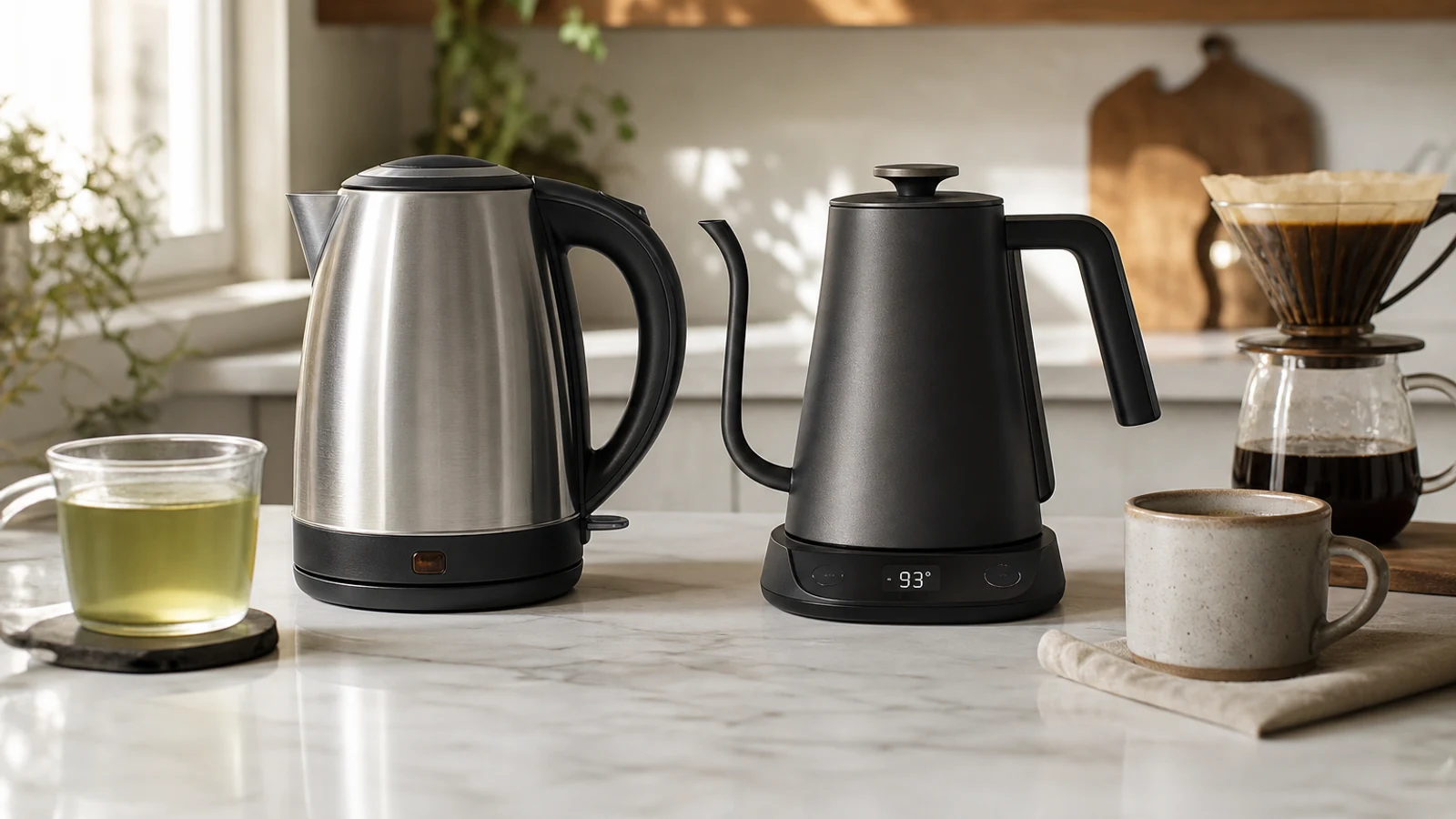
Basic vs Temperature-Control Electric Kettle
| Decision Point | Basic Kettle | Temperature-Control Kettle |
|---|---|---|
| Primary function | Heats water to a full boil, then shuts off | Heats water to a selected temperature, often with presets |
| Best for | Black tea, instant drinks, cooking, and general use | Green tea, white tea, oolong, pour-over coffee, and repeatable brewing |
| Ease of use | Fill, switch on, and pour | Choose a temperature and possibly a keep-warm setting |
| Temperature precision | Low; water must cool after boiling | Higher; useful for below-boiling recipes and brewing |
| Typical workflow | Fast and uncomplicated, with fewer controls | More steps and settings, but less guesswork |
| Maintenance | Usually simpler, with fewer electronic controls | May require cleaning around displays, buttons, sensors, and lids |
| Upgrade value | Best when hot water is the only requirement | Best when beverage quality or repeatability matters |
The right kettle depends less on how often you drink hot beverages than on what you do with the water after it heats. A basic electric kettle is designed to bring water to a boil and stop. A temperature-control kettle lets you select a lower target, such as the range commonly used for green tea or pour-over coffee, and some models hold that temperature for a period of time.
That difference can be meaningful, but it is easy to overbuy. If you mostly make black tea, instant coffee, noodles, oatmeal, or cooking water, a full boil is generally the useful default. You can always let boiling water cool, although that adds waiting and makes the result less repeatable.
The upgrade is most defensible when you want control rather than simply heat. Temperature selection can reduce guesswork, make repeated brews more consistent, and prevent you from having to stand by with a thermometer. It is less compelling if you rarely use sub-boiling temperatures or if your current kettle already meets your needs.
What A Basic Electric Kettle Does Well
A basic kettle focuses on one job: heating water quickly to a boil. Its controls are usually limited to a power switch, and automatic shutoff and boil-dry protection are more important than advanced brewing features. Fewer controls can also mean a simpler daily routine and fewer components to troubleshoot.
Basic kettles are a practical fit for households where different people want hot water without having to learn a brewing system. Fill the kettle with the amount you need, switch it on, and pour when it stops. For many kitchens, that simplicity is the main advantage.
Choose a basic kettle if: • You mostly drink black tea or use boiling water for instant beverages
- You need hot water for pasta, soup, oatmeal, or cooking
- You want the fewest buttons and settings possible
- You are replacing a broken kettle and do not have a specific temperature problem
- You prefer to spend more on capacity, materials, or a better pouring design instead of electronics
What Temperature Control Adds
Temperature-control kettles add a sensor and controls that let you stop heating before a full boil. Depending on the design, you may get a small set of preset temperatures, a variable dial, or a digital display with more precise increments. Some also include a keep-warm function, which maintains a selected temperature for a limited period rather than requiring a fresh heating cycle.
The most useful benefit is repeatability. Green and white teas are commonly brewed below boiling, while pour-over coffee is generally prepared with water below the boiling point. Exact targets vary by recipe, roast, leaf, altitude, and personal taste, so presets should be treated as starting points rather than universal rules.
Temperature control can also improve workflow. Instead of boiling water and waiting for it to cool, you select a target and begin brewing when the kettle signals that it has reached it. This is especially useful when you make several cups throughout the morning or switch between different teas with different preferences.
Who Should Pay For The Upgrade
The best reason to upgrade is a repeated inconvenience or quality problem. If your green tea tastes harsh because you routinely use boiling water, or if you are trying to make pour-over coffee more consistent, a variable-temperature kettle directly addresses that issue.
It is also useful for people who enjoy experimenting. When you can change the water temperature without changing the rest of the recipe, it becomes easier to compare results and find what works for a particular tea or coffee. A basic kettle can do the same job with a thermometer and manual timing, but the temperature-control model reduces the amount of monitoring.
A temperature-control kettle is a strong fit if: • You regularly drink green, white, or oolong tea
- You brew pour-over coffee, French press, AeroPress, or similar methods
- You want to repeat a recipe with less variation
- You often make multiple beverages at different temperatures
- You value a keep-warm function because you pour gradually or refill several cups
- You dislike waiting for boiled water to cool before brewing
Who Should Stay With A Basic Kettle
Temperature control is not automatically a quality upgrade for every household. If your usual drink calls for boiling or near-boiling water, selecting a lower temperature may add steps without improving the result. Black tea, many herbal infusions, instant meals, and cooking tasks often do not require fine control.
There is also a learning curve. Digital buttons, preset labels, temperature units, hold settings, and alert sounds can make the kettle more capable but less immediate. If several people share the kitchen, a simple switch may be easier for everyone to use correctly.
Stay with a basic kettle if: • You rarely drink delicate tea or specialty coffee
- You want one-button operation
- You usually need a full boil rather than a lower target
- You are buying for guests, a workplace, or a shared kitchen
- Your existing kettle is fast, safe, easy to clean, and not causing a specific frustration
Temperature Settings Matter More Than Preset Labels
A kettle advertised with tea presets is not necessarily better than one with a simpler variable control. Presets can be convenient, but the useful question is whether the available temperatures match your actual drinks. A model with only three broad settings may be perfectly adequate; a model with many settings may be unnecessary if you always choose the same one.
Look for a temperature range that covers your intended use, clear controls, and a display or indicator that is easy to read from where you normally stand. If you use Fahrenheit, confirm that the kettle supports it or can switch between Fahrenheit and Celsius. Some models show a target temperature but provide limited feedback about the current water temperature, which may matter if you are adjusting a recipe.
For coffee, the spout can be as important as temperature control. A gooseneck spout can provide a slower, more controlled stream for pour-over brewing, while a conventional spout may be better for quickly filling mugs, pots, and bowls. Do not pay for a specialty spout unless your brewing method benefits from it.
Speed, Capacity, And Energy Use
Temperature control does not inherently mean faster heating. Heating speed depends heavily on the amount of water, the kettle’s power, the starting water temperature, and the target temperature. A basic kettle may reach a full boil quickly, while a temperature-control kettle may stop earlier when you select a lower target. In either case, heating only the amount you need is usually more efficient than filling the entire kettle.
Capacity should match your normal routine. A smaller kettle can be convenient for one or two cups and may reduce unnecessary heating, but it can require multiple cycles for a household. A larger kettle is helpful for guests and cooking, though a full reservoir takes longer to heat and may occupy more counter space.
Before buying, consider: • How many mugs you make in one session
- Whether the minimum fill line allows one cup without wasting water
- Whether the kettle fits beneath cabinets and beside your coffee setup
- Whether the base and cord leave enough room near the outlet
- Whether the handle remains comfortable when the kettle is full
Safety Features To Prioritize
Both basic and temperature-control kettles should have automatic shutoff and protection against heating with too little or no water. These features reduce the chance of continued heating if the kettle is left unattended or accidentally switched on empty, but they are not a substitute for sensible use.
A secure lid, stable base, clear water-level markings, and a handle that stays comfortable during pouring can matter more in daily use than an extra temperature preset. Steam can escape from the lid and spout, and the body may remain hot after heating, so look for a design that keeps your hand away from the hottest surfaces.
If you have children, older adults, or anyone with limited grip strength using the kettle, pay close attention to filled weight, lid operation, pouring angle, and whether the kettle can be lifted cleanly from its base. A double-wall design may reduce exterior heat, but verify the manufacturer’s instructions and do not assume the entire kettle stays cool.
Cleaning, Hard Water, And Long-Term Use
Mineral buildup is a concern for both kettle types, especially in areas with hard water. Scale can collect around the heating surface, filter, lid, and temperature sensor. It may lengthen heating time, affect pouring, and make the interior look cloudy. Follow the manufacturer’s descaling instructions rather than assuming every kettle can be treated identically.
Temperature-control models can have more areas that need attention, including buttons, displays, seams, and sensor openings. The electrical base should not be immersed, and the kettle should be allowed to cool before cleaning. A removable limescale filter is useful, but it does not eliminate the need to descale the interior.
Maintenance checklist: • Empty leftover water instead of repeatedly reheating the same reservoir
- Wipe the body and base with a soft, damp cloth
- Keep the electrical connector and underside dry
- Descale when buildup appears or according to the manual
- Rinse thoroughly after using an approved descaling solution
- Avoid abrasive cleaners that can scratch glass or metal
When Not To Upgrade
Do not upgrade simply because a kettle has more settings. If your current kettle reaches the temperature you need, pours safely, fits your space, and is easy to clean, replacing it may produce little practical benefit. A separate kitchen thermometer can solve occasional temperature questions at a lower cost, although it is less convenient than built-in control.
You may also want to postpone an upgrade if the real problem is elsewhere. If coffee tastes inconsistent, grind size, water quality, dose, filter, pouring technique, and brew time may have a larger effect than a more advanced kettle. For tea, leaf quality, steep time, water temperature, and the amount of tea all interact.
Upgrade when the feature will change a repeated routine, not merely when it appears on a specification list. The clearest cases are frequent below-boiling brewing, a strong preference for repeatability, or a genuine need to keep water ready for multiple servings.
How To Choose Between The Two
Start with your most common use rather than your aspirational use. If you make black tea every morning but only occasionally try green tea, a basic kettle may remain the sensible choice. If you already brew pour-over coffee several times a week, the value of temperature control is easier to realize because it removes one variable from a repeated process.
Then decide whether convenience or simplicity matters more. Temperature control offers convenience after the initial setup, while a basic kettle offers simplicity every time you use it. A temperature-control model can also be a better choice for a household with several beverage preferences, provided everyone is comfortable with the controls.
A practical decision path: • Buy basic when your main requirement is boiling water quickly and safely
- Buy temperature control when you routinely need lower, repeatable temperatures
- Prioritize a precise spout only for controlled-pour brewing
- Prioritize capacity and a low minimum fill for family or shared use
- Prioritize a removable filter, wide opening, and simple controls for easier care
- Skip keep-warm if you normally pour immediately and want fewer controls
Bottom Line
For most general kitchens, a basic electric kettle is the better value. It handles boiling water quickly, keeps the workflow simple, and avoids paying for controls you may never use. Choose one with automatic shutoff, boil-dry protection, a comfortable handle, a stable base, and a minimum fill line suited to your typical serving size.
A temperature-control kettle is worth the upgrade when you regularly prepare beverages below a full boil or want more consistent brewing without monitoring a thermometer. Its strongest advantages are control, repeatability, and convenience—not necessarily speed. For green and white tea drinkers, pour-over coffee brewers, and people who make several styles of beverage, those advantages can justify the added complexity.
The short version is straightforward: buy a basic kettle for hot water; buy temperature control for a specific brewing workflow. If you cannot name the temperature-related problem the upgrade will solve, keep the simpler option and spend the difference on better tea, coffee, water, or brewing equipment.
Go Deeper Before You Choose
For more context, see Kitchen Upgrades Worth Considering.
For more context, see Drip Coffee Maker vs Single-Serve Coffee Maker.
Research References
These sources informed the factual background for this guide. BuyingView applies its own editorial judgment to the purchase decision.
Questions & Answers
Useful follow-up questions that often change the buying decision.
Is a temperature-control kettle better than a basic kettle?
Neither is universally better. A temperature-control kettle is better for people who regularly brew delicate tea or pour-over coffee below a full boil. A basic kettle is usually better for boiling water, black tea, instant drinks, cooking, and simple one-button operation.
Does temperature control make an electric kettle boil faster?
Not necessarily. Heating speed depends on power, water volume, starting temperature, and the selected target. Temperature control may let the kettle stop earlier for lower-temperature drinks, but it does not automatically increase heating performance.
Do I need temperature control for coffee?
Only if your brewing method benefits from repeatable water temperature. Pour-over and other manual methods can benefit from it, while instant coffee and many automatic coffee makers generally do not require a temperature-control kettle.
What temperature should I use for green tea?
A common starting range is below boiling, often around 170 to 180 degrees Fahrenheit, but the ideal setting varies by tea and personal taste. Use the tea maker’s instructions when available and adjust based on flavor.
Can I use a basic kettle for green tea?
Yes. You can boil the water and let it cool, or measure the temperature with a thermometer. The trade-off is less convenience and repeatability compared with selecting a target directly on a temperature-control kettle.
Is a keep-warm function worth paying for?
It can be useful if you make several cups over an extended period or pour gradually. It is less valuable if you drink immediately after heating, prefer fresh heating cycles, or want fewer controls and lower standby use.
How often should I descale an electric kettle?
The right interval depends on water hardness and usage. Inspect the interior regularly and follow the manufacturer’s guidance. Frequent use in hard-water areas generally requires more frequent descaling than occasional use with softer or filtered water.