Food Processor Vs Blender: Which Kitchen Jobs Need Which Appliance?
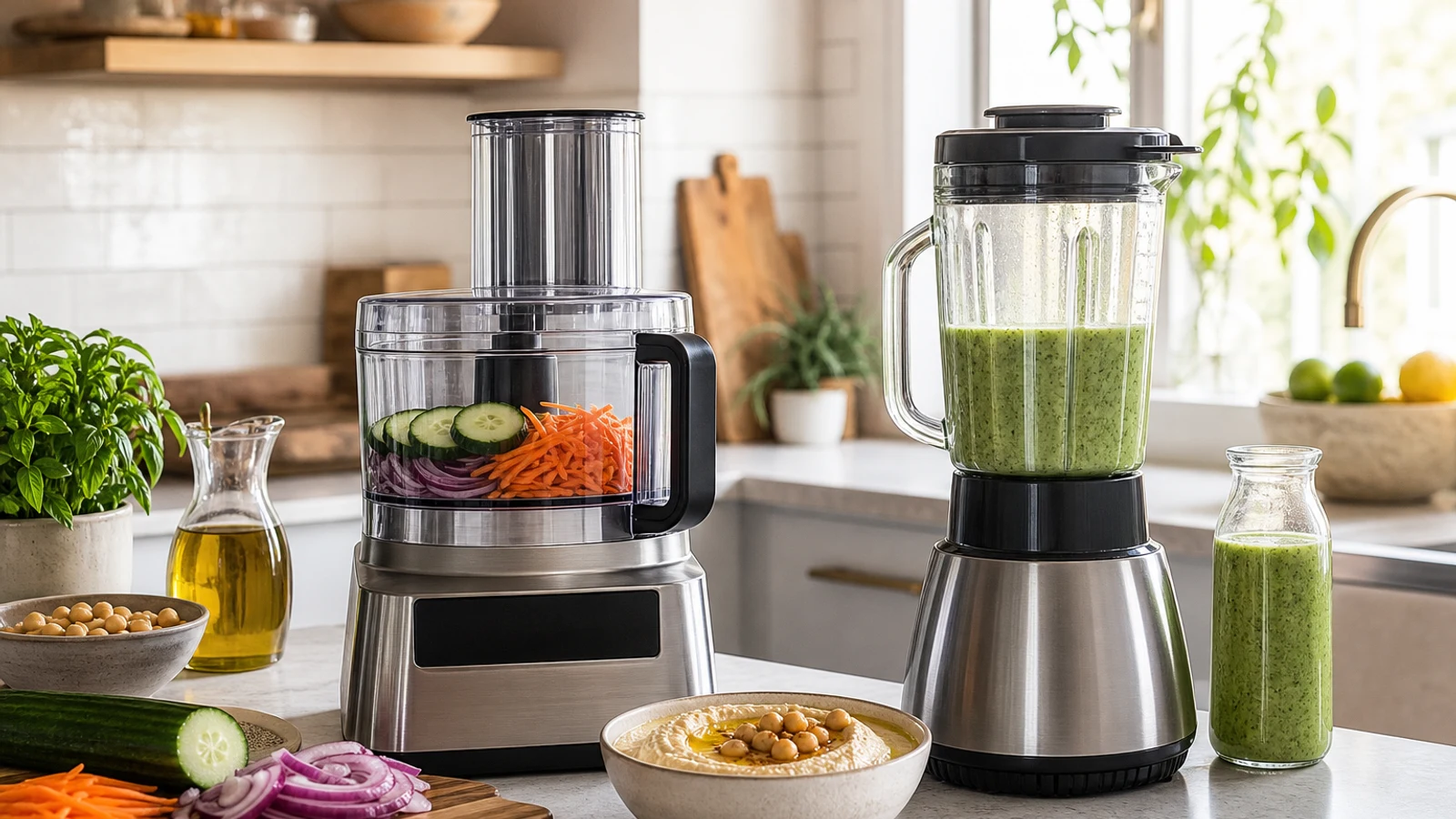
Food Processor Vs Blender At A Glance
| Decision Point | Food Processor | Blender |
|---|---|---|
| Best at | Chopping, slicing, shredding, grating, mixing, dough, thick dips | Smoothies, soups, shakes, sauces, frozen drinks, crushed ice |
| Typical container | Wide work bowl with a feed tube | Tall pitcher designed to create a circulating vortex |
| Liquid requirement | Often works with little or no added liquid | Usually performs best with enough liquid to move ingredients |
| Texture | Coarse, chunky, minced, grated, or moderately smooth | Very smooth, liquid, or finely pureed |
| Specialized parts | S-shaped blade, slicing disc, shredding disc, dough blade, optional attachments | Fixed blade assembly, pitcher, tamper or blending programs on some models |
| Strong use cases | Salsa, slaw, pie dough, pesto, hummus, nut butter, chopped vegetables | Smoothies, blended soups, protein shakes, mayonnaise-style sauces, margaritas |
| Main limitation | Less effective for silky liquids and ice-heavy drinks | Poor at slicing, shredding, and evenly chopping dry ingredients |
Food processors and blenders overlap enough to make the purchase confusing. Both can chop, puree, emulsify, and make sauces, but their designs push them toward different results. A blender pulls ingredients downward into a tall container and is optimized for liquids and smooth textures. A food processor uses a wider bowl, interchangeable blades, and discs to work through solid ingredients with more control.
The simplest rule is practical: buy a blender when the finished food is usually poured or sipped; buy a food processor when the finished food is usually served with a fork or spoon. That rule is not perfect, but it predicts most everyday results better than comparing motor wattage alone.
If your kitchen routine includes both smoothies and frequent vegetable prep, owning both may eventually make sense. If you have limited storage or only cook a few times a week, identify the jobs you repeat most often and choose the appliance that removes the most manual work.
What A Blender Does Better
A countertop blender is built around a tall jar and a fixed blade assembly at the bottom. Its shape helps ingredients circulate through the blades, especially when there is enough liquid to create movement. That makes it the better tool for recipes where smoothness matters more than precise chopping.
Blenders are the natural choice for smoothies, milkshakes, protein drinks, blended soups, frozen cocktails, and sauces that should be pourable. They are also generally better at crushing ice and turning fibrous produce into a fine puree, although performance varies substantially between models.
A blender is usually the better fit if you make these regularly: • Fruit and vegetable smoothies
- Protein shakes or meal-replacement drinks
- Pureed soups and bisques
- Frozen drinks or crushed-ice beverages
- Smooth tomato sauce, coulis, or salsa
- Nut or seed drinks that need a fine texture
- Pourable dressings and sauces The trade-off is that a blender often needs more liquid than a food processor. If you add too little liquid, ingredients can stall above the blade or remain in uneven chunks. A high-powered model may handle thicker mixtures with a tamper or specialized program, but the basic design still favors movement and liquefaction.
What A Food Processor Does Better
A food processor is designed as a food-preparation workstation rather than a liquidizing machine. Its wide bowl gives ingredients more room to spread out, while interchangeable blades and discs let one base handle multiple jobs. The work bowl is also easier to scrape when making thick mixtures.
The standard S-shaped blade is useful for chopping onions, herbs, vegetables, nuts, cooked meat, and cheese. Slicing and shredding discs turn repetitive knife work into a faster process, particularly when preparing slaw, gratins, potatoes, carrots, or large batches of grated cheese. Some models also include dough tools or attachments for dicing and julienne cuts.
A food processor is usually the better fit if you regularly make: • Chopped vegetables or herbs
- Salsa with a chunky or rustic texture
- Coleslaw and sliced vegetables
- Grated cheese or shredded vegetables
- Pie dough, biscuit dough, or other pastry mixtures
- Hummus, pesto, tapenade, or thick dips
- Nut butter or thick spreads
- Breadcrumbs, chopped nuts, or dry mixtures
- Large batches of minced or finely chopped ingredients A food processor can puree, but it typically does not produce the same silky result as a good blender. It also is not the right tool for crushing large amounts of ice or blending hot, thin liquids unless the manufacturer specifically allows that use. Check the appliance instructions before processing anything hot or unusually hard.
The Biggest Difference Is Texture, Not Just Function
Many recipes can be made in either appliance, but the texture and workflow may change. A food processor tends to give you more control over whether ingredients remain chunky, minced, grated, or thick. A blender tends to keep pushing the mixture toward smoothness and fluidity.
For example, both appliances can make salsa, but a food processor is usually easier when you want visible pieces of tomato, onion, and pepper. A blender is more likely to turn the same ingredients into a smooth sauce unless you pulse carefully and stop early. Both can make hummus or pesto, but a food processor generally handles thick mixtures with less added liquid and is easier to scrape out.
Use a blender when the target texture is: • Silky
- Pourable
- Fine and uniform
- Drinkable
- Smooth enough for a soup, shake, or sauce Use a food processor when the target texture is: • Chunky
- Minced
- Grated or shredded
- Thick and spreadable
- Structured enough to hold on a fork or spoon The exception is recipe-specific. A powerful blender can make thick nut butter or hummus, while a food processor can make smooth soups or sauces in smaller batches. Those substitutions may work, but they can require more scraping, extra liquid, smaller batches, or longer processing.
Which Appliance Is More Versatile?
On paper, food processors usually cover more categories of food preparation because they can use multiple blades and discs. They can replace several manual tools for chopping, slicing, shredding, grating, mixing, and sometimes kneading. That versatility is most valuable to people who cook from basic ingredients rather than relying mainly on prepared foods.
Blenders are narrower in function, but they are often more effective within their specialty. If you drink a smoothie every morning or regularly make pureed soups, a blender may deliver more useful performance than a food processor with many attachments you never use. Versatility only matters when it matches your routine.
Choose the food processor for broader prep versatility if: • You cook family-size meals or batch recipes
- You dislike repetitive knife work
- You make pastry, dips, pesto, slaw, or grated ingredients
- You want slicing and shredding attachments
- You often process thick or mostly solid mixtures Choose the blender for focused blending performance if: • Smoothies or shakes are a daily habit
- You want smooth soups or sauces
- You make frozen drinks or crush ice
- You prefer a pitcher with a pouring spout
- You value a simpler single-purpose workflow
Capacity, Counter Space, And Cleanup
The appliance that performs best is not necessarily the one you will use most. Counter space, cabinet height, storage for accessories, and cleanup can decide whether a theoretically useful appliance earns a permanent place in your kitchen.
Blenders usually have a tall pitcher that may be awkward under low cabinets or in a sink. The pitcher is convenient for pouring, but ridges and fixed blades can make scraping and washing more cumbersome. Some blender jars and blade assemblies are dishwasher-safe, but confirm the care instructions for the specific model.
Food processors often have a wider footprint and more separate parts. The bowl may be easier to scrape, but the lid, pusher, spindle, S-blade, and discs create more pieces to store. Sharp discs also require careful handling. A full-size processor can be excellent for batch prep yet excessive for someone who usually cooks for one or two people. A mini processor may be easier to store, but it cannot replace the capacity or slicing workflow of a full-size model in every recipe. Before buying, measure: • The available counter width and depth
- Clearance under upper cabinets
- The height of the appliance with its lid or pitcher attached
- Cabinet or drawer space for discs and accessories
- Sink space for washing the bowl or jar
- Whether the parts are dishwasher-safe according to the manual For a small kitchen, a compact blender may be the more practical first purchase if drinks and soups are your main needs. A mini food processor can be useful for small chopping jobs, but it may leave you doing large batches by hand.
Can One Appliance Replace The Other?
Sometimes, but not completely. A food processor can often stand in for a blender when the recipe is thick, the texture does not need to be perfectly smooth, or you can add enough liquid without ruining the result. It is especially useful for hummus, pesto, chopped sauces, and nut-based mixtures.
A blender can substitute for a food processor when the task is primarily pureeing or when the recipe already contains substantial liquid. It is less suitable for slicing, shredding, evenly chopping dry ingredients, or making dough. A blender may also turn ingredients smooth before you want it to.
Avoid treating every blade appliance as interchangeable. Do not assume a food processor is safe for hot liquids, hard ice, or unusually dense mixtures unless the manufacturer approves it. Likewise, do not force a blender to process dry ingredients or thick dough simply because the motor sounds powerful. Container shape, blade design, cooling, and manufacturer instructions all matter more than a headline power number.
When Buying Both Makes Sense
Buying both appliances is reasonable when they serve different daily workflows rather than duplicating the same occasional task. A blender can stay ready for breakfast drinks and soups while a food processor handles meal prep, baking, sauces, and batch chopping.
You are more likely to benefit from both if: • Smoothies and food prep are both frequent parts of your week
- You cook for several people or prepare meals in batches
- You make both frozen drinks and dough, slaw, or grated ingredients
- You want to avoid washing one appliance between separate recipes
- You have enough storage to keep accessories organized You probably do not need both if: • You rarely blend or process food
- You mostly cook simple meals with a knife and pan
- Your recipes fit clearly into one appliance’s strengths
- Storage is limited and the second appliance would live in a cabinet
- You are hoping one purchase will replace every other kitchen tool A combination appliance can save space, but evaluate it by the specific attachments and containers included. A unit that includes a small processing bowl may be excellent for occasional chopping but still less convenient than a dedicated full-size food processor for large batches. Conversely, a blender pitcher with a processing attachment may be enough for light use without delivering the same control as separate appliances.
How To Choose Based On Your Cooking Routine
Start with a one-week inventory instead of a feature list. Write down the jobs you actually do or expect to do, then count how often each appears. The winning appliance is usually the one that handles your highest-frequency tasks with the fewest workarounds.
Choose a blender first if your list is dominated by drinks, pureed soups, frozen beverages, and smooth sauces. Look for a container size that matches your usual batch, a stable base, controls you will actually use, and cleaning instructions that fit your routine. If you often blend fibrous produce or ice, motor performance and blade design become more important than extra preset programs.
Choose a food processor first if your list is dominated by chopping, slicing, shredding, dough, thick dips, or batch preparation. Pay attention to the included discs, work-bowl capacity, feed-tube size, pulse control, storage for accessories, and how easily the bowl locks together. A model with fewer attachments that you will use is preferable to a large kit that creates storage clutter.
Bottom Line
A blender is the specialist for smooth, liquid, and ice-based recipes. A food processor is the broader prep tool for solid ingredients, controlled chopping, slicing, shredding, thick mixtures, and dough. Neither is universally better.
If you are buying only one, choose based on your most repeated kitchen job: drinks and smooth purees point to a blender; meal prep and thick or textured foods point to a food processor. If both categories are equally important and you have the space, owning both can make sense because their strengths are genuinely different.
For more ways to evaluate countertop appliances by workflow, storage, and features rather than marketing claims, see the broader kitchen-upgrade guide before you buy.
Go Deeper Before You Choose
For more context, see kitchen-upgrade guide.
Research References
These sources informed the factual background for this guide. BuyingView applies its own editorial judgment to the purchase decision.
Questions & Answers
Useful follow-up questions that often change the buying decision.
Can a blender chop vegetables like a food processor?
A blender can chop some vegetables when used carefully, but it is harder to achieve even pieces. The blades and tall container encourage ingredients to move toward a puree, especially if liquid is added. A food processor is usually better for controlled chopping and larger dry batches.
Can a food processor make smoothies?
It can make a smoothie, particularly with enough liquid and soft ingredients, but the result may be less uniform and less convenient to pour. A blender is generally better for silky smoothies, crushed ice, and fibrous produce.
Is a food processor better for hummus?
Usually, yes. A food processor is well suited to thick hummus and can often process it with less liquid while making it easier to scrape from the bowl. A powerful blender can also work, but it may require more liquid, scraping, or a tamper.
Can I crush ice in a food processor?
Do not assume so. Ice can stress a food processor's blade, bowl, and motor, and some manufacturers do not approve it. Use a blender designed for ice or follow the food processor manual exactly.
Which is better for soup: a blender or food processor?
A blender is usually better for smooth soup because its container and blade design favor fine pureeing. A food processor can chop soup ingredients before cooking, but it may not be suitable for hot liquid processing unless the manufacturer specifically permits it.
Do I need both a blender and a food processor?
Not necessarily. Buy a blender if drinks and smooth purees dominate your routine, or a food processor if chopping, slicing, shredding, dough, and thick mixtures dominate. Both are worthwhile when you use both workflows frequently and have enough storage.