Rice Cooker Vs Instant Pot: Which Is Better If Rice Is The Main Job?
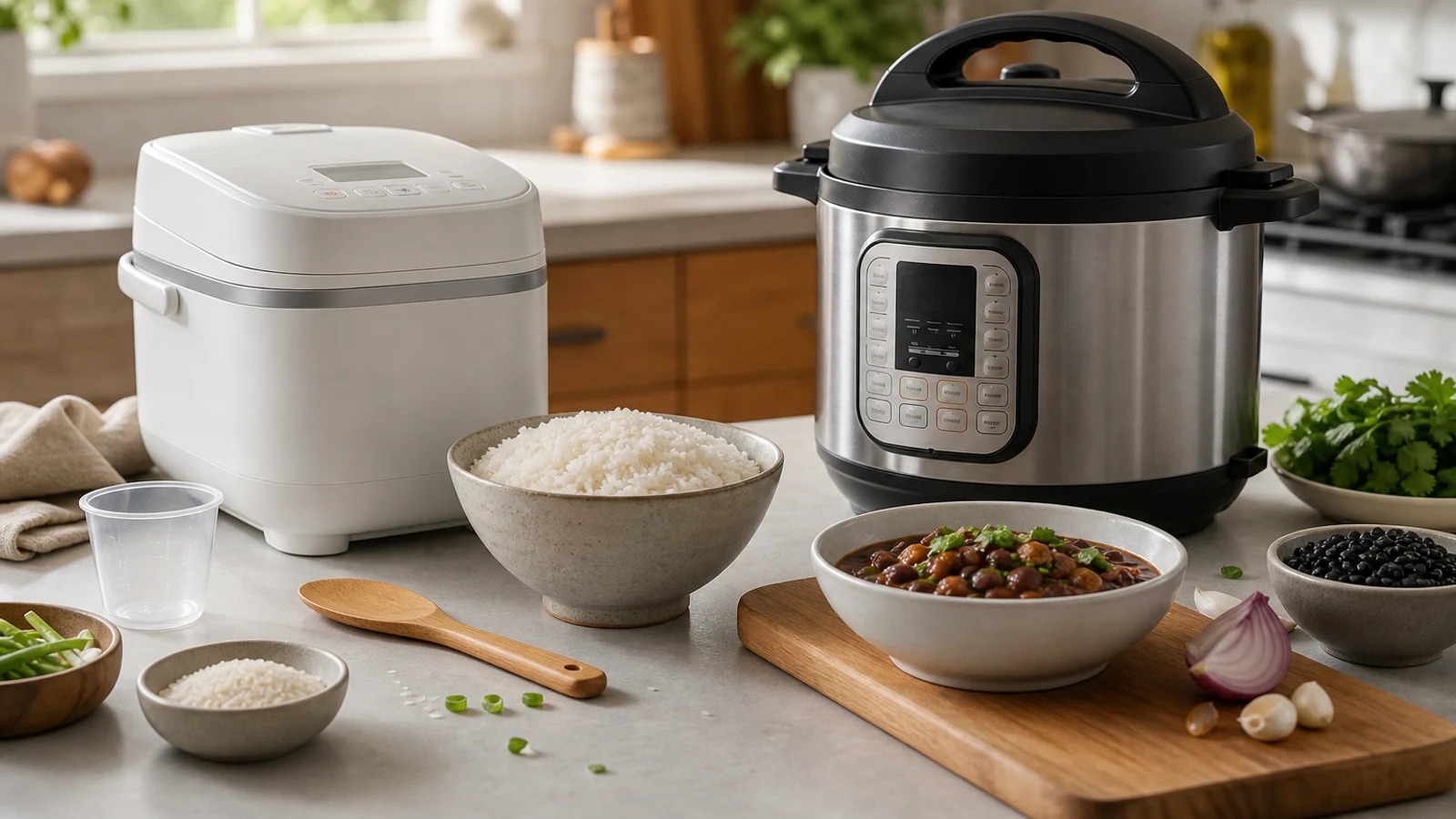
Rice Cooker Vs Instant Pot At A Glance
| Decision Point | Dedicated Rice Cooker | Instant Pot |
|---|---|---|
| Primary strength | Consistent rice and easy serving | Pressure cooking and multi-purpose meal prep |
| Rice workflow | Add rice and water, select a program, let it finish | Select a pressure or rice setting, then account for pressure release |
| Rice variety | Usually better suited to white, brown, sushi, mixed, and specialty grains | Works well for common rice but may require more recipe-specific adjustment |
| Keep-warm use | Designed around holding cooked rice | Useful for short holding, but not the appliance’s main specialty |
| Other meals | Limited, though some models steam or make porridge | Soups, beans, stews, braises, grains, yogurt, steaming, and more depending on model |
| Cleanup | Usually a removable pot and lid; fewer pressure-cooking parts | Removable inner pot plus lid, sealing ring, valve, and condensation components |
| Best for | Rice-centered households and predictable daily use | Small kitchens, mixed cooking, and shoppers avoiding a second appliance |
The better choice depends less on whether both appliances can cook rice and more on how often rice appears in your meals. An Instant Pot can produce good rice, and it may be all you need if rice is an occasional side dish. But a dedicated rice cooker is built around controlling the cooking cycle, handling different rice types, and keeping the finished rice ready to serve.
That distinction matters when rice is the main job. A rice cooker gives up pressure-cooking versatility in exchange for a simpler workflow and a more specialized cooking environment. An Instant Pot gives you a broader toolset, but rice becomes one program among many rather than the center of the design.
The short version: buy the rice cooker for repeatability and convenience around rice; buy the Instant Pot for versatility and fewer appliances. Do not buy both unless you regularly need to cook rice and the main dish at the same time, or your preferred rice texture is noticeably better in a dedicated cooker.
How The Two Appliances Cook Rice
A dedicated rice cooker uses a heating element, temperature sensing, and programmed timing to move through cooking and warming stages. More advanced models may offer separate programs for white rice, brown rice, sushi rice, mixed grains, porridge, or quick cooking. The important benefit is not simply the number of buttons; it is that the appliance is designed to manage rice as its central task.
An Instant Pot uses a sealed pressure-cooking environment for many of its functions. Its rice program or pressure-cook setting can be effective, but the exact results depend on rice variety, rinsing, water measurement, batch size, and the model’s programming. Pressure cooking also adds a warm-up period and a pressure-release step that are easy to overlook when comparing only the programmed cook time.
For plain long-grain white rice, the difference may be small enough that an Instant Pot satisfies you. For brown rice, short-grain rice, sushi rice, mixed grains, or rice that must sit warm for a meal window, a dedicated cooker gives you more reason to prefer its workflow.
Rice Quality And Consistency
If rice texture is your priority, the dedicated rice cooker has the clearer advantage in principle. Its programs are designed around the behavior of rice and often provide more targeted settings than a general-purpose multicooker. That can make it easier to repeat the same result without adjusting a pressure recipe each time.
An Instant Pot can still make excellent rice, especially after you establish a reliable method for the variety you buy. However, the margin for error can feel less forgiving when you change from jasmine to basmati, brown rice, sushi rice, or a blend. A recipe that works for one grain may not transfer perfectly to another.
Choose the rice cooker when: • Rice appears on the table several times per week
- You cook more than one rice variety
- You care about separated, tender grains rather than merely cooked rice
- You want a repeatable process that other household members can use Choose the Instant Pot when:
- You mostly cook one familiar type of white rice
- Texture only needs to be good enough for bowls, burritos, curries, or meal prep
- You are willing to keep a tested water ratio and method for your preferred rice
- Rice is usually cooked alongside pressure-cooked foods rather than as a stand-alone task
Convenience And Timing
Rice cookers are often easier to start and ignore. Add the measured ingredients, select the appropriate setting, and let the cooker switch to warming when finished. This is particularly useful when dinner timing is uncertain or when you want rice ready while you prepare vegetables and a main dish elsewhere.
An Instant Pot can be fast once it reaches pressure, but the total process includes pressurizing and releasing pressure. Quick release can shorten the wait but is not ideal for every rice preparation, while natural release adds time. The appliance also needs more attention around the lid, sealing position, and release method.
The Instant Pot’s advantage is workflow consolidation. You can brown aromatics, pressure-cook beans or meat, steam vegetables, and prepare grains in one vessel. If buying a rice cooker would create an extra appliance that sits unused most days, that broader usefulness may outweigh the rice-specific convenience of a dedicated machine.
Keep-Warm Performance And Meal Timing
Keep-warm behavior is one of the strongest reasons to choose a rice cooker when rice is central to your routine. Dedicated models are designed to keep cooked rice available after the cooking cycle, which suits households where people eat at different times or where rice is prepared before the rest of dinner.
An Instant Pot also has a keep-warm function, but its overall design is centered on pressure cooking rather than long rice service. The sealing ring, lid design, and residual moisture can also make the experience different from a rice cooker, particularly if you alternate between strongly seasoned foods and plain rice.
Neither appliance should be treated as a substitute for safe food storage indefinitely. Follow the manual’s guidance for keep-warm limits, and refrigerate leftovers promptly when you are finished serving. If you typically cook rice in the morning for dinner, confirm that the model’s recommended warming and scheduling features fit that routine before buying.
Versatility And The Cost Of A Second Appliance
The Instant Pot is the obvious choice for cooks who want one countertop appliance to cover several jobs. Depending on the model, it can pressure-cook beans, make soups and stews, braise tougher cuts, steam vegetables, cook grains, prepare yogurt, sauté ingredients, and keep food warm. That range is meaningful if you will actually use those functions.
A rice cooker is more limited, but limited does not mean inconvenient. Its smaller control set can be a benefit when you want a household appliance with little setup, fewer accessories, and a clear purpose. Some models also steam, make porridge, cook grains, or offer delayed start, but those features vary and should be checked against the exact model.
Ask yourself which inconvenience you are trying to remove. If your problem is inconsistent rice, a rice cooker addresses it directly. If your problem is juggling several cooking methods or owning too many pots, an Instant Pot is more likely to help. Buying the more versatile appliance is not automatically better if its rice workflow remains frustrating.
Counter Space, Storage, And Cleanup
A dedicated rice cooker may have a smaller footprint, especially in compact models, but it still occupies permanent storage or counter space. Its advantage is that it can stay ready for frequent use without needing to be assembled or cleared of pressure-cooking accessories.
An Instant Pot is often taller and heavier, with a lid, sealing ring, steam-release components, and inner pot to store or wash. It may replace several appliances, but it can also become a large item that is awkward to retrieve from a cabinet. Measure the vertical clearance under cabinets and the storage space for the lid before committing.
Cleanup is usually simpler with a rice cooker because there are fewer removable parts involved in cooking rice. An Instant Pot is not difficult to clean, but the lid, sealing ring, anti-block shield, and condensation areas require more attention. If you dislike washing specialized parts or routinely cook rice between other meals, the simpler appliance may be easier to live with.
When An Instant Pot Is The Better Buy
Buy an Instant Pot if rice is only one component of the meals you want to make and you do not need specialized rice programs. It is particularly sensible for apartment kitchens, first kitchens, meal-prep routines, and households that regularly cook beans, chili, soup, pulled meat, or braised dishes.
It is also the better option if you already own one and are wondering whether you need a separate rice cooker. Try a consistent method with your preferred rice before adding another appliance. If the results are acceptable and the extra cooker would be used only occasionally, keeping the counter clear is usually the more practical decision.
The catalog’s Instant Pot Duo 7-in-1 6 Qt is directly relevant for shoppers prioritizing a general-purpose multicooker. Its appeal is the combination of pressure cooking and multiple cooking modes, not the promise that it will outperform a purpose-built rice cooker at every rice task.
When A Rice Cooker Is Worth The Extra Appliance
A dedicated rice cooker earns its space when rice is a staple rather than an occasional side. The stronger case is households that cook rice several times a week, use multiple rice varieties, serve meals on a staggered schedule, or want the Instant Pot available for the main dish at the same time.
It can also make sense when the cook who prepares rice wants a low-friction appliance with minimal supervision. A clear rice-focused interface is useful in shared kitchens, busy households, and routines where someone may start dinner without wanting to remember pressure-release instructions.
Choose a rice cooker if:
- Rice is the most frequently used appliance function
- You want a dedicated pot for rice while another appliance cooks the entrée
- You regularly hold rice for serving
- You prefer purpose-built programs for different grains
- You are replacing inconsistent stovetop results Do not add one yet if:
- You cook rice only once or twice a month
- Your Instant Pot already gives you satisfactory results
- Counter and cabinet space are tight
- You are unlikely to use specialty rice programs or delayed start
Do You Need Both?
For some households, both appliances solve different bottlenecks. The rice cooker handles the staple while the Instant Pot cooks curry, beans, soup, or meat. This parallel workflow can be valuable when dinner has several components and rice is needed at the same time as a pressure-cooked main dish.
For others, owning both creates duplicate capacity. If you normally cook a one-pot meal, use rice as an occasional side, or have enough time to cook rice after the main dish, the second appliance may not add enough value. The decision should be based on weekly workflow, not on the fact that each appliance has a rice setting.
Before buying a second appliance, track your actual routine for a week or two. Note how often you cook rice, whether the Instant Pot is occupied when rice is needed, how often texture disappoints you, and whether leftovers sit warm for long periods. Those answers will tell you more than a generic feature list.
Bottom Line
If rice is the main job, choose a dedicated rice cooker unless you have a strong reason to prioritize versatility or avoid another appliance. It is the more natural fit for repeatable rice, varied grains, hands-off serving, and households that eat rice frequently.
Choose the Instant Pot when rice is one task within a broader cooking system. It is the better single-appliance solution for pressure-cooked meals, beans, soups, stews, and meal prep, especially when your rice expectations are practical rather than exacting.
The best answer can change with your household size, rice variety, storage space, and whether you cook the main dish in the same session. For a deeper look at capacity, compare this decision with an Instant Pot size guide; for smaller households, an Instant Pot buying decision may also change when portions and storage are limited.
Go Deeper Before You Choose
For more context, see Instant Pot Size Guide.
For more context, see Is An Instant Pot Worth It For Two?.
For more context, see Kitchen Upgrades For 2026.
Relevant Product
One catalog product is directly relevant to this decision. It is shown as a reference point, not as a universal winner. Current price, seller and availability should always be confirmed on Amazon.

Instant Pot Duo 7-in-1 (6 Qt)
Pressure cooks, slow cooks, and steams in one countertop unit.
View on AmazonResearch References
These sources informed the factual background for this guide. BuyingView applies its own editorial judgment to the purchase decision.
Questions & Answers
Useful follow-up questions that often change the buying decision.
Can An Instant Pot Replace A Rice Cooker?
Yes, if you mainly cook one familiar rice variety and are satisfied with the texture and workflow. It is less likely to fully replace a dedicated rice cooker if you cook rice frequently, use several grain types, or depend on extended keep-warm convenience.
Does A Rice Cooker Make Better Rice Than An Instant Pot?
A dedicated rice cooker generally has the advantage when consistency, specialty rice programs, and serving flexibility matter. An Instant Pot can make very good rice, but results depend more on the rice variety, method, water measurement, and pressure-release approach.
Which Is Easier To Clean?
A rice cooker is usually simpler for rice because it has fewer pressure-related parts. An Instant Pot requires cleaning the inner pot and several lid components, including the sealing ring and steam-release areas.
Is An Instant Pot Faster For Rice?
Not necessarily when you count the complete process. Pressure cooking may shorten the active cooking stage, but the Instant Pot also needs time to pressurize and release pressure. A rice cooker may take longer on the display while requiring less intervention.
Should I Buy Both A Rice Cooker And An Instant Pot?
Buy both when rice is a frequent staple and you often need the Instant Pot for the main dish at the same time. Otherwise, start with the appliance that matches your broader weekly cooking pattern and add the second only if a specific workflow problem remains.
Is A Rice Cooker Worth It For One Or Two People?
It can be worthwhile if you eat rice often and value easy portions, repeatability, or leftovers. For occasional rice, a small saucepan or an existing Instant Pot may provide enough capacity without another countertop appliance.