What Size Instant Pot Do You Actually Need?
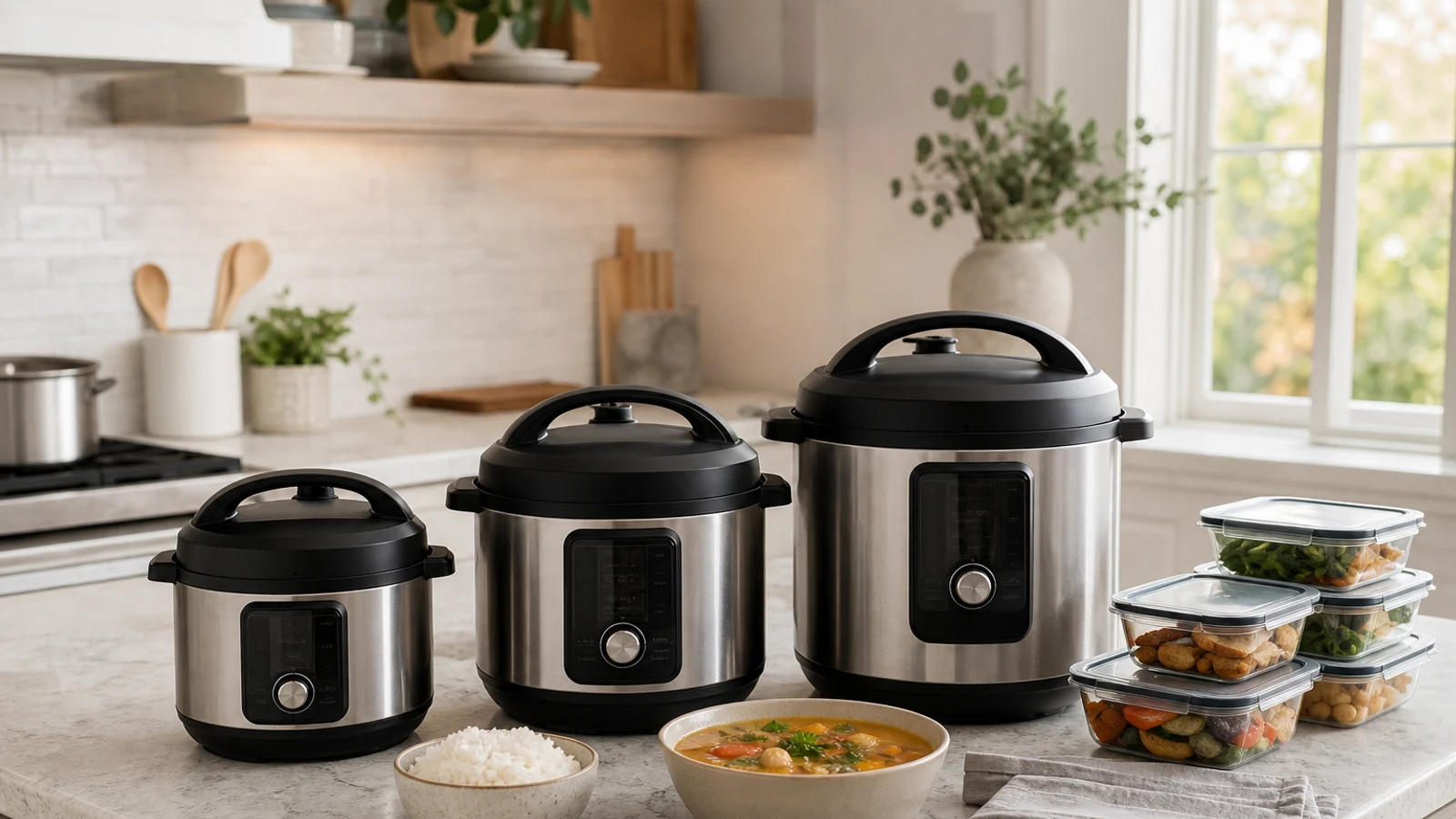
Instant Pot Size At A Glance
| Decision Point | Best For | What To Know |
|---|---|---|
| 3 Quart | One or two people; small portions; compact kitchens | Smallest footprint, but limited headroom for leftovers and large ingredients |
| 6 Quart | Most households; family meals; general-purpose cooking | Broadest recipe compatibility and the easiest one-pot default |
| 8 Quart | Large households; batch cooking; stock and meal prep | More capacity, but needs more storage, liquid, and countertop space |
| Usable Capacity | Pressure-cooked foods, grains, beans, and soups | Do not fill to the rim; expanding foods generally stay below the halfway mark |
| Counter Space | Small kitchens and limited storage | Measure the appliance footprint and overhead clearance before buying |
| Recipe Compatibility | Following published Instant Pot recipes | Many recipes are written around the common 6-quart size |
| Upgrade Logic | Replacing a cooker that feels cramped | Upgrade for a recurring capacity problem, not just because a larger size exists |
If you are buying your first Instant Pot, size matters more than the number of cooking programs on the front panel. A cooker that is too small can force extra batches, while one that is too large can occupy valuable counter space for meals that would fit comfortably in a smaller pot.
For many shoppers, the 6-quart model is the practical middle ground. It is large enough for a typical family dinner and leftovers, but still manageable in an average kitchen. The 3-quart model makes more sense when portions are consistently small. The 8-quart model is worthwhile when you already know you need additional volume rather than simply wanting the biggest option.
The right choice depends on four questions: how many people you usually feed, whether you want leftovers, what foods you cook, and where the cooker will live between uses.
The 3-Quart Instant Pot: Best For Small Portions
A 3-quart Instant Pot is designed for compact cooking rather than maximum versatility. It is a reasonable fit for one person, a couple with modest appetites, or someone who mainly cooks rice, oatmeal, small soups, sauces, vegetables, and side dishes.
Its main advantage is not necessarily faster cooking. The benefit is proportionality: a small meal takes up less space in the pot, and the appliance is easier to store in a small apartment, dorm, RV, or office kitchenette. It can also be useful as a second cooker for side dishes when a larger pressure cooker is already in use.
The limitation is headroom. A recipe that fits in a 6-quart cooker may not scale neatly into a 3-quart model, especially when it contains beans, pasta, grains, foamy ingredients, or bulky vegetables. You may also have less room for leftovers, meal prep, or large cuts of meat.
Choose The 3-Quart If
- You usually cook for one or two people.
- You prefer single meals over batch cooking.
- Your kitchen has limited counter or cabinet space.
- You mainly make side dishes, grains, eggs, oatmeal, or small soups.
- You are comfortable checking that recipes can be safely scaled down.
- You want a compact second cooker rather than your only large-capacity appliance.
The 6-Quart Instant Pot: The General-Purpose Default
The 6-quart Instant Pot is the safest starting point for shoppers who want one cooker that can handle a wide range of recipes. It generally suits couples, small families, and households that want dinner plus leftovers without making the appliance unusually difficult to store.
The size also has a recipe advantage. Many Instant Pot recipes and accessory suggestions are developed around the common 6-quart format. That does not mean every recipe requires 6 quarts, but it reduces the amount of conversion and guesswork when you are following instructions from cookbooks, food sites, or the manufacturer.
A 6-quart cooker can handle everyday pressure-cooked meals, rice, beans, stews, shredded meats, yogurt, steamed foods, and many whole ingredients. It is also large enough for many family-size portions without the extra bulk of an 8-quart machine. The trade-off is that very large batches or oversized foods may require multiple runs.
Choose The 6-Quart If
- You cook for roughly two to five people.
- You want dinner with some leftovers.
- You are buying your first and only Instant Pot.
- You follow online recipes without wanting frequent size conversions.
- You make a mix of grains, soups, meats, beans, and one-pot meals.
- You have ordinary kitchen storage and want a balance between capacity and footprint.
The 8-Quart Instant Pot: For Volume And Headroom
An 8-quart Instant Pot earns its larger footprint when you regularly use the extra volume. It is a strong fit for larger households, frequent entertainers, meal-prep routines, and cooks who make stock, large batches of chili, beans, soup, or shredded meat.
The additional capacity can be useful even when the number of people at dinner is not especially high. A batch-cooking routine may involve preparing several days of food at once, freezing portions, or cooking a large ingredient that would be awkward in a 6-quart pot. If your recurring complaint is that food reaches the fill line before the batch is complete, the 8-quart size solves a real problem.
The downside is not just physical size. Larger pressure cookers can require more liquid and may take longer to heat and reach pressure, depending on the model and the amount of food inside. Small meals can also feel inefficient if they occupy only a shallow layer at the bottom. Manufacturer instructions still control safe fill levels, regardless of how much unused space remains.
Choose The 8-Quart If
- You regularly cook for five or more people.
- You batch-cook several meals at once.
- You make large quantities of stock, beans, soup, or pulled meat.
- You often cook bulky foods or want more room for a large roast or poultry.
- You have a permanent counter location or reliable storage space.
- You would rather have extra capacity than optimize for the smallest footprint.
Why The Quart Number Can Be Misleading
The advertised quart number describes the total volume of the inner pot. It is not the same as safe usable cooking capacity. Pressure cooking requires space for steam, expansion, and safe operation, so the pot should not be filled to the rim.
For foods that expand or foam, such as rice, beans, pasta, grains, and porridge, Instant Pot guidance generally calls for staying below the halfway mark. Other foods may be filled only to the marked maximum pressure-cooking line. The exact limits and minimum liquid requirements vary by cooker and recipe, so the manual for the specific model takes priority.
This is why a 6-quart cooker should not be thought of as six quarts of finished soup or six quarts of cooked beans. If your shopping decision depends on a particular food, estimate the finished batch and leave the required safety margin rather than comparing labels alone.
Think About Food Shape, Not Just Servings
Capacity is only one dimension. A pot may hold enough total food but still be inconvenient for a whole chicken, a tall roast, a large steamer basket, or multiple containers used for pot-in-pot cooking.
A 3-quart cooker can be excellent for volume-sensitive foods such as oatmeal or a small rice batch, but its diameter and height may limit large ingredients. The 8-quart model offers more room, yet the extra width and height may make it harder to fit under cabinets or beneath a range hood. Check the manufacturer’s listed dimensions, lid clearance, and steam-release direction before deciding where it will sit.
Also consider the countertop workflow. Pressure release produces hot steam, and the cooker needs room around the valve and lid. Do not plan to operate it directly beneath a cabinet, beside delicate electronics, or in a location where the steam path is blocked.
The Kitchen And Storage Test
Before buying, measure the space in three ways: the place where the cooker will operate, the cabinet or shelf where it will be stored, and the route between those two locations. A cooker that technically fits may still be frustrating if its lid, cord, accessories, or inner pot have nowhere to go.
Weight matters too. If you expect to store the cooker after every use, a larger model may become a chore. If it will remain on the counter, look at the full footprint rather than only the inner pot diameter. Handles, lid hinges, steam release, and cord placement all affect the space it actually occupies.
What Changes The Answer Most
Household size is useful, but it is not a complete sizing rule. Two people who make large weekend batches may need more capacity than four people who cook small meals every evening. A single person who freezes soups and beans may prefer an 8-quart model, while a family that rarely wants leftovers may be comfortable with a 6-quart cooker.
Your cooking style can be more important than your headcount:
- For mostly side dishes and small portions, lean 3 quart.
- For mixed everyday cooking, lean 6 quart.
- For batch cooking and large ingredients, lean 8 quart.
- For very occasional use, consider whether a pressure cooker will earn its storage space at all.
- For air frying, compare the separate air-fryer basket or lid design rather than assuming a larger pressure-cooking pot will perform the same job.
When You Should Not Buy The Bigger Size
A larger cooker is not automatically more future-proof. If you live alone, have limited storage, and mostly cook one or two servings, the extra capacity may add bulk without improving your routine. A bigger pot also does not eliminate the need to follow minimum liquid requirements or safe fill lines.
Do not size up solely because a larger model has more programs. Cooking modes and capacity are separate decisions. If you are unsure whether you will use pressure cooking regularly, it may be wiser to start with a manageable size or postpone the purchase rather than buying an oversized appliance that becomes permanent clutter.
Should You Choose The Cataloged 6-Quart Duo?
The Instant Pot Duo 7-in-1 (6 Qt) is the most directly relevant catalog option for shoppers who want the common middle size and a conventional multi-function pressure cooker. Its fit depends less on finding a universal winner and more on whether your household, recipes, and storage space line up with the 6-quart format.
Treat it as a practical reference point when comparing sizes, not proof that every household should buy 6 quarts. A 3-quart cooker may be better for a small kitchen and small portions, while an 8-quart model may be more useful for recurring batch-cooking needs. Verify the current model’s dimensions, included accessories, controls, and manual before purchase, since product variations can change over time.
How To Decide In Five Minutes
Use this quick process before you shop:
- Write down the largest meal or batch you realistically make, not the largest meal you imagine making.
- Decide whether leftovers are occasional or part of your weekly routine.
- Check whether your favorite recipes specify a cooker size.
- Measure the operating and storage space, including overhead clearance and steam direction.
- Choose the smallest size that handles your largest recurring task without crossing safe fill limits.
- If two sizes still seem workable, choose based on storage and batch-cooking habits rather than extra programs.
Go Deeper Before You Choose
For more context, see Is An Instant Pot Worth It For Two?.
For more context, see Instant Pot Vs. Slow Cooker.
For more context, see Kitchen Upgrades To Consider In 2026.
Relevant Product
One catalog product is directly relevant to this decision. It is shown as a reference point, not as a universal winner. Current price, seller and availability should always be confirmed on Amazon.

Instant Pot Duo 7-in-1 (6 Qt)
Pressure cooks, slow cooks, and steams in one countertop unit.
View on AmazonResearch References
These sources informed the factual background for this guide. BuyingView applies its own editorial judgment to the purchase decision.
Questions & Answers
Useful follow-up questions that often change the buying decision.
Is a 3-quart Instant Pot big enough for two people?
It can be, especially for modest portions, side dishes, rice, oatmeal, and small soups. Choose a 6-quart model instead if you regularly want leftovers, cook bulky foods, or prefer to follow recipes without scaling them down.
Is a 6-quart Instant Pot enough for a family of four?
For many families of four, a 6-quart model is a practical fit for everyday meals and leftovers. An 8-quart model makes more sense if you batch-cook, serve unusually large portions, or often prepare stock, beans, or large cuts of meat.
Does an 8-quart Instant Pot cook faster than a 6-quart model?
Not necessarily. A larger cooker may take longer to heat and reach pressure, particularly with a large amount of food. Cooking time depends on the recipe, food quantity, starting temperature, and model.
Can I use 6-quart Instant Pot recipes in an 8-quart model?
Often, but you must follow the 8-quart model’s minimum liquid requirements and safe fill markings. Some recipes may need more liquid to reach pressure, and timing can vary with the quantity and shape of the food.
What size Instant Pot is best for meal prep?
A 6-quart model is suitable for moderate meal prep, while an 8-quart model is better when you routinely prepare several days of meals or freeze large portions. Choose based on the batch size you actually make each week.
Should I buy an Instant Pot if I only cook for one?
Consider a 3-quart model if you want compact pressure cooking and mostly prepare small portions. A 6-quart model can still make sense if you want leftovers, cook large batches occasionally, or prefer broader recipe compatibility. If you rarely cook these foods, do not buy solely for the idea of convenience.