Air Fryer Vs Convection Oven: Which One Fits Your Cooking Routine?
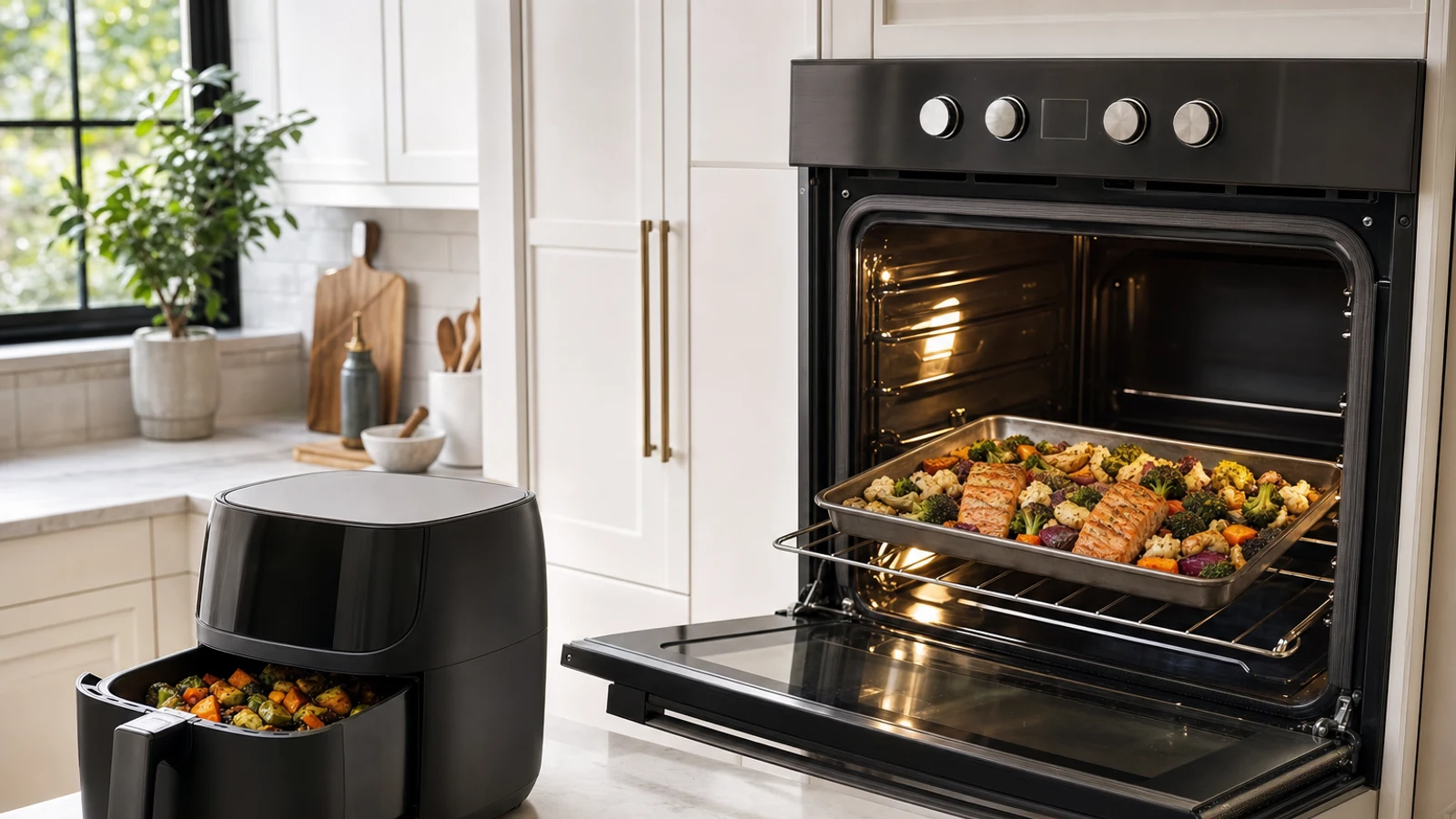
Air Fryer vs Convection Oven at a Glance
| Decision Point | Air Fryer | Convection Oven |
|---|---|---|
| Best For | Small portions, crisping, reheating | Larger meals, baking, roasting |
| Capacity | Compact; batching may be needed | More room for trays and cookware |
| Speed | Usually faster for small loads | More preheating, but handles more food at once |
| Crisping | Strong for small, well-spaced portions | Depends more on airflow, pan and oven mode |
| Space | Uses countertop space | No extra counter space if already built in |
| Good Fit | One or two people and frequent quick meals | Families and cooks who need broader flexibility |
The short answer is that an air fryer is essentially a compact convection cooker, but the cooking experience is not identical. Both circulate heated air around food. An air fryer’s smaller cavity and basket usually put hot air closer to the food, while a full-size convection oven gives you substantially more room for trays, dishes, and larger portions.
That makes this less a question of which technology is universally better and more a question of what you cook repeatedly. A single person reheating leftovers, roasting vegetables, or crisping frozen food may value the air fryer’s small footprint and quick start-up. A family preparing a whole meal, baking casseroles, or cooking several trays at once may find the oven more useful.
The most important distinction is capacity. An air fryer can be fast and effective when the food is arranged with room for air to move, but overcrowding can produce uneven cooking. USDA guidance specifically recommends cooking in batches when the basket is too full.
How The Two Appliances Actually Differ
A convection oven uses a fan to circulate hot air inside a relatively large oven cavity. Depending on the model, it may have one or more heating elements, multiple rack positions, and settings for baking, roasting, broiling, or convection cooking. A built-in oven can also accommodate cookware that will not fit in a basket, such as a large roasting pan, Dutch oven, or casserole dish.
An air fryer uses the same broad convection principle in a smaller chamber. Its basket or perforated tray is designed to expose more of the food’s surface to moving air. The heating element and fan are physically closer to the food than they are in a full-size oven, which can help small portions brown and crisp quickly. USDA describes air fryers as countertop convection ovens and notes that they commonly cook foods in roughly the 350°F-to-400°F range, although exact settings and times vary by appliance.
The word “air fry” can be confusing because it does not mean the food is immersed in hot oil. It refers to a dry-heat method that can create browning and crispness with little or no added oil. Results still depend on the food itself, surface moisture, spacing, temperature, and cooking time. Neither appliance perfectly reproduces the texture of food submerged in oil.
Air Fryer Advantages
For Small Portions, An Air Fryer Is Often More Convenient
An air fryer is well suited to one or two servings: chicken wings, vegetables, fish portions, frozen snacks, potatoes, and leftovers. You can place food in the basket, set the controls, and avoid heating a large oven for a relatively small load. A recent 2026 consumer buying guide similarly highlights air fryers’ appeal for smaller households and quick meals, while warning that a larger capacity is not automatically better if the appliance is mostly used by one person.
It can also be useful when you want a crisp exterior rather than the softer texture produced by microwaving. Foods such as fries, roasted vegetables, breaded items, and pizza slices often benefit from circulating dry heat. For reheating, the air fryer may be preferable when preserving crispness matters more than absolute speed or moisture retention. This does not mean every leftover is better air-fried; rice, saucy dishes, and foods that dry out easily may be better suited to a microwave or covered oven method. See our guide to Air Fryer Vs Microwave Reheating for that specific trade-off.
Air Fryer Limitations
The basket is both the air fryer’s strength and its main constraint. A single layer generally cooks more evenly than a packed basket, but a single layer may not be enough for a family meal. You may need multiple batches, and the second batch can take longer if you are waiting for the first one to finish.
Air fryers also have a limited shape. A basket may fit nuggets and vegetables but not a 9-by-13-inch casserole, a full sheet pan, or a large loaf. Some oven-style air fryers offer shelves and more vertical room, but they occupy more counter space and can begin to overlap with the role of a countertop convection toaster oven.
Cleaning is manageable but not frictionless. Grease and crumbs collect in the basket, rack, or drip area, and foods with sticky sauces can require more attention. Before buying, check whether the removable parts are dishwasher-safe according to the manufacturer and whether the basket is easy to lift, empty, and clean around. A compact appliance is only convenient if it does not become a maintenance task you avoid.
Convection Oven Advantages
For Families And Larger Dishes, The Oven Usually Wins
A convection oven is the more flexible choice when you cook for several people or prepare food in larger vessels. You can roast a larger cut of meat, bake a casserole, use a standard baking sheet, or cook multiple components on separate racks. That flexibility matters more than peak crispness if your routine includes full meals rather than snacks and side dishes.
The oven also fits established recipes and cookware more naturally. You can use pans and dishes you already own, and convection settings may let you cook multiple items with more even heat distribution than a conventional oven. The U.S. Department of Energy notes that convection cooking can reduce energy use in applicable oven cooking because increased air circulation can cook food faster or allow lower operating energy under the test procedure. Actual savings depend on the oven, load, temperature, preheating, and electricity use.
Convection Oven Limitations
The main drawback is scale. A full-size oven has a larger cavity to heat, so it may be inefficient for a small serving, especially if you are cooking for one person. It may also take longer to preheat and can add more heat to the kitchen, which is noticeable in warm weather.
A convection oven does not automatically produce the same crisp results as a compact basket air fryer. Airflow design, fan strength, rack position, pan type, and how much food is on the tray all matter. Whirlpool notes that air fryers and convection ovens work similarly but are not identical, and recommends following the oven manufacturer’s instructions when adapting cooking times and temperatures.
If your oven has a dedicated air-fry mode, a perforated tray, or an accessory basket, the gap may narrow. Even then, the larger cavity may require more food or a longer warm-up to make the setup worthwhile. The feature can be useful, but it does not necessarily make a full-size oven behave exactly like a small basket air fryer.
Texture, Speed, And Energy Use
For crisping a small amount of food, the air fryer generally has the practical advantage because the food sits in a compact, highly ventilated space. That can mean shorter cooking cycles and less preheating than a full-size oven. The USDA also notes that air fryers cook faster and consume less energy than larger ovens in general, though this is a broad comparison rather than a guarantee for every appliance or recipe.
The comparison changes when you cook a large amount. One air-fryer batch may be efficient, but several batches can erase the time advantage. A convection oven may be the better workflow if it can cook the entire meal at once. The right question is not simply “Which appliance uses less electricity?” It is “Which appliance can finish my normal quantity with fewer heating cycles and less waiting?”
Texture also depends on spacing. A lightly loaded basket or tray lets air reach more surfaces. A crowded air fryer can steam food instead of crisping it, while an overloaded oven tray can produce a similar problem. For either appliance, avoid treating the maximum physical capacity as the ideal cooking capacity.
Which One Fits Different Cooking Routines?
Choose An Air Fryer If You
- Usually cook for one or two people.
- Reheat pizza, fries, breaded foods, or roasted leftovers often.
- Want quick weeknight side dishes and small portions.
- Prefer crisp textures and do not mind cooking in batches.
- Have limited oven access, a small kitchen, or a hot climate where avoiding the full oven matters.
- Want a simple appliance dedicated to a narrow set of frequently repeated tasks.
Choose A Convection Oven If You:
- Cook for a family or regularly host guests.
- Bake, roast, broil, or prepare casseroles and larger dishes.
- Need multiple racks or want to cook several components together.
- Already own cookware that will not fit in an air-fryer basket.
- Want one broad-purpose appliance rather than a countertop appliance for crisping.
- Prefer fewer batches, even if preheating takes longer.
What If You Already Own One?
If you already have a convection oven, do not buy an air fryer simply because the marketing suggests a completely different cooking technology. First try convection with a shallow pan, adequate spacing, and the oven’s air-fry setting if available. You may find that the oven handles your usual foods well enough.
An air fryer becomes more compelling when convenience is the problem. It can be worth adding if you frequently cook small portions, dislike heating the oven for a snack or side dish, or want a dedicated appliance that another household member can operate without occupying the main oven. It may also help when the oven is already busy with a larger meal.
If you already own an air fryer, an oven upgrade makes more sense when you are repeatedly cooking in batches, cannot fit the cookware you need, or want to bake and roast beyond the basket’s limits. Do not upgrade merely for the promise of faster cooking if your current appliance already handles your usual portions comfortably.
Space, Ventilation, And Maintenance Considerations
Measure more than the appliance’s listed width. Leave the clearance recommended by the manufacturer around vents and heat-producing surfaces, and make sure the basket or door can open without hitting a wall or cabinet. An air fryer may be smaller than an oven overall but still need a permanent counter position because moving it after every use becomes inconvenient.
Think about workflow, not just storage. If you use the appliance several times a week, a visible location may be practical. If it lives in a cabinet, confirm that you can lift it safely and that the cabinet can accommodate the appliance’s depth and accessories.
For either option, clean grease and food residue regularly. Do not assume “dishwasher-safe” means every part can go in the dishwasher, and follow the owner’s manual for coatings, heating elements, and removable trays. Keep raw and cooked food separate, and use a thermometer for meat and poultry rather than relying only on browning or appearance. USDA lists 165°F for poultry, 160°F for ground meats, 145°F for fish and whole cuts of beef, pork, veal, and lamb with a three-minute rest, and 165°F for leftovers.
A Practical Buying Checklist
Before choosing, answer these questions:
- How many people do you normally cook for?
- What are your five most common uses: crisping, reheating, baking, roasting, or full meals?
- Do you need a basket, a sheet pan, or a casserole dish?
- Can you tolerate cooking in batches?
- Where will the appliance live, and can it vent safely there?
- How often will you clean it?
- Do you already have a convection setting or air-fry mode that covers most of your needs?
- Would a larger air-fryer oven duplicate equipment you already own?
For shoppers who want a straightforward countertop option for small-batch crisping, the catalog’s COSORI Air Fryer is the directly relevant product entry to compare against your routine. However, product fit still depends on the specific model’s capacity, dimensions, controls, cleaning instructions, and warranty; verify those details before purchase rather than assuming every air fryer performs alike.
The Bottom Line
An air fryer is the better fit for small portions, quick crisping, and frequent reheating. A convection oven is the better fit for capacity, cookware flexibility, baking, roasting, and complete meals. Neither one eliminates the other’s strengths.
If you are deciding between buying an air fryer and relying on a convection oven you already own, start with your average portion size and number of batches. If the oven is mostly used for small jobs, an air fryer may make everyday cooking easier. If the air fryer would require two or three rounds for most dinners, the oven is likely the more practical tool.
The best choice is the one that matches your recurring workflow—not the appliance with the most modes or the broadest marketing claim.
Go Deeper Before You Choose
For more context, seeAir Fryer Vs Toaster Oven.
For more context, seeWhat Size Air Fryer Do I Need?.
For more context, seeAir Fryer Vs Microwave Reheating.
Relevant Product
One catalog product is directly relevant to this decision. It is shown as a reference point, not as a universal winner. Current price, seller and availability should always be confirmed on Amazon.

Research References
These sources informed the factual background for this guide. BuyingView applies its own editorial judgment to the purchase decision.
Questions & Answers
Useful follow-up questions that often change the buying decision.
Is an air fryer just a convection oven?
An air fryer is a type of compact convection cooker, but it is not identical to every convection oven. Airflow pattern, cavity size, heating-element placement, basket design, and food spacing can produce different results.
Which cooks faster, an air fryer or a convection oven?
For small portions, an air fryer often feels faster because it has a smaller chamber and usually needs less preheating. For a large meal, a convection oven may finish sooner overall because it can cook more food at once. Recipe, load, appliance design, and temperature all matter.
Can I use an air-fryer recipe in a convection oven?
Usually, but do not assume the same time and temperature will work perfectly. Use the convection or air-fry guidance in your oven manual, leave space between pieces, and check food early. Whirlpool recommends following the oven manufacturer’s instructions when adapting cooking settings.
Does an air fryer use less energy than a convection oven?
It can use less energy for a small load because it heats a smaller space, but several batches may change the comparison. A convection oven can be efficient when it cooks a large quantity at once. The appliance, cooking time, preheating, load size, and local electricity rate all affect actual use.
Is an air fryer better for reheating leftovers?
It is often better for foods where you want a crisp exterior, such as pizza, fries, roasted vegetables, and breaded items. Moist foods, soups, rice, and saucy dishes may be better in a microwave or covered oven method.
Do I need an air fryer if my oven has an air-fry setting?
Not necessarily. Try the oven’s setting first if it handles your typical portions well. A separate air fryer may still be worthwhile for small servings, faster access, or when the main oven is occupied.