Instant Pot vs Slow Cooker: Which One Fits Your Routine Better?
By BuyingView Editorial Team · Published September 21, 2026 · 11 min read
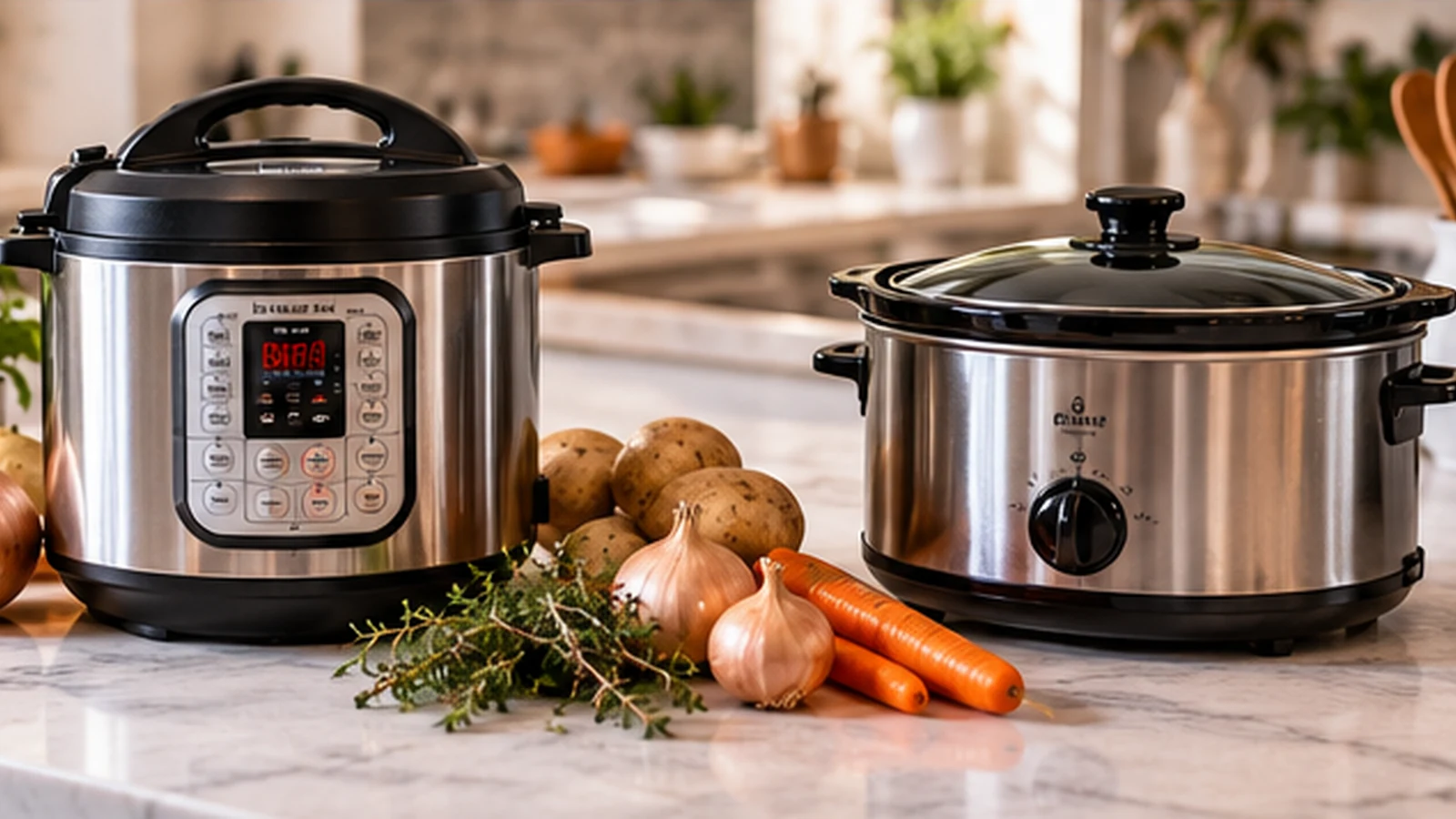
An Instant Pot and a slow cooker can produce some of the same foods, which is why people often assume the pressure cooker makes the slow cooker obsolete. In practice, they solve different scheduling problems. A pressure cooker compresses cooking into a shorter window. A slow cooker stretches cooking across the day.
The best choice depends on when you want to make decisions. If you know what dinner is at breakfast, slow cooking can feel effortless. If you decide what to cook at 6 p.m., pressure cooking is much more forgiving.
How the Instant Pot changes your schedule
An electric pressure cooker uses a sealed pot and pressure to raise the boiling point of water, which can reduce the cooking time of foods that normally need a long simmer. Dried beans, stews, braised meats, and some grain dishes are common use cases.
The Instant Pot Duo 7-in-1 is a familiar example. Its value is not that every mode replaces a dedicated appliance perfectly. Its value is that one pot can pressure cook, slow cook, steam, and handle several routine one-pot jobs.
If you are usually deciding dinner after work, this flexibility is a strong advantage.
How a slow cooker changes your schedule
A slow cooker is built around the opposite rhythm. You prepare ingredients earlier, set a low or high heat, and let the food cook for several hours. There is no pressure-release step and very little interaction once cooking begins.
That simplicity is appealing if your morning routine allows a few minutes of prep. You come home to food that has been cooking steadily all day. The disadvantage is obvious: if you forget to start it, the appliance cannot compress an eight-hour plan into one hour.
Which is easier to learn?
A slow cooker is usually simpler. The basic model is add food, choose a heat setting, and wait. Recipes still matter, but there are fewer unfamiliar controls.
A pressure cooker asks you to learn sealing, venting, minimum liquid requirements, and the difference between quick and natural pressure release. Once learned, those steps become routine, but the first few uses can feel more technical.
Which is better for beans?
Pressure cooking is particularly useful for dried beans because it shortens a process that otherwise takes substantial time. That can make dried beans more realistic on a weeknight.
A slow cooker can also cook beans, but the long timeline is the entire point. Follow tested recipes and food-safety guidance for the specific bean because some beans require proper boiling or preparation before slow cooking.
Which is better for stews and braises?
Both can work well. Pressure cooking gets you to tender meat much faster, while slow cooking gives you a long unattended window and a more traditional low-and-slow workflow.
Texture preferences matter. Pressure cooking can make meat tender quickly but can also overcook delicate vegetables if everything goes in at once. Slow cookers are easier to understand visually because the process is gentler and more gradual.
What about browning?
Browning adds flavor, and neither appliance eliminates the value of searing when a recipe benefits from it. Many multi-cookers have a sauté mode that lets you brown food in the same pot before pressure cooking.
Traditional slow cookers may require a separate pan if you want strong browning first. Some people happily skip that step; others consider it important enough that one-pot sautéing becomes a meaningful advantage for the multi-cooker.
Hands-on time versus elapsed time
Pressure cooking often reduces elapsed time, but it still includes time to come to pressure and release pressure afterward. A recipe advertised as twenty minutes under pressure does not necessarily mean dinner is ready in twenty minutes.
Slow cooking has much longer elapsed time but can have very little active attention. That is why the two appliances can both be described as time-saving: they save different kinds of time.
Batch cooking and leftovers
Both are excellent for batch-friendly meals. Chili, pulled meats, stews, beans, and soups often make several portions and reheat well. For a two-person household, this is one of the strongest reasons to own either appliance.
Our guide Is an Instant Pot Worth It for Two People? goes deeper into the leftover and storage question.
Counter and cabinet space
A multi-cooker can replace some separate appliances, which helps justify its footprint. But it is still bulky and relatively tall. A slow cooker may be simpler internally but occupies similar storage space depending on capacity.
Before buying either, decide where it will live. An appliance that must be excavated from the back of a cabinet rarely feels convenient.
Cleanup
Both usually center around one removable cooking vessel. Pressure cookers add a lid with a sealing ring, steam-release components, and parts that need to stay clean. Slow-cooker lids are mechanically simpler.
If odors in a silicone sealing ring bother you or you dislike cleaning small lid components, a slow cooker can feel easier. If one-pot sautéing prevents you from dirtying a second pan, the pressure cooker can still win overall.
Which is better for someone who meal-plans?
If you plan meals several days ahead and can load the cooker before leaving home, a slow cooker fits naturally into that routine. The long cooking window becomes a feature rather than a limitation.
If your schedule changes often and you do not know what dinner will be until late afternoon, pressure cooking is more flexible. You can start later without automatically turning dinner into a very late meal.
Can the Instant Pot replace a slow cooker?
Technically, many multi-cookers include a slow-cook mode. Whether it replaces a dedicated slow cooker for you depends on pot shape, heating behavior, lid configuration, and how much you value a dedicated simple appliance.
If you already own a slow cooker you use often, there is no need to discard it because a multi-cooker has the same label on a button. Add the pressure cooker only if the faster workflow solves a real problem.
Bottom line
Choose the Instant Pot if you value late-start flexibility, faster cooking for foods that normally simmer a long time, and several functions in one appliance. Choose a slow cooker if you prefer morning prep, low-and-slow cooking, and the simplest possible set-it-and-leave-it workflow.
For a wider kitchen-buying plan, see 5 Kitchen Upgrades Worth Buying in 2026.
Featured in this guide

Instant Pot Duo 7-in-1 (6 Qt)
Pressure cooks, slow cooks, and steams in one countertop unit.
Frequently asked questions
Does an Instant Pot replace a slow cooker?
It can for some people because many models include a slow-cook mode, but the workflow and heating behavior are not identical to every dedicated slow cooker.
Which is faster?
An electric pressure cooker is much faster for foods that normally simmer for hours, though pressurizing and pressure release add time beyond the programmed cook time.
Which is easier to use?
A slow cooker is usually simpler because it has fewer unfamiliar steps and no pressure-release process.
Which is better for meal prep?
Both are good for batch cooking. Pressure cookers help when you start later; slow cookers help when you can start earlier.
Which is better for two people?
Either can work. The better choice depends on whether you want quick batch cooking or all-day unattended cooking and whether you use leftovers.
Do I need both?
Only if you genuinely use both scheduling styles. Many households can choose one based on when they prefer to start dinner.