What Size Dehumidifier Do You Need?
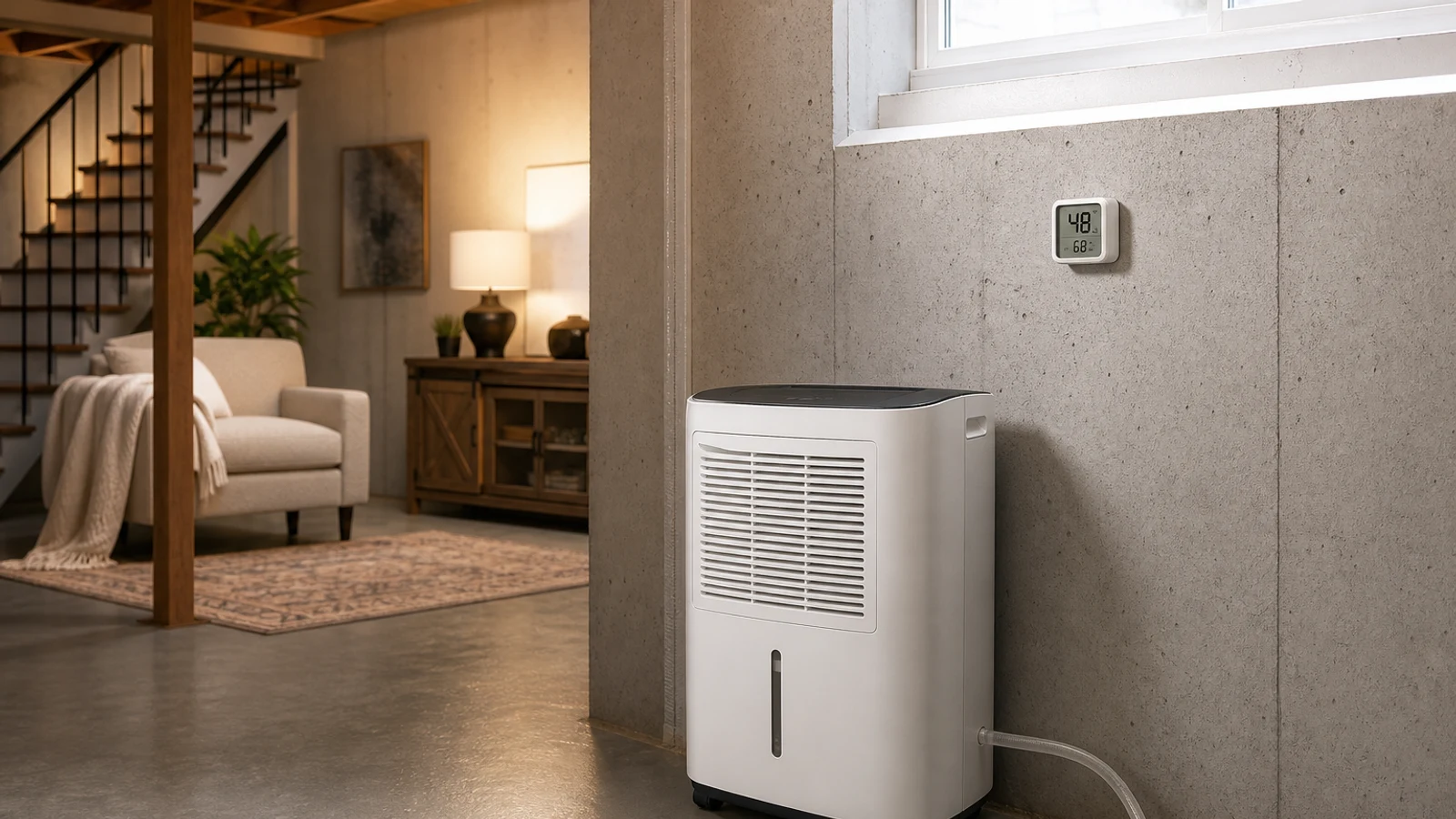
The right dehumidifier size depends on two measurements: the area you want to dry and the amount of moisture entering that area. A small, mildly damp bedroom and a same-size basement after a plumbing leak do not have the same requirements.
Capacity is usually listed in pints per 24 hours. That number describes how much water the unit can remove under standardized test conditions, not how much water it will collect every day in your home. Actual collection varies with temperature, humidity, ventilation, and the moisture load of the space.
For most shoppers, the safest approach is to measure the area, assess how damp it really is, then choose the higher capacity when two options seem close. Oversizing modestly is generally preferable to buying a unit that runs continuously without bringing humidity down.
Start With The Space You Actually Need To Dry
Measure the length and width of the room or connected area, then multiply them to get square footage. If several rooms are connected by open doorways, consider them one zone only if air can circulate freely. Closed bedrooms, separated floors, and rooms with doors may need their own units or a whole-home approach.
Ceiling height matters less than floor area for a basic estimate, but unusually tall rooms, open stairwells, unfinished basements, and large connected spaces can hold more air and may be harder to control. Treat an open basement with several sections as a larger, more demanding zone than a simple square-foot calculation suggests.
Before shopping, note where the unit will sit, where its warm exhaust air will go, and how collected water will be handled. A powerful unit that is blocked against a wall, placed beside furniture, or constantly stops because its bucket is full will not solve the problem efficiently.
Use Moisture Conditions To Choose Capacity
ENERGY STAR’s current portable-dehumidifier guidance uses three broad moisture conditions for spaces under about 2,000 square feet. These ranges are more useful than a rigid room-size chart because they account for why the space is damp in the first place.
Slightly To Moderately Damp
- The room feels damp at times or has an occasional musty odor.
- Relative humidity is roughly 50% to 75%.
- Start around 20–30 pints per day for a small-to-medium space.
- Choose the upper end if the area is near a bathroom, has several windows, or humidity rises quickly after showers or cooking. Very Damp
- The space consistently feels damp and smells musty.
- Damp spots may appear on walls or floors.
- Relative humidity is roughly 75% to 90%.
- Look in the 25–40-pint range for a small-to-medium space.
- A basement with limited airflow often belongs in this category even when it does not look visibly wet. Wet Or High-Load
- Walls or floors sweat, seepage is present, or clothes are drying nearby.
- Relative humidity may approach 90% to 100%.
- Consider approximately 30–50 pints for a small-to-medium space.
- Persistent seepage, flooding, or visible water damage requires repair or professional remediation rather than relying on a larger appliance alone.
A Practical Capacity Guide By Room Size
The table below is a starting point, not a guarantee. It assumes a portable unit serving one reasonably open area. If the space is unusually damp, cold, or poorly ventilated, move up a category.
Up To About 500 Square Feet
- Mildly damp: roughly 20–25 pints.
- Very damp: roughly 25–30 pints.
- Wet or high-load: roughly 30–40 pints. About 500 To 1,000 Square Feet
- Mildly damp: roughly 25–30 pints.
- Very damp: roughly 30–40 pints.
- Wet or high-load: roughly 40–50 pints. About 1,000 To 2,000 Square Feet
- Mildly damp: roughly 30 pints or more.
- Very damp: roughly 40 pints or more.
- Wet or high-load: roughly 50 pints or more. These are deliberately overlapping ranges. Manufacturer charts can differ, and the same capacity may be adequate in a warm finished room but marginal in a cool basement with concrete walls and limited air circulation. When a manufacturer’s chart for a specific model is more conservative than a general estimate, follow the manufacturer’s guidance.
When To Size Up
Choose the higher end of a range when the space has a large or continuous moisture load. The most important factors are not decorative features but how quickly new moisture enters the air.
Size up if
- The room is in a humid climate or receives humid outdoor air through frequent door opening.
- Several people occupy the space for long periods.
- The area has many windows, exterior doors, or air leaks.
- Laundry is dried in or near the room.
- The basement has exposed concrete, a dirt floor, or limited ventilation.
- Condensation returns soon after the unit shuts off.
- The appliance will serve an open area larger than the room where it sits.
- You want faster initial drying after a period of high humidity. A slightly larger unit can also give you operating flexibility. Once humidity is under control, it may run for shorter periods or at a lower setting. That does not automatically guarantee lower electricity use, however; compare the model’s efficiency rating and real operating pattern rather than assuming bigger is always cheaper.
Do Not Confuse Capacity With Bucket Size
A 30-pint rating and a 30-pint collection bucket describe different things. Capacity is the amount of water the machine is rated to remove over 24 hours under test conditions. Bucket size is how much water the removable tank can hold before the unit shuts off.
A larger bucket can reduce emptying, but it may also make the unit heavier to carry when full. If the dehumidifier will run in a basement, laundry room, or vacation property, continuous drainage may matter more than bucket capacity. Look for a hose connection and confirm that the hose can slope to a floor drain or reach a condensate pump.
Automatic shutoff is useful when the bucket fills, but it means the unit may stop during the dampest part of the day. If nobody is home to empty it, prioritize continuous drainage, a pump option when necessary, and a hose installation that cannot kink or back up.
Account For Temperature And Current Pint Ratings
Portable compressor dehumidifiers generally remove moisture more effectively in warmer air. In a space that regularly falls below about 65 degrees Fahrenheit, coils can frost and the unit may cycle through defrosting instead of collecting water. For a cool basement, choose a model specifically designed for low-temperature operation or with an anti-frost feature, and check the manufacturer’s minimum operating temperature.
Current capacity labels can also look smaller than older labels. Federal test procedures changed so portable units are rated under cooler conditions that more closely resemble basement operation. As a result, a newer model labeled 30 pints may not be directly equivalent to an older model labeled 50 pints under the previous test method.
When replacing an old unit, compare the model’s current rating, efficiency metric, temperature specifications, and manufacturer guidance rather than matching the old pint number one-for-one. The label change does not necessarily mean the newer appliance is weaker.
Choose Portable Or Whole-Home
A portable dehumidifier makes sense when one room, basement, apartment, or seasonal area has the problem. It is easier to buy and install, but you must plan for noise, airflow, bucket emptying, and moving the unit if several rooms need help.
A whole-home dehumidifier is a different type of project. It is connected to ductwork and is intended to control humidity across the home rather than only the room where the appliance sits. It may be appropriate when humidity remains high throughout a relatively well-sealed home, especially when central air conditioning is already installed.
Whole-home systems should be sized and installed by a qualified HVAC professional. The design must account for duct layout, drainage, controls, air sealing, and the home’s actual moisture load. A portable unit placed in a hallway is not a substitute for properly balancing humidity across multiple floors and closed rooms.
Check Humidity Before And After Buying
A hygrometer is one of the most useful low-cost tools for sizing and troubleshooting. Measure the problem area at different times of day, including after showers, cooking, laundry, rain, or overnight cooling. Do not rely only on how the room feels; people adapt to humidity, and musty odors can appear before visible condensation.
For general indoor moisture control, EPA guidance recommends keeping relative humidity below 60%, ideally between 30% and 50% when possible. Set the dehumidifier based on the room’s behavior and your comfort, then verify the reading after several days rather than expecting the first hour of operation to represent normal performance.
If humidity remains high despite continuous operation, check for blocked airflow, a full bucket, a kinked drain hose, dirty filters, low temperature, open windows, foundation seepage, plumbing leaks, or moisture entering from a crawl space. The issue may be the building envelope rather than the appliance size.
Do Not Buy A Larger Unit To Hide A Water Problem
A dehumidifier can remove moisture from the air, but it cannot stop a roof leak, repair a plumbing failure, seal a foundation, or dry hidden materials inside a wall. If water is entering continuously, the appliance may run almost nonstop while the underlying damage worsens.
Fix leaks and seepage promptly, dry damp materials as quickly as possible, and be cautious around visible mold or contaminated floodwater. Extensive water damage, recurring basement seepage, or mold in HVAC systems may require a qualified contractor or remediation professional.
You may also not need a dehumidifier if the main issue is a bathroom exhaust fan that does not vent outdoors, a clothes dryer vent problem, or an air conditioner that is oversized and short-cycles. Correcting the source can be more effective than increasing appliance capacity.
Features Worth Prioritizing After Capacity
Once the capacity range is right, prioritize features that fit your room and maintenance habits.
Look for
- A built-in humidistat so the unit can maintain a target humidity instead of running continuously.
- Continuous-drain capability if the unit will operate unattended.
- Low-temperature operation or anti-frost control for cool basements.
- Washable or accessible air filters.
- Clear bucket-full indicators and an automatic shutoff.
- Casters and handles if the unit must move between rooms.
- A published efficiency rating, preferably ENERGY STAR certification when a qualifying model fits your needs.
- Noise information if the unit will operate near a bedroom, office, or living area. Avoid choosing solely by the largest advertised pint number. A quieter, drain-ready unit with a usable humidistat may fit your workflow better than a nominally larger model that is difficult to place or maintain.
A Simple Buying Decision
If you are shopping for one ordinary room that feels slightly damp, begin around 20–30 pints per day and move upward for extra moisture sources. For a consistently damp basement or open area near 1,000 square feet, a 30–40-pint class model is a more realistic starting point. For wet conditions, laundry drying, or visible condensation across a larger space, consider 40–50 pints or more, then verify the model’s low-temperature performance and drainage options.
If several rooms or the entire house stay above your target humidity, stop treating the problem as a single-room purchase. Consider whether multiple portable units, improved ventilation, air sealing, HVAC adjustments, or a professionally sized whole-home dehumidifier makes more sense.
For a closer look at the operating differences between common technologies, see the guide to compressor versus desiccant dehumidifiers. If you are comparing humidity control with broader air-cleaning needs, the air purifier size guide explains why room coverage claims should be interpreted separately from dehumidifier capacity.
Bottom Line
Choose by moisture load first and square footage second. For most portable applications under 2,000 square feet, the practical starting ranges are 20–30 pints for mildly damp conditions, 25–40 pints for very damp conditions, and 30–50 pints for wet or high-load conditions.
When in doubt between adjacent sizes, modestly oversize, especially if the space has many windows, laundry, poor airflow, or humidity that rises quickly. Then make sure the unit can operate at the room’s temperature, drain in a way you can maintain, and fit without blocking airflow.
Most importantly, use the appliance to control humidity—not to cover up leaks, seepage, or wet building materials. The best size is the one that can consistently hold your target humidity while fitting the room, drainage setup, temperature, and maintenance routine.
Go Deeper Before You Choose
For more context, see Compressor Versus Desiccant Dehumidifiers.
For more context, see Air Purifier Size Guide.
Research References
These sources informed the factual background for this guide. BuyingView applies its own editorial judgment to the purchase decision.
Questions & Answers
Useful follow-up questions that often change the buying decision.
Is a 30-pint dehumidifier enough for a basement?
It may be enough for a small, mildly to moderately damp basement, but not necessarily for a large, very damp, cold, or poorly ventilated one. Check the basement’s square footage, humidity reading, temperature, and whether water is entering through walls or floors. For persistent high humidity, compare 30-pint and 40-pint models and prioritize low-temperature operation and continuous drainage.
Is it better to oversize or undersize a dehumidifier?
A modestly oversized unit is generally preferable to an undersized one because it can reach the target humidity without running constantly. Do not assume the largest unit is automatically best: it still needs adequate airflow, a suitable temperature range, and a drainage setup that will not interrupt operation.
What does 50 pints per day mean?
It means the unit is rated to remove up to 50 pints of water in 24 hours under specified test conditions. It does not mean the appliance will collect 50 pints every day in your home. Actual removal depends on temperature, relative humidity, ventilation, and how much moisture enters the space.
What size dehumidifier do I need for 1,000 square feet?
For a 1,000-square-foot area, a mildly damp space may need about 25–30 pints per day, while a very damp area may need around 30–40 pints. Wet conditions, laundry drying, condensation, or seepage can push the requirement toward 40–50 pints or more. Use the manufacturer’s current sizing chart when selecting a specific model.
Can a dehumidifier remove mold?
No. A dehumidifier can lower humidity and help reduce conditions that support mold growth, but it does not remove established mold or fix the moisture source. Repair leaks, dry wet materials promptly, and seek professional help for extensive growth, contaminated water, or damage inside building materials.
Do dehumidifiers work in cold basements?
They can, but standard compressor models may frost or cycle through defrosting in cooler spaces. If the basement regularly falls below about 65 degrees Fahrenheit, look for a model specified for low-temperature operation or one with anti-frost controls. A desiccant model may be worth considering in some consistently cold applications.