Compressor vs Desiccant Dehumidifier: Which Fits Your Space?
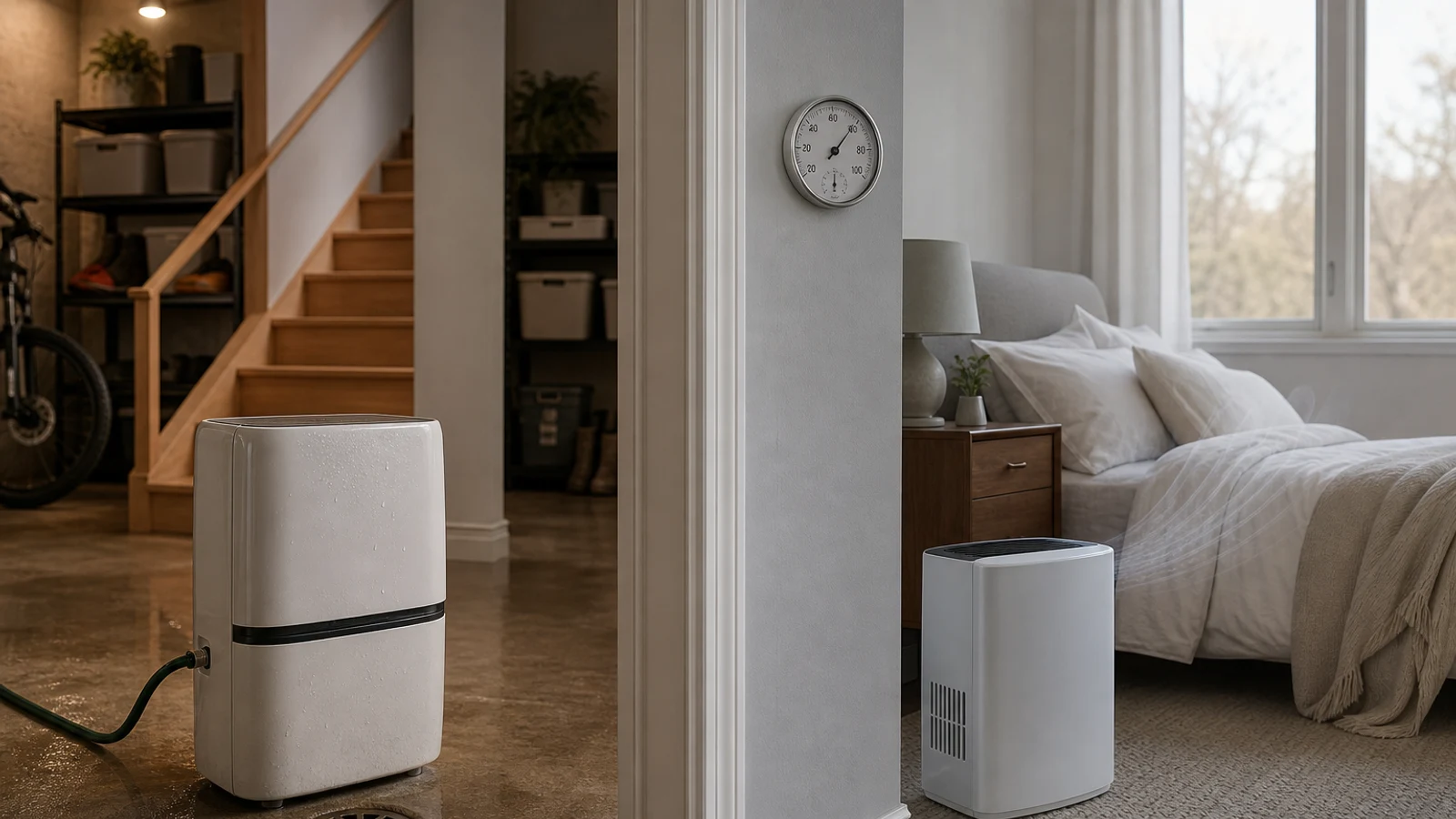
Compressor vs Desiccant Dehumidifiers At A Glance
| Decision Point | Compressor | Desiccant |
|---|---|---|
| Best temperature range | Warm to moderate indoor temperatures; performance can decline in cool rooms | Cool to moderate rooms; generally more consistent in low temperatures |
| How moisture is removed | Cools air over a cold coil so water condenses and collects | Passes air over a moisture-absorbing material, then dries that material with heat |
| Typical strengths | Higher moisture removal potential and lower running energy in suitable conditions | Quiet, steady operation and strong performance in cool spaces |
| Heat added to room | Usually modest heat from the compressor and fan | More noticeable warm-air output |
| Noise profile | Fan plus compressor noise; cycling may be noticeable | Primarily fan noise, often smoother and less mechanical |
| Best use cases | Basements, laundry rooms, living spaces, and persistently humid rooms | Bedrooms, offices, garages, storage rooms, and cool seasonal spaces |
| Main drawback | Can frost or lose effectiveness in colder conditions | Often uses more electricity and may remove moisture more slowly in a warm, very humid room |
The choice between a compressor and desiccant dehumidifier is less about which technology is universally better and more about where the machine will operate. Temperature is the biggest dividing line, followed by the amount of moisture entering the room and how much noise or warmth you can tolerate.
A compressor model is usually the practical default for a warm basement, laundry area, bathroom-adjacent space, or large room that stays noticeably humid. It can remove substantial amounts of water when the air is warm enough for condensation to work efficiently.
A desiccant model is often the more flexible option for a cool bedroom, garage, unheated basement, office, caravan, or seasonal space. It does not depend on cooling a coil below the air’s dew point in the same way, so it can maintain useful performance when temperatures fall. The trade-off is typically higher electricity use and warmer exhaust air.
How Compressor Dehumidifiers Work
A compressor dehumidifier draws humid air across a cold evaporator coil. Water vapor condenses on that coil, falls into a tank or drain hose, and the drier air is reheated slightly before returning to the room. The refrigeration circuit is broadly similar to the moisture-removal side of an air conditioner, although a dehumidifier is designed to return the processed air indoors rather than send heat outdoors.
This design is effective when the room is warm and the air contains enough moisture to condense readily. It is especially useful when humidity is high for long periods or when damp laundry, showers, groundwater, or a large basement volume create a continuing moisture load.
Compressor units are commonly rated by how many pints they can remove per day, but the published figure is tied to test conditions. Actual output can be much lower in a cool room or when the humidity level has already been reduced. Compare the operating conditions behind a rating rather than treating the number as a guarantee for every space.
How Desiccant Dehumidifiers Work
A desiccant dehumidifier moves air across a rotating or stationary moisture-absorbing material. A separate warm airflow removes the collected moisture from that material, allowing the process to continue. Because the system does not rely on a cold evaporator coil, it can remain useful in conditions where a compressor unit would cycle into defrost mode or remove moisture slowly.
The process also produces more heat. That can be helpful in a chilly bedroom, office, or garage, particularly during cooler months. It can be unwelcome in a warm summer room, where the extra heat may make the space less comfortable and increase the need for air conditioning.
Desiccant models are often selected for their smoother sound profile and low-temperature capability rather than for the lowest possible energy consumption. They can be a good fit when the dehumidifier runs near people, operates overnight, or needs to protect belongings in a cool storage area.
Temperature Is The Main Decision Factor
If the room usually stays above roughly 65 degrees Fahrenheit, a compressor model will often be the more economical starting point. That includes many finished basements, living rooms, laundry rooms, and continuously occupied homes. In this range, the compressor can condense moisture effectively and may remove more water for each unit of electricity than a desiccant model.
If the room regularly drops below that level, especially in winter, compare low-temperature specifications carefully. Compressor coils can frost in cool conditions. Defrost controls may protect the unit, but the machine can spend more time cycling and less time removing water. A desiccant unit may provide steadier moisture control in the same space.
Temperature is not always stable across a home. A basement that is comfortable in July may become cold in January. If you need year-round operation, estimate the lowest normal room temperature rather than choosing based only on the season when the humidity problem is most obvious.
Choose A Compressor If You Have A Larger Moisture Load
Compressor models generally make more sense when the room is warm, humid, and receiving moisture continuously. They are commonly considered for basements with damp air, laundry rooms where clothes are drying, and larger areas where a small desiccant unit would need to run for long periods.
Choose a compressor first if
- The room is normally warm or moderately warm.
- Humidity stays high for much of the day.
- You need to remove a significant amount of water.
- You want a lower-energy option under suitable operating conditions.
- The unit can sit near a floor drain, condensate pump, or frequently emptied tank.
- A modest increase in room temperature is acceptable.
Choose A Desiccant If The Room Is Cool Or Noise-Sensitive
Desiccant models are worth closer consideration when a compressor would be operating in an unfavorable temperature range. They can also suit spaces where a steady fan sound is preferable to compressor cycling, or where the unit must run close to a bed, desk, or living area.
Choose a desiccant first if
- The room is unheated or regularly cool.
- You are managing moisture in a garage, caravan, storage room, or seasonal property.
- You want to run the unit overnight in a bedroom.
- The room benefits from warm exhaust air during cooler weather.
- You need useful performance across a wider temperature range.
- You are removing moderate moisture rather than drying a very large, heavily damp space.
Energy Use And Running Cost
Compressor models are often the better choice for ongoing moisture control in warm conditions because condensation can be an efficient way to remove water. Look for an ENERGY STAR label where available and compare the integrated energy factor or another standardized efficiency measure rather than relying on marketing language such as low power or eco mode.
Desiccant units usually consume more electricity for a comparable moisture-removal task because they use heat to regenerate the moisture-absorbing material. That does not automatically make them the more expensive choice overall. If a compressor model struggles in a cold room, it may run for long periods with limited water removal, while a desiccant unit may reach the target humidity more reliably.
The most useful comparison is not the wattage printed on the box alone. Consider how many hours the unit will run, the room temperature, the target humidity, whether it can drain continuously, and whether the machine’s heat output changes your heating or cooling demand.
Noise, Heat, And Everyday Comfort
A compressor dehumidifier usually combines fan noise with the sound of a compressor starting, stopping, or cycling. The sound may be acceptable in a basement or laundry room but distracting beside a bed or work desk. Anti-vibration design, fan settings, and a stable floor can make a noticeable difference, but a quiet rating should still be checked carefully.
Desiccant models generally avoid the mechanical compressor sound and may deliver a more consistent fan noise. They are not silent, and the airflow can be prominent at higher settings. Their warmer discharge may improve comfort in a cold room but may be a drawback in a warm bedroom or office.
For sleeping areas, also consider display brightness, automatic restart behavior, humidistat accuracy, tank alerts, and whether the unit can maintain a low fan setting after reaching the target humidity. A model that is technically powerful but inconvenient to leave running may not be the best practical choice.
Room Size And Moisture Load Matter More Than Labels
Do not select solely by whether a machine is called a basement, bedroom, or whole-room model. Two rooms with the same floor area can have very different moisture loads. A basement with concrete walls, groundwater intrusion, laundry activity, and poor ventilation needs more capacity than a dry bedroom of the same size.
Use the room’s condition as a starting point
- Slightly damp: occasional musty odor or a room that feels clammy.
- Very damp: persistent dampness, condensation, or musty smell.
- Wet: visible sweating on walls or floors, seepage, or laundry drying in the room.
- High load: multiple moisture sources, open-plan areas, or a space connected to other damp rooms.
Drainage And Maintenance Can Decide The Better Buy
A dehumidifier is only useful if it can run long enough to control humidity. Tank-only operation may require frequent emptying, especially in a wet basement or during laundry. If a floor drain or sump is available, prioritize a model with continuous drainage and confirm that the hose can run with the required gravity drop. Some installations need a condensate pump.
Both technologies need airflow maintenance. Clean or replace the filter according to the manual, keep intake and exhaust openings clear, and inspect the tank or drain path for buildup. Compressor units may require attention to coil and grille cleanliness, while desiccant units still depend on an unobstructed filter and airflow path.
Place the machine with adequate clearance and keep doors and windows closed while it operates in the target space. Running a portable dehumidifier while humid outdoor air continually enters can make it appear underpowered and waste energy.
When Neither Type Is The Right Fix
A dehumidifier treats airborne moisture; it does not repair the source. If water is entering through a foundation, roof, plumbing connection, window, or drainage failure, fix that problem first. Persistent standing water, visible mold, wet building materials, or strong recurring odors may require building repair or professional remediation rather than a larger appliance.
A dehumidifier may also be unnecessary when the issue is short-lived and can be solved with bathroom exhaust, a properly vented dryer, kitchen ventilation, air-conditioning use, or improved airflow. Measure relative humidity with a separate hygrometer before buying if the problem is unclear. Indoor humidity is generally best kept below 60 percent, with many guidance sources using approximately 30 to 50 percent as a practical target range.
Do not expect either technology to replace ventilation where fresh-air exchange is needed, or to solve condensation caused by very cold surfaces, poor insulation, or a missing vapor-control strategy. Those conditions may require a broader moisture-management plan.
What To Look For Before Buying
Once you have chosen the technology, compare the details that affect daily use rather than focusing only on extraction capacity.
Prioritize these features
- A humidistat with a clear target setting.
- Continuous-drain capability if a suitable drain is available.
- Automatic shutoff when the tank is full.
- A washable or easily replaceable air filter.
- Low-temperature specifications if the room gets cold.
- Reasonable operating noise for the intended location.
- Wheels and handles if the unit will move between rooms.
- A restart function after a power interruption if unattended operation matters.
- Accessible controls and a readable humidity display.
- Safety instructions that match the installation location.
Bottom Line
For most warm, humid rooms with a meaningful moisture load, a compressor dehumidifier is the sensible first option. It is usually better suited to sustained moisture removal and can be more economical when operating within its preferred temperature range.
For cold or intermittently heated spaces, bedrooms, offices, garages, and storage areas, a desiccant unit may be the better fit. Its advantages are steadier low-temperature performance, a smoother sound profile, and useful warmth, but those benefits usually come with higher electricity use and less appeal for very warm, heavily humid rooms.
The best decision starts with a thermometer and hygrometer: measure the room’s normal temperature and humidity, identify where the water is coming from, and decide whether the unit must operate unattended. If the room is warm and wet, lean compressor. If it is cool, quietness-sensitive, or seasonally used, lean desiccant. In either case, choose a model with practical drainage and a maintenance routine you will actually follow.
Go Deeper Before You Choose
For more context, see Air Purifier HEPA vs HEPA Carbon.
Research References
These sources informed the factual background for this guide. BuyingView applies its own editorial judgment to the purchase decision.
Questions & Answers
Useful follow-up questions that often change the buying decision.
Is a desiccant dehumidifier better than a compressor model?
Neither is universally better. A desiccant model is often better for cool rooms, quiet operation, and moderate moisture loads. A compressor model is usually better for warm rooms, larger spaces, and sustained high humidity where efficient water removal matters.
Which type is best for a cold basement?
A desiccant model is often the safer starting point if the basement remains cool for long periods. A compressor model can still work if it is specifically designed for low-temperature operation and includes effective defrost control, but compare the manufacturer’s operating range carefully.
Do desiccant dehumidifiers use more electricity?
They often do for a similar moisture-removal task because heat is used to regenerate the desiccant material. However, real-world cost depends on room temperature, humidity, runtime, target setting, and whether a compressor unit would struggle or spend substantial time defrosting.
Are compressor dehumidifiers noisy?
They can be. In addition to fan noise, the compressor may produce a mechanical hum or clicking as it cycles. Noise varies substantially by model and setting, so check the manufacturer’s published sound information and user controls before placing one near a bed or desk.
Can either type prevent mold?
They can help control one important condition for mold growth by reducing indoor humidity, but they do not remove the need to fix leaks, dry wet materials, clean existing mold, and improve ventilation. A dehumidifier is part of moisture control, not a complete mold-remediation solution.
What humidity should I set on a dehumidifier?
A practical starting target is around 40 to 50 percent relative humidity, then adjust for comfort and condensation. Avoid setting the unit unnecessarily low, since over-drying can waste energy and may make the room uncomfortable.