Drip Coffee Maker vs Single-Serve: Which Is Better for Your Routine?
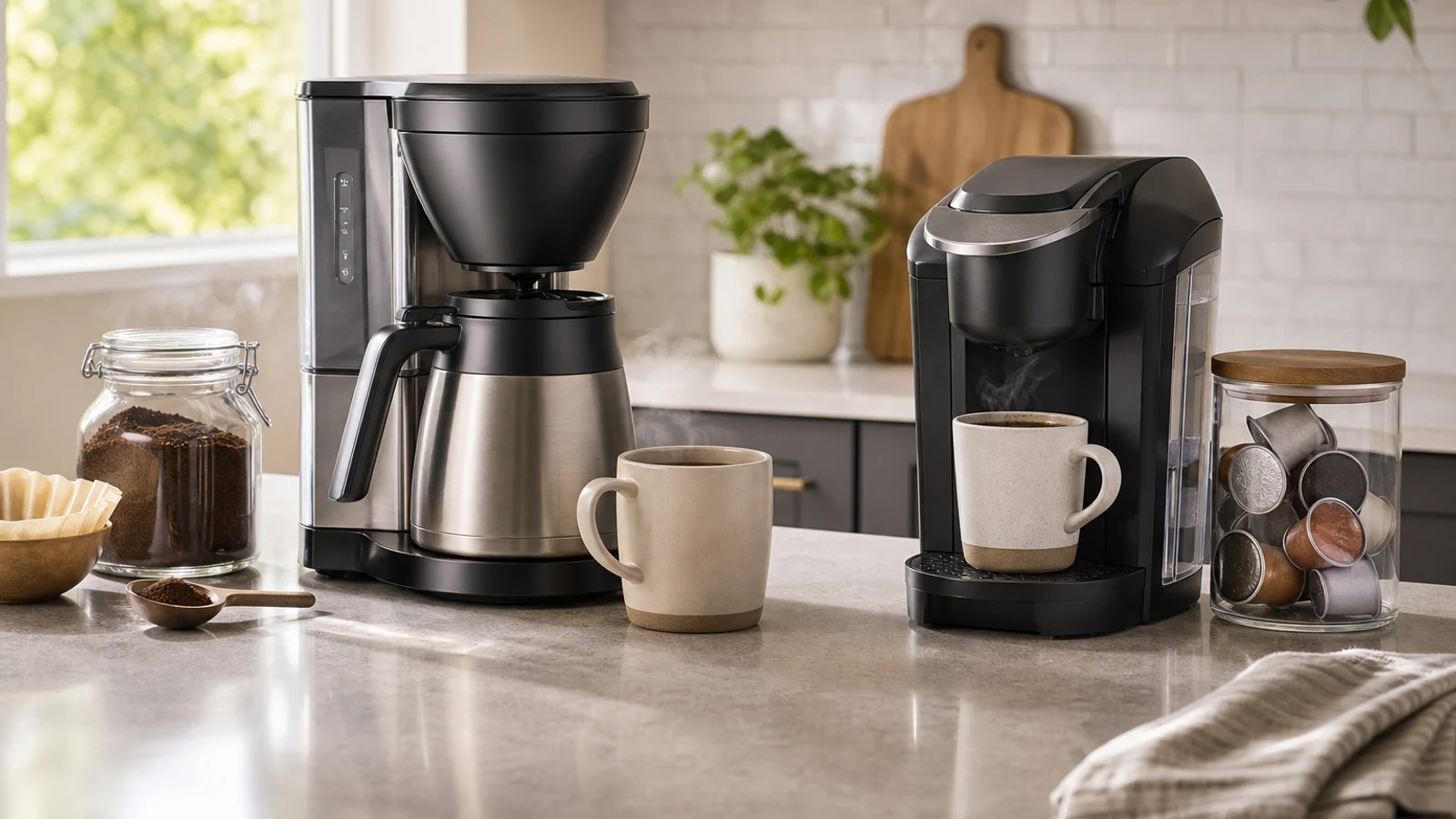
Drip Coffee Maker vs Single-Serve At A Glance
| Decision Point | Drip Coffee Maker | Single-Serve Coffee Maker |
|---|---|---|
| Best For | Two or more cups, shared households, and entertaining | One cup at a time, variable schedules, and fast routines |
| Coffee Format | Ground coffee, paper filters, or sometimes whole beans | Pods or capsules; some models also accept reusable grounds baskets |
| Cost Per Cup | Usually lower when using ground coffee or whole beans | Usually higher because each serving uses a pod or capsule |
| Speed | Often slower if brewing a full carafe | Fast for a single cup with little preparation |
| Cleanup | Filter basket, carafe, and leftover grounds require attention | Discard pod and rinse or empty the drip tray |
| Waste | Paper filters and unused coffee can create waste | Individual pods create more packaging, though reusable options reduce it |
| Coffee Quality | More control over coffee, grind, strength, and batch size | Consistent and convenient, but flavor depends heavily on the pod system |
| Counter Space | Often wider or taller, especially with a carafe | Compact options are available, but pod storage takes space |
The better coffee maker is the one that matches the way you actually drink coffee. A drip coffee maker is designed around a batch: add water and grounds, brew a pot, and serve several cups. A single-serve machine is designed around a moment: add water and one pod or capsule, press a button, and drink immediately.
That distinction affects nearly everything else, including flavor, cost, cleanup, storage, and waste. A household that makes a full pot every morning may find single-serve coffee unnecessarily expensive and packaging-heavy. Someone who drinks one cup before leaving for work may see a large drip machine as more work than it is worth.
The most useful question is not which machine makes the best coffee in the abstract. It is how many servings you need, how often you brew, whether everyone drinks the same coffee, and how much preparation you will tolerate before your first cup.
Choose A Drip Coffee Maker If You Brew More Than One Cup
Drip coffee makers make the most sense when coffee is a shared or scheduled part of the day. They can brew enough for several people at once, and many models let you program the machine for a morning start. A thermal carafe can keep coffee hot without relying on a hotplate, while a glass carafe and warming plate may be more convenient if you serve coffee soon after brewing.
The listed capacity can be misleading. Coffee makers often describe a cup as roughly 5 to 6 ounces rather than a full 8-ounce mug. A machine labeled for 10 or 12 cups may therefore produce fewer large travel mugs than expected. Before buying, convert the advertised capacity into the mug sizes your household uses.
Drip is also the more flexible format for coffee selection. You can use supermarket grounds, specialty coffee, a reusable filter, or a grinder if the machine supports whole beans. That makes it easier to adjust strength, roast, grind size, and freshness over time.
Choose Single-Serve If Convenience Is The Main Requirement
Single-serve machines are built for speed and portion control. You do not need to measure a batch of grounds or decide how much coffee to brew. Insert a pod, add the required water, and brew one cup. That workflow is useful for early mornings, home offices, occasional coffee drinkers, and households where people wake up at different times.
A compact model such as the Keurig K-Mini Coffee Maker can be appealing when counter depth or width is limited. Its small footprint and one-cup water approach fit a narrow kitchen area, dorm room, guest room, or office better than many full-size drip machines. The trade-off is that a small reservoir generally means refilling it for every drink rather than brewing several cups from one fill.
Single-serve also works well when preferences differ. One person can choose dark roast, another can choose decaf, and a guest can select a different flavor without leaving half a pot behind. That convenience becomes less compelling if everyone drinks the same coffee and several cups are needed at once.
Coffee Quality Depends On More Than The Machine Type
A good drip coffee maker gives you more control over the variables that shape flavor. You can choose the beans, grind them shortly before brewing, adjust the coffee-to-water ratio, and make a larger batch. If the machine brews at a suitable temperature and distributes water evenly, it can produce a balanced cup with more character than a basic pod.
Single-serve machines are more consistent in a different way. Each pod contains a premeasured amount of coffee, so there is less measuring and fewer opportunities to use the wrong ratio. That consistency is useful when convenience matters more than fine adjustment. However, the result is tied to the pod's coffee quality, freshness, roast, and serving size.
Do not assume that every drip machine automatically makes better coffee. A poorly designed model, stale grounds, incorrect measurements, or a carafe left on a hotplate for hours can produce disappointing results. Likewise, a single-serve brewer can be perfectly satisfying when paired with a pod you enjoy and used at a sensible cup size.
Compare The Ongoing Cost, Not Just The Purchase Price
The purchase price is only one part of the decision. Drip coffee usually has a lower ongoing cost because one bag of grounds or whole beans can produce many servings, and paper filters are relatively inexpensive. The exact difference depends on the coffee you buy, how much you use per cup, and whether you frequently discard coffee that was brewed but never consumed.
Single-serve coffee typically costs more per serving because each cup uses its own pod or capsule. The premium pays for portion control, speed, storage convenience, and reduced measuring. If you drink only one cup a day, the extra cost may be modest in practical terms. If several people drink multiple cups daily, the difference can become a more important part of the household budget.
A reusable grounds basket can lower the operating cost of some single-serve machines, but it changes the workflow. You must measure coffee, empty wet grounds, and clean the basket. That can make the machine more flexible, but it removes part of the hands-off convenience that attracted you to pods in the first place.
Think About Waste And Packaging Before Choosing Pods
Drip coffee creates waste through paper filters, used grounds, and coffee that goes stale in the carafe. The amount can be reduced by brewing only what you need, using a reusable filter where appropriate, or choosing a smaller machine. Batch brewing can be efficient when most of the pot is consumed, but wasteful when a large amount is routinely poured out.
Single-serve systems create a separate waste issue: one pod or capsule for each cup. Recycling rules vary by material, brand, and local program, and a pod that is technically recyclable may still require preparation or a specialized collection route. Emptying the grounds or separating materials can also add work that is easy to overlook when comparing machines.
If reducing packaging is a priority, a drip machine with measured batches is generally the simpler choice. A reusable pod can reduce single-use packaging, but it requires more handling and may not perform equally well across all brewers. The most sustainable option is often the one that helps you make only the amount of coffee you will actually drink.
Cleanup And Maintenance Are Different, Not Absent
Single-serve machines usually minimize the immediate mess. There is no carafe full of leftover coffee and no batch filter to remove after brewing. You still need to empty the drip tray, wipe the pod area, rinse removable parts, and descale the internal water path according to the manufacturer's instructions. A small water reservoir may also need frequent refilling.
Drip machines have more visible cleanup after brewing. The filter basket and used grounds must be removed, and the carafe needs regular washing. Models with thermal carafes, removable reservoirs, reusable filters, or dishwasher-safe parts can make that routine easier. If the machine has a hotplate, cleaning spills promptly matters because coffee residue can bake onto the surface.
Neither format should be treated as maintenance-free. Mineral buildup can affect flow, temperature, and taste in any coffee maker. Before choosing, check whether the water reservoir is easy to access, whether the carafe lid can be cleaned properly, and whether descaling instructions are clear.
Counter Space And Workflow Can Change The Answer
Measure the space before buying, including the height needed to open a lid or insert a pod. A drip machine may have a wider footprint because of its carafe and filter basket. A single-serve machine can be narrower, but the overall station may need room for pods, a mug, and possibly a separate storage container.
Also consider where water comes from. A machine with a large reservoir may reduce refills but require clearance to remove the tank. A compact brewer may fit better under cabinets but require filling before every cup. If the machine will live in a home office, bedroom, or guest room, noise, splashing, cord placement, and access to a sink may matter as much as brew speed.
Choose the workflow you are most likely to repeat on a tired morning: measuring grounds and brewing a batch, or adding water and inserting a pod. The theoretically better machine is not a good purchase if its daily process annoys you enough that you stop using it.
What Changes The Decision For Different Households
For One Coffee Drinker
A single-serve machine is often the easiest fit when you drink one cup at a time and do not want leftovers. A small drip brewer can be a better value if you prefer ground coffee, want to reduce packaging, or regularly drink two large mugs.
For Couples And Families With The Same Preference
- Choose drip if most people drink coffee at the same time.
- Choose single-serve if schedules rarely overlap.
- Consider a thermal carafe if coffee is consumed over several hours.
- Consider a dual-format machine only if both batch and individual brewing will be used regularly; extra flexibility can also mean more parts and a larger footprint. For Households With Different Preferences
- Single-serve is convenient when one person wants regular coffee, another wants decaf, and another wants a flavored option. Drip remains practical if differences can be handled with separate small batches or if most people prefer the same grounds. Buying a pod machine for occasional preference changes may not be worthwhile if the majority of cups are identical. For A Home Office Or Small Kitchen
- A compact single-serve model can simplify a one-cup routine and conserve counter space. A small drip brewer may be the better choice when you want lower per-cup costs during a workday. Include pod or coffee storage in your space calculation rather than comparing the machine footprint alone.
Features Worth Paying Attention To
For drip coffee makers, prioritize features that improve daily use rather than decorative controls. Useful considerations include a thermal carafe, programmable start, a small-batch setting, an easy-fill reservoir, clear capacity markings, a removable filter basket, and a design that can be cleaned without awkward crevices. A built-in grinder may add convenience, but it also adds noise, cleaning, and more parts to maintain.
For single-serve machines, check the compatible pod system before buying. A machine locked into one format may limit future coffee choices. Look for a removable drip tray, clear descaling instructions, accessible water filling, cup-height clearance, and a brew size that matches your mug. Some machines support reusable grounds baskets, but confirm that the basket is intended for that model rather than assuming universal compatibility.
Avoid choosing based only on the number of buttons or advertised drink sizes. More settings do not automatically mean better coffee, and a very large cup option can produce weak results if the same small amount of coffee is stretched with more water.
When You Should Not Upgrade Yet
You may not need a new machine if your current brewer still makes coffee at the temperature and strength you like, fits your routine, and can be cleaned safely. Replacing a working appliance solely for extra buttons may not improve the result. First try changing the coffee, grind, water, ratio, filter, or descaling routine.
A switch from drip to single-serve may also disappoint if your main complaint is flavor rather than convenience. Pods can simplify preparation, but they do not guarantee fresher or more complex coffee. Conversely, moving to drip may not solve a time problem if you rarely have the patience or need to brew a full pot.
If you want both individual cups and batch brewing, compare the actual frequency of each use. A dual-format machine can be worthwhile for a mixed household, but it may occupy more space and require more cleaning than either simple option.
Bottom Line
Choose a drip coffee maker when your routine is built around several cups, shared coffee, lower operating cost, and control over grounds. It is usually the more economical and less packaging-intensive format for regular household use, especially when most people drink the same coffee.
Choose a single-serve machine when your priority is making one cup quickly with minimal measuring and cleanup. It is especially useful for different schedules, different coffee preferences, occasional drinkers, and small spaces. Accept that pods generally cost more per cup and create more packaging unless you consistently use a reusable option.
If you are undecided, track your routine for one week: count how many cups are actually consumed, how often coffee is discarded, whether people drink at the same time, and how much cleanup bothers you. Those answers will usually make the better format clear before you compare specific models. For broader kitchen decisions, see the BuyingView guide to kitchen upgrades, and use a structured product-comparison process rather than relying on feature lists alone.
Go Deeper Before You Choose
For more context, see Kitchen Upgrades That Improve Daily Routines.
For more context, see How To Compare Amazon Products.
Relevant Product
One catalog product is directly relevant to this decision. It is shown as a reference point, not as a universal winner. Current price, seller and availability should always be confirmed on Amazon.

Research References
These sources informed the factual background for this guide. BuyingView applies its own editorial judgment to the purchase decision.
Questions & Answers
Useful follow-up questions that often change the buying decision.
Is drip coffee healthier than single-serve coffee?
Neither format is automatically healthier. The coffee itself, serving size, additives, and how much you drink matter more than whether it was brewed in a carafe or a pod machine. Paper-filtered drip coffee can reduce some coffee oils, while pod systems vary by machine, coffee, and filter design.
Is a single-serve coffee maker cheaper to use than a drip coffee maker?
Usually not on a per-cup basis. Ground coffee and whole beans generally cost less per serving than pods or capsules, although a single-serve machine can reduce waste when you would otherwise brew a full pot and discard most of it.
Can a single-serve machine use regular ground coffee?
Some models support a manufacturer-approved reusable grounds basket, but compatibility and brew quality vary. Check the specific machine instructions before buying accessories. Using grounds adds measuring and cleanup, so it may reduce some of the convenience advantage.
Does drip coffee taste better than pod coffee?
Drip often gives you more control over coffee freshness, grind, ratio, and batch size, so it can produce a more customized cup. Pod coffee can be consistent and satisfying, especially when speed and convenience are more important than fine control.
Which type is better for a small apartment?
A compact single-serve machine often takes less counter space and avoids a full carafe, but remember to account for pod storage. A small drip machine may be better if you want lower ongoing costs or plan to brew multiple cups.
Should I buy a thermal-carafe drip coffee maker?
It is worth considering if you drink coffee over several hours. A thermal carafe can keep coffee hot without continuously heating it on a hotplate. If you usually finish the pot soon after brewing, a simpler glass-carafe model may be sufficient.