What Size Air Purifier Do You Need? A Room-by-Room Buying Guide
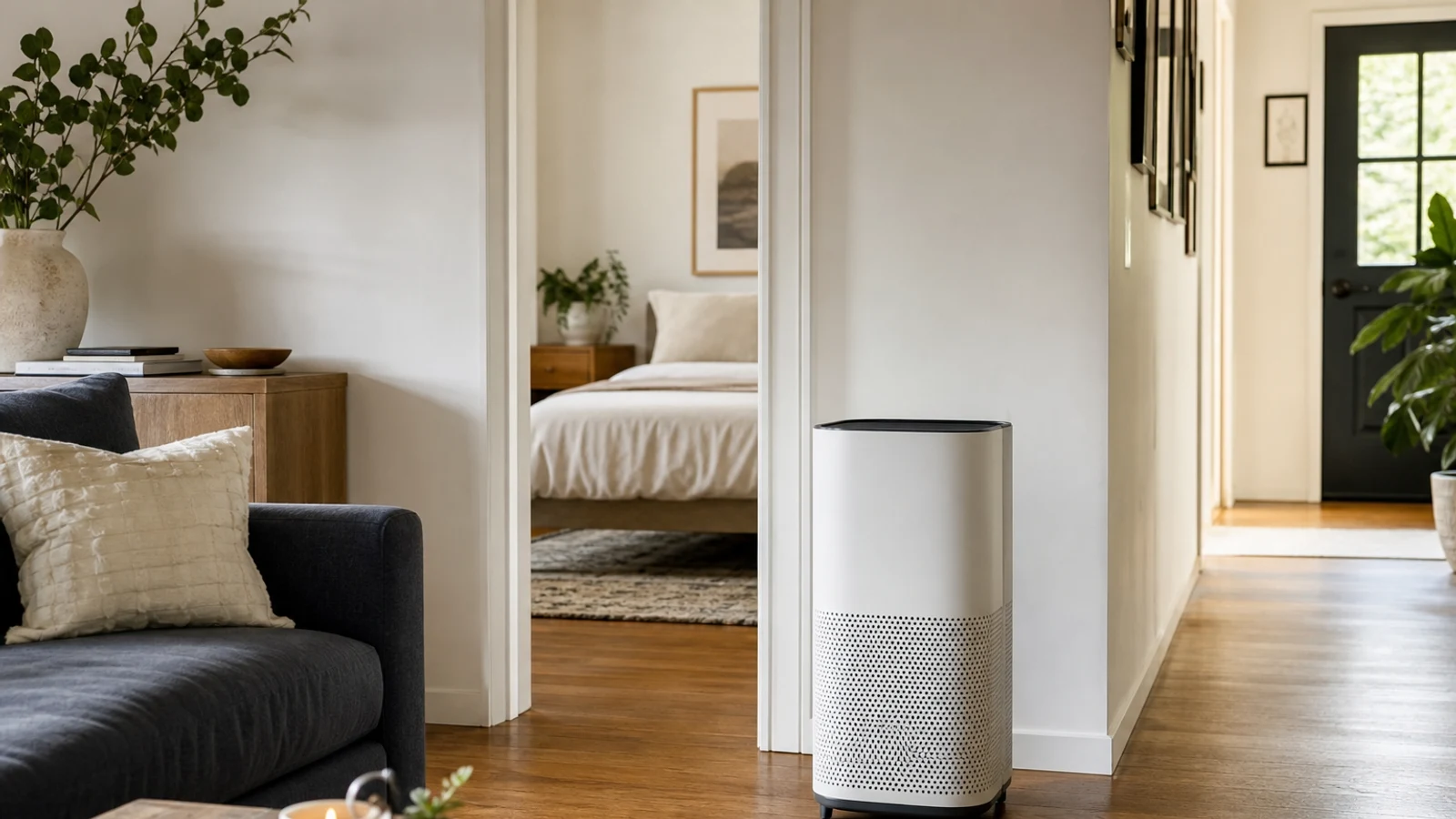
Air purifiers are easiest to size when you treat them like room appliances, not whole-home appliances. A unit advertised for “up to 1,000 square feet” may be using a low air-change target, while another model with a smaller-looking coverage number may move filtered air faster. The most useful performance figure is usually the smoke clean air delivery rate, or smoke CADR.
For most rooms, start with the area the purifier will actually serve. Measure the length and width, multiply those numbers, and compare the result with the purifier’s verified CADR or room-size information. If the room has an 8-foot ceiling and ordinary particle concerns such as dust or pollen, the AHAM sizing rule of thumb is a smoke CADR equal to at least two-thirds of the room’s square footage.
That is a minimum starting point, not a requirement to buy the smallest acceptable model. A larger purifier can clean the air faster, maintain the target air quality at a lower and quieter fan speed, or cope better with smoke, pets, cooking, and open doorways. The trade-off is usually a higher purchase price, a larger footprint, and potentially more expensive replacement filters.
The Basic Air-Purifier Sizing Rule
CADR measures how quickly an air cleaner delivers filtered air. Air purifiers may list separate CADR figures for smoke, dust, and pollen. Smoke CADR is generally the most useful number for fine particles because the test category represents smaller particles than the dust and pollen categories.
For a standard room with an 8-foot ceiling, use this quick calculation: room area in square feet multiplied by 0.67 equals a reasonable minimum smoke CADR target.
Examples
Quick Sizing Examples
- 100-square-foot bedroom: look for at least about 67 cfm smoke CADR.
- 150-square-foot bedroom or office: look for at least about 100 cfm smoke CADR.
- 200-square-foot bedroom or nursery: look for at least about 135 cfm smoke CADR; a higher figure may be preferable for quieter operation at night. • 300-square-foot living room: look for at least about 200 cfm smoke CADR. • 400-square-foot open living area: look for at least about 270 cfm smoke CADR. • 600-square-foot great room: look for at least about 400 cfm smoke CADR, or consider using two appropriately sized units. • Wildfire-smoke conditions: AHAM recommends targeting a smoke CADR approximately equal to the room’s square footage when practical.
Why The Box’s Room-Size Number Can Mislead
Manufacturers do not always use the same assumptions when they publish a maximum room size. One model may calculate its figure using a relatively low number of air changes per hour, while another may use a more demanding target. Some coverage claims may also be based on an ideal closed room rather than an open living area with doors, hallways, and air leakage.
Use the room-size claim as a screening tool, but favor a published smoke CADR when one is available. An AHAM Verifide listing can make comparisons easier because it uses a standardized performance approach and provides a suggested room size tied to the unit’s tested airflow.
If a purifier lists only an unusually large “maximum coverage” number and does not provide a clear CADR, treat the claim cautiously. It may still be useful, but you have less information for comparing it with another model.
Bedroom Size: Prioritize Quiet, Continuous Cleaning
Bedrooms are often smaller than living rooms, but they can benefit from a purifier that is somewhat oversized. A larger unit can run at a lower fan speed while still moving enough air, which may be more comfortable during sleep than a small purifier running near its maximum setting.
For a typical 100- to 200-square-foot bedroom, begin with the CADR calculation and then consider whether the door stays closed. If the door is usually open to a hallway, the purifier will not behave as if it is serving a sealed room. Choose the next size up if you want it to influence adjacent space or if the room has pets, heavy carpeting, or persistent outdoor-pollen exposure.
Look for: • A sleep mode that does not disable meaningful filtration. • A low-speed noise rating you can tolerate, rather than only the quietest advertised figure. • A dimmable display or the ability to turn lights off. • A filter indicator based on usage or airflow, with replacement filters that are easy to find. • A stable design that cannot be easily tipped by children or pets.
Home Office, Nursery, Or Small Study
A small office or nursery may not need a large tower purifier, but location matters. A purifier tucked under a desk, behind a chair, or against a curtain may have restricted intake or exhaust airflow. Choose a size that fits the room without forcing the appliance into an obstructed corner.
For a 100- to 150-square-foot room, a compact unit can be sufficient when its smoke CADR meets the room’s needs. A slightly larger model may make more sense if you want lower fan speeds during calls, reading, or sleep.
Keep expectations realistic. An air purifier can reduce airborne particles, but it does not replace ventilation, source control, moisture management, or cleaning. It will not remove carbon dioxide buildup in a closed office, and it is not a substitute for fixing a leak, controlling mold growth, or eliminating a strong pollutant source.
Living Rooms And Family Rooms
Living rooms are often the best place to spend more on capacity because they are larger, busier, and connected to other parts of the home. People, pets, upholstery, cooking, fireplaces, and open doors can all increase the particle load.
Measure the full area that the purifier is expected to serve. If the living room opens directly into a dining room or kitchen without a substantial doorway, sizing only the seating area will probably understate the workload. You can either select one larger purifier for the combined area or use multiple units positioned in the areas where people spend the most time.
A single large unit is usually simpler to manage and may use fewer filters, while two smaller units can provide better distribution around corners and separate rooms. Two purifiers also offer redundancy if one is turned off or needs a filter change.
Open Floor Plans And Great Rooms
Open layouts are where room-size labels become least reliable. Air mixes across the space, but not perfectly; walls, furniture, ceiling fans, staircases, and temperature differences create pockets where particles may remain.
For a connected area, add the square footage of the spaces you want to cover. Then compare the combined area with the total smoke CADR of one or more units. If the result requires a very large purifier, two units may be more practical than one oversized model.
Place units so that they have several inches of clearance around intake and exhaust openings. Avoid hiding a purifier behind a sofa or placing it directly beside a wall unless the manufacturer permits that arrangement. In a long room, positioning one unit near each end can distribute airflow more evenly than placing a single unit in the middle.
High Ceilings Change The Calculation
Most room-size calculations assume an 8-foot ceiling. A room with a 10- or 12-foot ceiling contains substantially more air than the same room with an 8-foot ceiling, so a purifier selected only by floor area may clean it more slowly.
A practical adjustment is to multiply the room’s floor area by the ceiling height divided by eight, then apply the two-thirds CADR rule to that adjusted area. For example, a 200-square-foot room with a 10-foot ceiling has an adjusted area of 250 square feet. Two-thirds of that is about 167 cfm smoke CADR.
This is an estimate, not a laboratory requirement. If the room has unusually high ceilings, a lofted section, or a large open stairwell, favor a larger model or multiple units.
Wildfire Smoke, Heavy Pollution, And Fine Particles
If your main concern is wildfire smoke or another high-particle event, ordinary minimum sizing may leave too little capacity. A purifier that is adequate for occasional dust may need to run at maximum speed during smoke conditions, and a small unit may struggle to keep up.
For smoke-heavy conditions, target a smoke CADR roughly equal to the room’s square footage when possible. In a 300-square-foot room, that means looking for about 300 cfm smoke CADR. If you cannot achieve that with one portable unit, use multiple units and add their CADRs together as an approximation.
During a smoke event, keep windows and exterior doors closed when outdoor air quality is poor, and operate the purifier continuously at a speed that balances air cleaning with noise. A purifier cannot compensate for a major source of outside air entering through an open window or poorly sealed door.
Kitchens, Pets, And Odors Need More Than Room Size
Room size primarily helps you estimate particle-cleaning capacity. It does not tell you how well a purifier will handle gases and odors. Cooking smells, pet odors, cleaning products, and volatile organic compounds may require an activated-carbon stage in addition to a particle filter.
Carbon performance varies widely. A thin carbon-coated filter may help with occasional odors, but it usually has less adsorption capacity than a filter containing a substantial amount of carbon. Manufacturers may not provide a standardized odor-removal rating, so consider the filter design, replacement cost, and the specific pollutants you are trying to address.
For pet homes, size the purifier for the room and look for a washable or replaceable pre-filter that can catch hair and larger dust before it loads the main filter. An air purifier will not replace vacuuming, grooming, litter-box management, or source control. For kitchen smoke, use the range hood or exhaust fan at the source whenever possible.
One Large Purifier Or Several Smaller Ones?
One larger purifier is often the simplest option for a single room. It generally means one control interface, one filter to replace, and fewer decisions about placement. It can also be more efficient if its larger filter and fan move the required amount of air at a moderate speed.
Several smaller units may be better when: • The home has separate bedrooms and living areas. • Doors are usually closed. • The floor plan is long, divided, or obstructed. • You want filtration on two floors. • You prefer to move a lighter unit between rooms. • You want continued coverage if one device is unplugged or being serviced.
Do not assume a purifier rated for a large open room will clean every closed bedroom equally well. Airflow between rooms is limited. If your priority is sleeping-area filtration, placing an appropriately sized purifier in the bedroom is usually more direct than relying on a distant living-room unit.
Filter Type, Maintenance, And Running Cost
A properly sized purifier still underperforms if its filter is overloaded. EPA guidance emphasizes regular filter replacement because a dirty filter can reduce performance. Check the replacement schedule, filter price, availability, and whether the pre-filter can be cleaned without damaging the main filter.
HEPA-style or high-efficiency particle filters are commonly used for dust, pollen, smoke particles, and other airborne particles. Activated carbon is the relevant addition for some gases and odors, but it is not a universal solution for every chemical pollutant. Our guide to HEPA versus HEPA-and-carbon air purifiers can help clarify that trade-off.
Running cost depends on fan speed, operating hours, electricity rates, and filter replacement frequency. ENERGY STAR-certified room air cleaners are designed to use less energy than standard models, but energy efficiency should not outweigh inadequate CADR. A very efficient purifier that is too small may need to run at high speed more often.
Safety Checks Before You Buy
Avoid ozone generators marketed as air cleaners. Ozone is a lung irritant, and California requires covered portable air-cleaning devices sold in the state to meet an ozone-emissions standard. CARB certification is a useful low-ozone safety check, especially for electronic or ionizing models, although it does not tell you whether a purifier is powerful enough for your room.
If a purifier includes an ionizer, plasma, or electronic cleaning feature, check whether that feature can be turned off. For straightforward particle filtration, a mechanical filter with a clearly stated CADR is often the easier option to evaluate.
Also check the electrical and placement instructions. Keep the unit away from water, do not block vents, and avoid running it where cords create a trip hazard. If you have asthma, chemical sensitivities, or another health concern, ask a qualified clinician or indoor-air professional about your specific situation rather than relying on marketing claims.
Go Deeper Before You Choose
For more context, see HEPA Versus HEPA-and-Carbon Air Purifiers.
For more context, see Dehumidifier Compressor Versus Desiccant.
Research References
These sources informed the factual background for this guide. BuyingView applies its own editorial judgment to the purchase decision.
Questions & Answers
Useful follow-up questions that often change the buying decision.
Is a bigger air purifier always better?
Not always, but extra capacity is usually useful when it lets the purifier clean the room at a lower, quieter speed. A much larger unit may cost more, occupy more floor space, and use larger or more expensive filters. Choose extra capacity when the room has high ceilings, open doorways, pets, cooking, or wildfire-smoke concerns.
Can I use one air purifier for the whole house?
Usually not with the same effectiveness as room-by-room placement. Portable purifiers work best in the room or connected area where they are operating. A large unit may influence adjacent spaces when doors are open, but closed bedrooms, separate floors, and divided layouts generally need their own appropriately sized units.
Should I size an air purifier by square feet or CADR?
Use both, but give more weight to CADR when it is available and independently verified. Square-foot coverage claims may use different assumptions, while smoke CADR provides a more useful performance comparison. For an 8-foot ceiling, a smoke CADR of at least two-thirds of the room’s square footage is a practical starting point.
What size air purifier do I need for a 200-square-foot room?
For an 8-foot ceiling and ordinary particle concerns, start with at least about 135 cfm smoke CADR. Consider a larger model if the room has a high ceiling, an open doorway, pets, heavy pollen, cooking exposure, or wildfire smoke concerns.
Does a purifier remove odors?
It may reduce some odors if it includes a meaningful activated-carbon filter, but carbon capacity varies considerably. Particle filters are primarily for airborne particles, not gases. Source control and ventilation remain important for cooking smells, smoke, cleaning chemicals, and pet odors.
How many air purifiers do I need for an open floor plan?
Add the square footage of the connected area you want to cover, then compare it with the combined smoke CADR of one or more units. Two units can distribute airflow more evenly around corners and furniture, while one larger unit may be simpler to maintain.