Air Fryer Features That Actually Matter Before You Buy
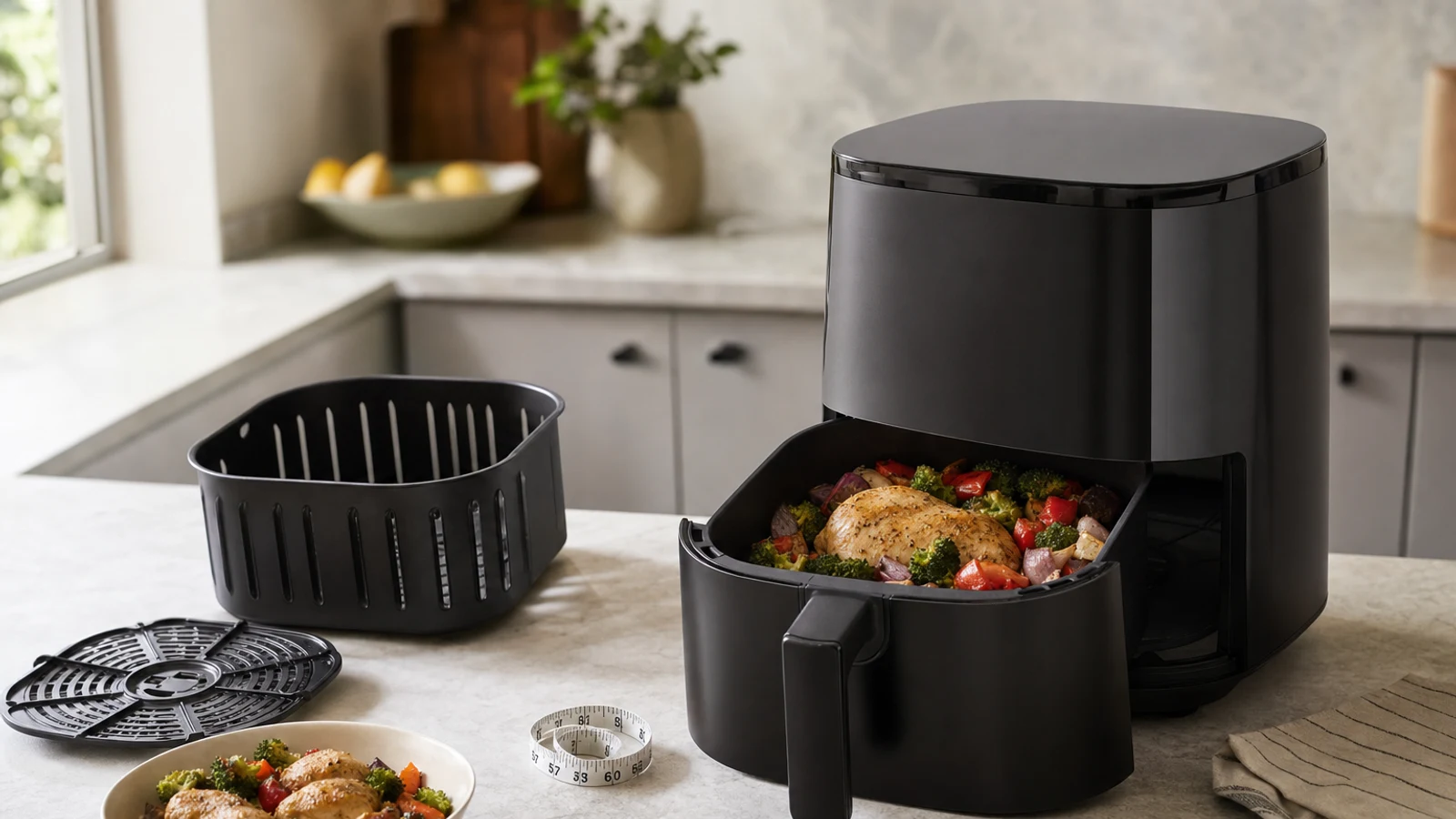
Air fryers have become more capable, but their feature lists have also become harder to compare. One model may advertise a dozen cooking programs, another may emphasize a large quart rating, and a third may promise smart controls or unusually high heat. Those specifications can matter, but they do not all matter equally.
The best purchase is usually the one that makes your actual cooking easier: it fits the food you prepare, gives that food enough room to brown, cleans without a fight, and can live on your counter without becoming an obstacle. A smaller, simpler basket fryer may be a better choice for one or two people than a large multifunction oven. A family that cooks two foods at different temperatures may benefit more from dual baskets than from a rotisserie kit.
This guide focuses on the features that change day-to-day use, the trade-offs behind them, and the situations where paying more—or not buying at all—makes sense.
Start With Usable Cooking Space, Not The Quart Number
Capacity is one of the easiest specifications to misunderstand. A stated quart rating describes the overall basket volume, but food generally cooks best when it is spread in a relatively even layer rather than piled to the top. A broad basket with useful surface area can therefore be more practical than a taller basket with a larger headline capacity.
Think about the foods you make most often. Frozen fries, vegetables, wings, fish fillets, and breaded foods usually benefit from room around each piece so hot air can circulate. If the basket forces you to stack everything, you may need multiple batches even when the published capacity sounds generous.
Use these questions before comparing models: • Do you normally cook for one or two people, a family, or guests? • Do you want one batch of a main dish, or are you comfortable cooking in rounds? • Will the basket fit the shapes you use most, such as several chicken breasts or a layer of vegetables? • Can you lift and wash the basket comfortably? Ask the manufacturer for interior dimensions when available, not just total quarts.
Choose The Basket Style That Matches Your Workflow
A single-basket model is usually the simplest choice. It takes less space, has one set of controls, and works well when you cook one food at a time or do not mind coordinating side dishes separately. For many households, simplicity is a feature because there are fewer parts, fewer settings, and less counter space to sacrifice.
Dual-basket models are useful when you regularly cook two foods at different temperatures or cooking times. Some can synchronize the finish time, which is more meaningful than merely having two compartments. The trade-off is a wider footprint, more surfaces to clean, and potentially less usable space in each individual basket.
Air-fryer ovens and toaster-oven-style models can handle flatter foods, racks, toast, baking pans, or larger portions. They are more versatile, but they usually occupy more vertical or horizontal space and may require more cleaning. They also may not crisp small portions as quickly as a compact basket design. Consider this style if you want to replace or supplement another countertop oven, not simply because it has the longest feature list.
Look For Strong Airflow And Useful Heating Capacity
Air frying depends on hot air moving efficiently around the food. Heating-element power and fan design both influence how well a machine recovers heat and dries the surface of food, but wattage alone does not tell you how evenly a particular model cooks. A larger number can also mean higher electrical demand and a circuit that is already heavily loaded by other kitchen appliances.
When comparing specifications, treat wattage as a supporting clue rather than a guarantee. Look for a sensible combination of power, basket dimensions, airflow design, and manufacturer instructions. Independent testing also commonly evaluates cooking speed, evenness, noise, and usable capacity because these factors reveal more than a single wattage figure.
A wide temperature range is helpful if you want to dehydrate, gently reheat, bake, or cook foods that need lower heat. For ordinary air-frying, the top temperature matters less than whether the machine can maintain heat and circulate air effectively. Do not pay extra for an extreme maximum temperature unless you have a specific recipe or cooking method that needs it.
Make Cleaning A Buying Requirement
The feature most likely to determine whether an air fryer remains in regular use is cleanup. Look for a removable basket and crisper plate with surfaces that are easy to reach, few grease-trapping seams, and clear manufacturer instructions for dishwasher use. Dishwasher-safe does not mean every part of the appliance can go in the dishwasher, so confirm which components qualify.
A nonstick coating can make release and washing easier, but it still benefits from nonabrasive utensils and careful cleaning. A perforated crisper plate may improve airflow, yet its holes can collect residue. A design with a removable plate is usually easier to maintain than one with a fixed, difficult-to-access surface.
Consider the whole routine rather than just the basket. • Can you remove the basket without touching a hot exterior? • Is the tray easy to lift out when grease has accumulated underneath? • Are the heating area and interior reachable for wiping? • Does the appliance have a strong odor after cooking fatty foods? • Will the parts fit your dishwasher without blocking other dishes? If the answer to several of these is no, a cheaper model with simpler construction may be the better long-term purchase.
Controls Should Reduce Decisions, Not Add Them
Clear manual controls for temperature and time are more important than a long menu of presets. You should be able to adjust both settings quickly, pause the cycle, and understand what the display is showing from your normal cooking position. Physical dials can be fast and durable; digital controls can offer more precise adjustments and reminders. The right choice depends on which interface you find easiest to use.
Presets are convenient for repeat foods, but they are not a substitute for learning how your particular machine cooks. A shake reminder can be genuinely useful for fries or vegetables. A preheat option can help when a recipe depends on a hot cooking surface, although some foods can start in a cold basket with a small time adjustment. A keep-warm function is helpful only if you frequently need to hold food before serving.
A viewing window and interior light can reduce the need to pull out the basket, but they add surfaces that may become greasy or harder to keep clear. Smart or app controls can be useful for notifications and recipe guidance, yet they rarely replace the basic need to be present when food needs shaking, turning, or checking. Buy connected features for a real workflow benefit, not because the appliance appears more advanced.
Check Counter Space, Ventilation, And Storage
An air fryer needs more than a footprint measurement. Measure the space where it will operate, including clearance above and around the vents specified in the manual. Steam and hot air need somewhere to go, and pushing the appliance tightly against a wall or beneath a cabinet can make everyday use impractical or unsafe.
Also measure the path from storage to counter. A large appliance that must be moved each time may be used less often than a smaller model that can stay ready. Door swing, basket clearance, cord length, and the location of your nearest outlet all affect convenience.
Before buying, confirm: • Width, depth, and height with the basket fully extended • Required clearance around vents • Whether the lid of an overhead cabinet can open safely above it • Storage space for racks, dividers, skewers, or trays • Whether the electrical outlet and circuit are suitable for the appliance's power demand.
Separate Useful Features From Marketing
Some features are genuinely useful but highly personal. Dehydration, baking, broiling, rotisserie accessories, and multiple racks can replace separate appliances for some cooks. For others, they add parts that occupy cabinet space and increase cleanup without changing the foods they prepare.
A ceramic or other nonstick surface may be attractive if easy release and cleanup are priorities, but the coating type is only one part of the design. Check the care instructions, replacement-part availability, warranty, and whether the manufacturer clearly identifies the materials used. Avoid treating labels such as “healthy,” “professional,” or “turbo” as performance measurements.
The same caution applies to very large capacities. Bigger can reduce batch cooking for a family, but a larger cavity may take more counter space, and an oversized basket is not automatically better for small meals. For many users, the best value comes from paying for the right dimensions, dependable controls, and easier cleaning rather than every available cooking mode.
When To Buy, And When Not To Upgrade
Buy an air fryer when you have a clear recurring use: reheating crisp foods, cooking frozen items quickly, preparing vegetables or proteins in smaller portions, or avoiding the need to heat a full-size oven. The appliance is especially practical when speed and portion size match your routine.
You may not need one if your kitchen is already crowded, you rarely cook foods that benefit from circulating heat, or you already have a convection oven that handles your portions efficiently. An air fryer can shorten cooking for small batches, but it is not automatically more convenient when you must clean and store another appliance.
If you already own one, consider upgrading only when a specific limitation affects you repeatedly: too little usable surface, excessive batch cooking, difficult cleanup, inadequate controls, or a basket style that does not fit your meals. More presets, app connectivity, or a larger advertised quart number alone may not improve your results.
A Practical Pre-Purchase Checklist
Before selecting a model, write down the foods and quantities you actually make. Then compare models in this order:
- Usable cooking surface and basket shape
- Single basket, dual basket, or oven-style layout for your workflow
- Countertop footprint, basket clearance, and ventilation requirements
- Removable, easy-to-clean parts and confirmed dishwasher guidance
- Clear temperature and time controls
- Heating capacity, airflow design, and a useful temperature range
- Noise, visibility, reminders, and smart features only if they solve a real problem
- Warranty, replacement parts, and care instructions
- Whether the appliance duplicates equipment you already own If the model passes those checks, the remaining choices—color, presets, windows, and accessory bundles—can be judged according to preference and budget.
Bottom Line
The air fryer features that matter most are the ones you will notice every time you cook: enough usable room for a good layer of food, effective heating and airflow, straightforward controls, easy cleanup, and a size that works in your kitchen. Basket style should follow your workflow, not a trend. Dual baskets are valuable for coordinated meals; oven-style models make sense when versatility and flat cooking space matter; simple single-basket units remain practical for many people.
Do not let presets, app control, or a large quart rating distract from dimensions and maintenance. If you match the appliance to your portions, counter space, and cleaning habits, you are more likely to get an air fryer that earns a permanent place in the kitchen.
Go Deeper Before You Choose
For more context, see Compare Air Fryers With Toaster Ovens.
For more context, see Choose The Right Air Fryer Size.
For more context, see Compare Air Fryers With Convection Ovens.
Relevant Product
One catalog product is directly relevant to this decision. It is shown as a reference point, not as a universal winner. Current price, seller and availability should always be confirmed on Amazon.

Research References
These sources informed the factual background for this guide. BuyingView applies its own editorial judgment to the purchase decision.
Questions & Answers
Useful follow-up questions that often change the buying decision.
What is the most important air fryer feature?
For most buyers, it is usable cooking space. A basket should provide enough surface area for the food you normally cook without excessive stacking or repeated batches. After that, prioritize easy cleanup, clear controls, and a footprint that fits your kitchen.
Are air fryer presets worth paying more for?
Presets can make common foods easier to start, and shake or finish-time reminders may be useful. They are not essential, however. Manual temperature and time controls are usually more important because cooking times vary by food quantity, starting temperature, and basket design.
Is a dual-basket air fryer better than a single-basket model?
Neither is universally better. Dual baskets suit households that often cook two foods separately or want different settings with the same finish time. A single basket is usually smaller, simpler, and easier to clean, making it a better fit for smaller kitchens or one-food cooking.
Does higher wattage mean a better air fryer?
Not by itself. Higher power can help an appliance recover heat, but performance also depends on basket size, airflow, heating-element placement, and control quality. Treat wattage as one specification among several rather than a guarantee of faster or more even cooking.
Should I upgrade my current air fryer?
Upgrade when a recurring limitation affects how you use it, such as insufficient usable space, difficult cleaning, poor controls, or a basket style that does not fit your meals. If your current model cooks enough food and is easy to maintain, extra presets or app features may not justify replacing it.
What should I check besides the air fryer's dimensions?
Check the space needed when the basket is fully extended, the clearance required around vents, overhead cabinet access, cord placement, storage for accessories, and whether the appliance can operate on an appropriate outlet and circuit. These details often determine whether the fryer is convenient to use.