Upright Vs Canister Vacuum: Which One Cleans Your Home Better?
Upright Vs Canister Vacuum At A Glance
| Decision Point | Upright Vacuum | Canister Vacuum |
|---|---|---|
| Best For | Wall-to-wall carpet, open rooms, and simple floor cleaning | Hard floors, stairs, furniture, edges, and mixed surfaces |
| Carpet Cleaning | Often strong because the powered cleaning head stays aligned with the main body | Can be excellent when equipped with an electrically powered carpet head |
| Hard-Floor Care | Works well with height adjustment, brush-roll shutoff, or a dedicated setting | Often easier to pair with a suction-only or soft-floor brush |
| Maneuverability | Easy to push in straight lines but can feel bulky around furniture | Light wand and head are easy to steer, although the canister follows behind |
| Stairs And Above-Floor Cleaning | Usually requires carrying or using a hose and attachments | Typically more convenient because the hose and wand reach without lifting the body |
| Storage | Compact vertical footprint and often simpler to park | Separate body, hose, wand, and attachments need more organized storage |
| Typical Workflow | Grab it, plug it in, and cover large areas efficiently | Switch tools more often, but reach more surfaces with one machine |
The upright-versus-canister decision is not really a contest between “powerful” and “weak.” Both formats can clean effectively when the floor head matches the surface, the brush roll is used correctly, and filters and bags or dust cups are maintained. The more useful question is which design makes your most common cleaning jobs easier to complete thoroughly.
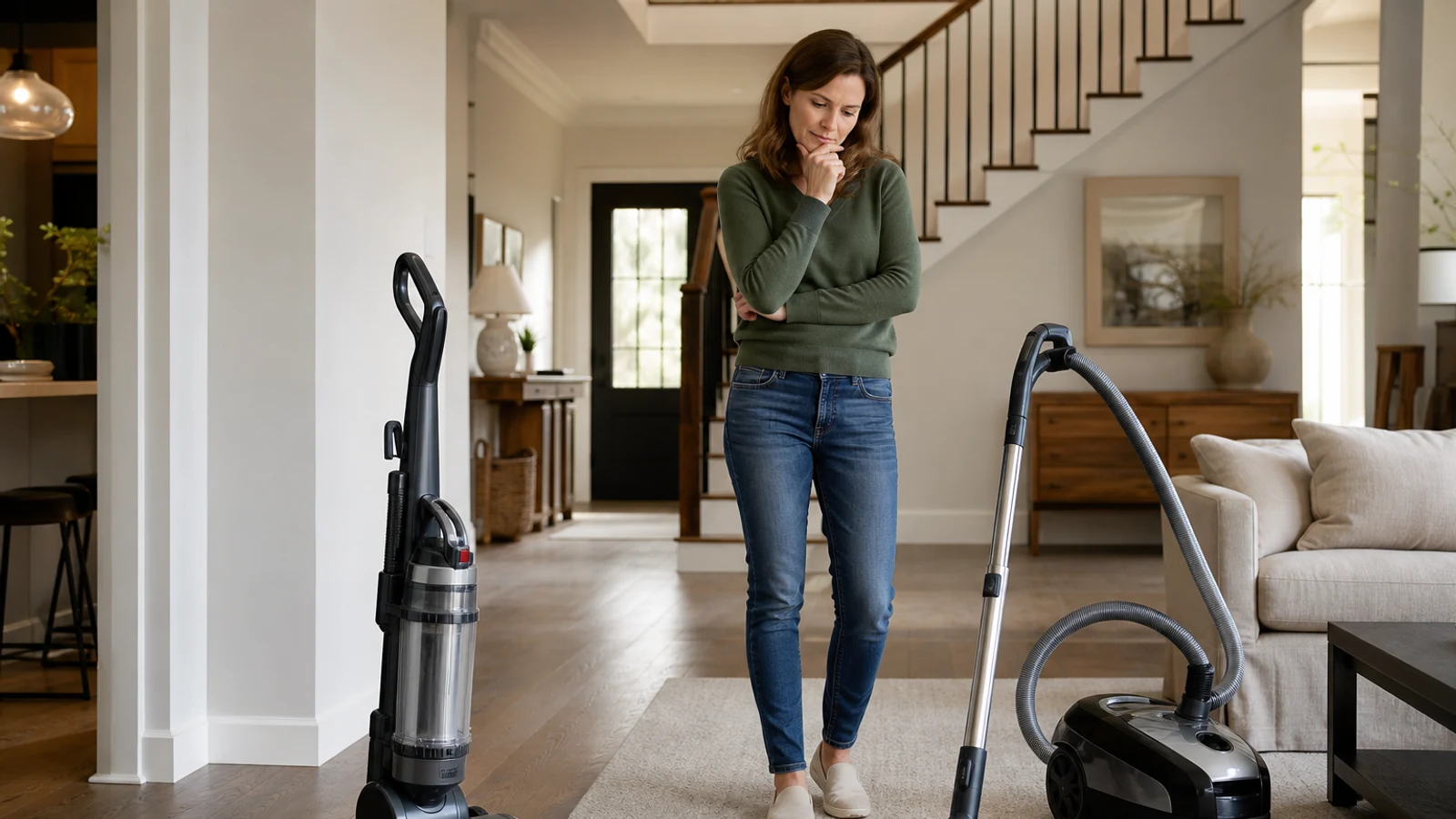
An upright keeps the motor, dirt container, handle, and cleaning head together in one tall machine. You push the complete unit across the floor. A canister separates the motor and dirt container from the floor head, connecting them with a hose and wand. You move the smaller head across the floor while the canister rolls behind you.
That difference changes the experience more than marketing claims about suction. An upright tends to feel efficient and stable on broad carpeted areas. A canister tends to feel more flexible when you need to move around furniture, clean stairs, reach under beds, or switch between floor and above-floor surfaces.
Choose An Upright If Carpet Is The Main Job
Uprights are usually the simpler choice for homes with substantial wall-to-wall carpet. Their cleaning head is integrated into the body, so the machine is naturally set up for repeated forward-and-back passes across large areas. Many models also use a motorized brush roll designed to agitate carpet fibers and lift embedded debris.
That does not mean every upright is automatically better on carpet. A basic upright with poor height adjustment, an ineffective brush roll, or inadequate edge cleaning may underperform a well-equipped canister. Look for a powered carpet head, height adjustment or automatic height sensing, brush-roll control, and a design that does not become difficult to push on thicker carpet.
An upright can also be a practical choice for pet owners because the format is often efficient for covering large shedding zones. The important feature is not the upright label itself but a brush roll that can pick up hair, a way to clear tangles, and a sealed filtration system that limits dust escaping through the exhaust.
Choose A Canister If Flexibility Matters More Than Simplicity
Canisters earn their reputation for versatility because the wand and hose let you position the cleaning head independently of the motor and dirt container. You can guide a relatively light floor tool under furniture, around chair legs, along baseboards, and across awkward spaces while the canister remains nearby.
This design is particularly useful in homes with mostly hard flooring, area rugs, stairs, curtains, upholstery, shelves, and other surfaces that require attachments. A canister with a suction-only floor brush is often a natural fit for delicate hard floors, while a model with an electrically powered carpet head can handle more demanding rugs and carpets.
The trade-off is workflow. You have to pull the canister behind you, manage the hose, and store more separate pieces. On a crowded floor, the body can bump into furniture or catch on corners. If you dislike managing a trailing machine, the canister’s flexibility may not compensate for the extra handling.
Flooring Should Decide The Floor Head
The head attached to the vacuum often matters more than whether the vacuum is upright or canister. Hard floors, low-pile rugs, thick carpet, delicate rugs, and high-pile carpet do not all benefit from the same brush action.
For carpet, prioritize a powered brush roll that can agitate fibers. For smooth or delicate flooring, look for brush-roll shutoff, adjustable suction, or a dedicated soft-bristle floor tool. A rotating brush can scatter debris on some hard floors and may be inappropriate for delicate rugs if it cannot be turned off.
If your home has mixed flooring, avoid assuming that a “multi-surface” label tells the whole story. Check whether the machine changes height, whether the brush roll can be stopped, whether the included head is motorized or air-driven, and whether the manufacturer provides clear instructions for rugs and hard surfaces. A canister marketed for hard floors may need an optional powered head for serious carpet cleaning; an upright may need a dedicated attachment for delicate flooring.
Think Through Stairs, Furniture, And Above-Floor Cleaning
Stairs are one of the clearest differences between the formats. A canister lets you carry or position the body on a landing while using a long hose and wand to clean each step. With an upright, you may need to lift the machine repeatedly, balance it on the stairs, or rely on a shorter hose and handheld attachment.
For furniture and tight spaces, canisters generally offer a more natural reach. The wand can extend beneath beds and sofas without requiring you to push the full vacuum body under them. An upright can still perform these jobs well if it has a detachable hose, long reach, and useful tools, but the attachments may feel like an add-on rather than the primary workflow.
Choose a canister if your routine includes several of these tasks: • Carpeted or open-riser stairs • Low furniture that is difficult to reach beneath • Upholstery, mattresses, curtains, or blinds • Detailed cleaning along trim and corners • Frequent transitions between floor cleaning and above-floor surfaces
Maneuverability Is Personal, Not Absolute
People often describe canisters as more maneuverable, but that depends on the room and the user. The wand and floor head are usually easy to steer, and the separated body reduces the weight in your hand. However, the canister itself must follow behind, and its hose can snag around table legs or doorways.
Uprights are often easier to understand: lean the handle, push forward, pull back, and turn the whole machine. They can cover open rooms quickly and may stand upright for a quick pause. Their weakness appears in cluttered rooms, narrow gaps, stairs, and areas where the full body cannot easily turn.
Consider your actual floor plan rather than a showroom. An upright may be the more maneuverable option in a large, mostly open carpeted basement. A canister may be easier in a smaller home with hard floors, dining chairs, stairs, and furniture placed close together.
Storage, Noise, And Maintenance Can Change The Answer
Uprights usually win on storage convenience because they occupy a tall, narrow footprint and can often park in a closet. Their attachments still need a home, but the main machine is one connected unit. Canisters typically need space for the body, hose, wand, floor head, and accessory tools, either assembled or separated.
Noise varies more by model, motor design, airflow, and insulation than by format. Do not assume that every canister is quieter or every upright is louder. If noise matters, look for a published sound level when available, read independent evaluations, and pay attention to whether the machine becomes louder as filters clog or bags fill.
Maintenance is similarly model-specific. Bagged machines contain debris neatly and may be preferable for people who want less contact with dust, but they require replacement bags. Bagless models avoid bags but require regular dust-cup emptying and filter cleaning. Either format can lose performance when the brush roll, hose, filter, or airflow path is blocked. A vacuum that is easy to maintain is more likely to keep cleaning well over time.
Filtration Matters More Than The Body Style
If dust, pet dander, or allergies are a concern, compare the vacuum’s filtration system and overall sealing rather than choosing upright or canister by default. A HEPA filter can help reduce the amount of vacuumed dust that escapes back into the room, but the filter is only part of the system. Air can also leak around seals, bags, dust cups, or poorly fitted components.
Look for clear manufacturer information about the filter type, replacement schedule, and whether the vacuum is designed as a sealed system. Follow the maintenance instructions; a neglected filter can restrict airflow and reduce performance. People who are especially sensitive to dust may also prefer a bagged design because emptying a full dust cup can release a visible cloud of debris.
Vacuuming itself can stir settled dust into the air. If someone in the household has asthma or strong allergies, schedule cleaning when that person is away from the room when possible, and do not treat a vacuum’s filtration claim as a substitute for addressing moisture, mold, or other indoor-air problems.
Pet Hair Requires The Right Tools
Pet owners should start with the type of hair and where it collects. Long hair wrapped around a brush roll creates a maintenance problem; fine fur pressed into carpet requires agitation; hair on sofas and stairs calls for a compact powered or turbine tool.
An upright can be efficient when most pet hair is on broad carpeted floors. A canister can be more convenient when hair is spread across hard floors, furniture, stairs, and narrow spaces. Either can work well if it includes a suitable powered floor head and a smaller pet-hair tool.
Before buying, verify: • Whether the main brush roll is motorized • Whether brush-roll access is tool-free or easy to open • Whether the brush roll can be shut off for hard floors • Whether a mini motorized or turbo tool is included • Whether bags, filters, and replacement parts are readily available
When Neither Format Is The Right Upgrade
A new upright or canister may not solve the real problem if your current vacuum mainly needs a clean filter, an unclogged hose, a replacement belt, or a new brush roll. Check maintenance items before replacing a machine that still has a suitable floor head and intact seals.
You may also be better served by a second, lighter vacuum if the existing machine is good for deep cleaning but inconvenient for quick daily messes. A cordless stick vacuum can fill that role, while a corded upright or canister remains the better tool for longer, deeper sessions. That is a workflow decision, not proof that one category has made the other obsolete.
Do not upgrade solely because a new model advertises higher suction. Cleaning results depend on airflow, head design, brush action, contact with the surface, filtration, and how consistently you use the machine. A vacuum that is stored conveniently and matched to your floors may outperform a theoretically stronger model that is awkward to unpack.
How To Choose Between Them
Choose an upright when most of these statements describe your home: • Wall-to-wall carpet covers much of the living space • You clean large open rooms in continuous passes • You want a machine that stores vertically • You prefer a straightforward floor-cleaning workflow • You rarely clean stairs, upholstery, or high surfaces
Choose a canister when most of these statements fit better: • Hard floors make up most of your home • You clean stairs or furniture often • You need to reach under low furniture • You use several specialized tools • You value a light wand and floor head more than one-piece simplicity
For a mixed-floor home, compare the specific configurations rather than the category name. An upright with strong height adjustment and brush-roll shutoff may be excellent. A canister with an electrically powered carpet head and a soft hard-floor tool may be equally capable. The right choice is the one whose included tools match your most difficult surface without requiring expensive add-ons.
Bottom Line
There is no universal winner. Uprights are usually the better starting point for carpet-heavy homes, large open spaces, and shoppers who want a simple, compact floor-cleaning machine. Canisters are usually the better fit for hard floors, stairs, furniture, tight spaces, and homes where one vacuum must handle many different surfaces.
If you are deciding between two specific models, compare their floor heads, brush-roll controls, hose and cord reach, filtration, maintenance access, storage footprint, and available replacement parts. Those details will tell you more about cleaning performance and long-term convenience than the upright-versus-canister label alone.
Go Deeper Before You Choose
For more context, see Bagged Vs Bagless Vacuum: Which Dirt Disposal System Fits Your Home?.
For more context, see Robot Vacuum Vs Cordless Vacuum: Which One Should You Buy?.
Research References
These sources informed the factual background for this guide. BuyingView applies its own editorial judgment to the purchase decision.
Questions & Answers
Useful follow-up questions that often change the buying decision.
Is an upright vacuum better than a canister vacuum for carpet?
Often, especially for wall-to-wall carpet and large open rooms, because the upright format keeps the powered cleaning head aligned with the machine and makes repeated passes simple. A canister with an electrically powered carpet head can also clean carpet very effectively, so compare the included head and height controls rather than relying on the format alone.
Are canister vacuums better for hardwood floors?
They can be easier to configure for hardwood because many include suction-only or soft-bristle floor tools and offer more control around furniture. An upright can also be excellent on hardwood if it has brush-roll shutoff, suitable height adjustment, or a dedicated hard-floor setting.
Which is easier to use on stairs?
Canisters are usually more convenient because the hose and wand let you clean the steps without lifting the entire machine onto each one. An upright can work if it has a long, flexible hose and useful stair attachments, but the body may be harder to position safely.
Which vacuum is better for pet hair?
Either can work. Choose based on where the hair collects and whether the vacuum includes a motorized brush roll, an effective tool for upholstery, and accessible brush-roll maintenance. Uprights are convenient for large carpeted areas; canisters are often more flexible for stairs, furniture, and mixed floors.
Does a canister vacuum have stronger suction than an upright?
Not necessarily. Suction and cleaning performance vary by model, airflow design, floor head, brush action, and filtration. A canister may feel powerful on hard floors, while a well-designed upright may be more effective on carpet. Compare independent performance information and the complete cleaning head rather than motor claims alone.
Are upright vacuums easier to store?
Usually. Uprights have a vertical footprint and often park as one assembled unit. Canisters require room for the body, hose, wand, floor head, and accessories, although some compact canisters are easy to fit in a closet or cabinet.
Should I choose bagged or bagless as well as upright or canister?
Yes. Bagged and bagless are separate decisions. Bagged machines can reduce direct contact with collected dust but require replacement bags. Bagless machines avoid bags but require dust-cup emptying and filter maintenance. Compare both the vacuum format and the dirt-disposal system for your household.