Tower Fan Vs Air Circulator: Which Moves Air Better?
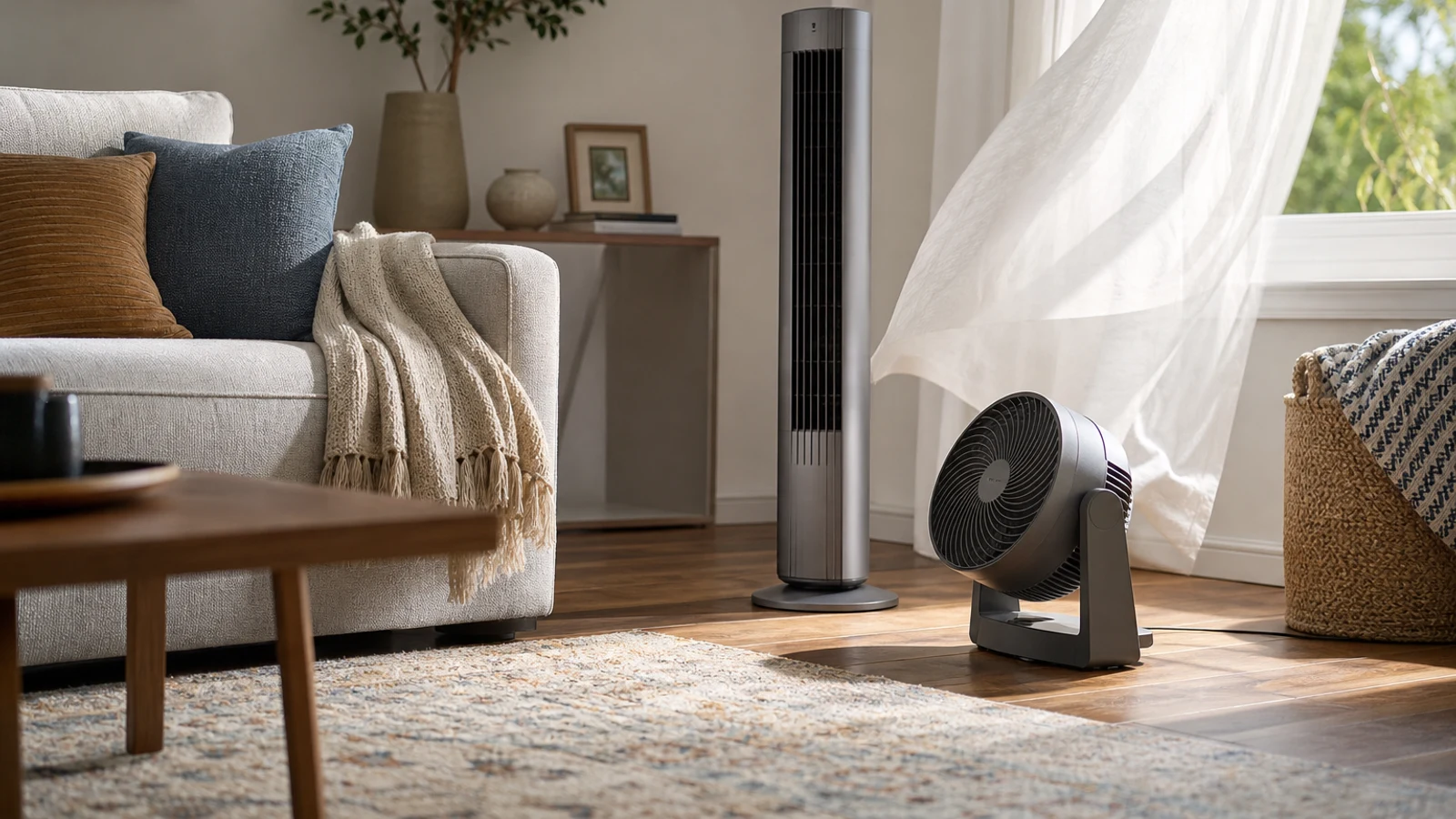
Tower Fan Vs Air Circulator At A Glance
| Decision Point | Tower Fan | Air Circulator |
|---|---|---|
| Typical airflow pattern | Broad, vertical stream; often oscillates side to side | Focused, projected stream designed to travel across the room |
| Best use | Personal comfort in bedrooms, offices, and living rooms | Room mixing, HVAC assistance, and longer-distance airflow |
| Perceived breeze | Usually softer and more evenly distributed nearby | Often stronger and more noticeable at a distance |
| Floor-space advantage | Tall, narrow footprint | Usually wider or more rounded footprint |
| Oscillation | Common and useful for covering multiple nearby people | Often fixed, though some models oscillate or pivot |
| Cleaning | Intake grilles and internal channels can be difficult to reach | Grilles and exposed blades may be easier to clean, depending on design |
| Noise considerations | Often chosen for bedrooms, but motor and airflow noise vary widely | Can sound more forceful at higher speeds; low-speed noise varies by model |
| Best answer to “which moves air better?” | Better for nearby, wide-area personal airflow | Usually better for long-distance projection and room circulation |
The short answer is that an air circulator usually moves air farther, while a tower fan often makes personal cooling easier in a small or shared space. That distinction matters because “moves air better” can mean several different things: creating a breeze on your skin, covering more than one person, pushing air across a room, or blending warm and cool air from different parts of the space.
A tower fan and an air circulator are not defined by one universal performance standard. Some tower fans use strong, directed airflow, and some modern air circulators oscillate. Individual designs also differ in motor strength, grille shape, blade or impeller design, speed control, and airflow measurement. Treat the category comparison as a starting point, then check the specific model’s airflow claims, noise information, dimensions, controls, and cleaning instructions.
Neither type replaces air conditioning. Fans mainly improve comfort by increasing air movement across the body and, in some setups, by mixing or distributing already-cooled air. They do not meaningfully lower the temperature of a closed room on their own. Turn a fan off when nobody is benefiting from it, especially if your goal is to save energy.
How The Airflow Differs
A tower fan is designed around a tall, narrow housing. Inside, a cylindrical blower or similar mechanism sends air through a vertical outlet. Many models oscillate, sweeping the stream from side to side. This makes a tower fan useful when the people benefiting from the breeze are sitting or sleeping near the fan and do not all occupy exactly the same position.
The airflow often feels broad rather than sharply projected. That can be comfortable at a desk, beside a sofa, or near a bed, particularly when a strong, concentrated stream would be irritating. The vertical outlet can also distribute air across a larger portion of the body than a small desk fan, although the actual coverage depends on the outlet height and oscillation range.
An air circulator is generally built to create a more coherent stream that travels farther before dispersing. Its housing, grille, and propeller or impeller are shaped to move a column of air across the room. Instead of sweeping the breeze from side to side, you typically aim the unit toward a wall, ceiling, doorway, or the opposite side of the room so the moving air returns through the space and helps mix it.
When An Air Circulator Moves Air Better
Choose an air circulator when the priority is distance, room mixing, or helping existing heating and cooling reach more evenly. A strong directional stream can be useful in a long living room, open-plan area, home gym, or room with noticeable hot and cold spots. It can also help distribute air from a window or an air-conditioning vent, provided the setup does not block the appliance or create a safety problem.
An air circulator is usually the stronger choice when you want to feel airflow from several feet away rather than sit directly in front of the fan. It can also work well when you prefer to aim the fan at a wall or ceiling instead of having air blow constantly into your face. That indirect arrangement may provide more even mixing and reduce the sensation of a harsh draft.
Choose an air circulator if: • You want airflow to travel across a room.
- You are trying to mix warm air near the ceiling with cooler air below.
- You want to distribute conditioned air from an HVAC vent.
- You prefer a fixed, aimed stream rather than constant oscillation.
- You need stronger airflow for a larger room or open layout.
- You want to move air toward or away from an open window, subject to safe placement and outdoor conditions.
When A Tower Fan Is The Better Choice
A tower fan is often better when the fan will sit close to people and the main goal is personal comfort. Its slim footprint is convenient beside a bed, sofa, desk, or narrow walkway. The tall profile can place the outlet at a useful height without requiring a pedestal base, while oscillation can spread the breeze among two people or across a seating area.
Tower fans are also easier to blend into rooms where appearance and floor space matter. Their enclosed housing can look less industrial than a large circular fan, and many include remote controls, timers, sleep modes, and several speed settings. Those features do not automatically mean better airflow, but they can make a tower fan easier to live with every day.
A tower fan may be the better fit if: • You have limited floor space.
- You want a fan beside a bed, desk, or sofa.
- More than one nearby person needs occasional airflow.
- You prefer oscillation over aiming the fan at one fixed target.
- You want a tall, relatively discreet design.
- You value a timer, remote control, display dimming, or sleep-oriented controls.
- You are cooling a small or medium room rather than trying to move air across a large open area.
Personal Cooling Vs Whole-Room Circulation
The most important buying question is whether you want to cool people or circulate room air. Personal cooling is about air speed at the body. A fan pointed toward someone can make that person feel cooler even though the room temperature has not changed. In this role, a tower fan can work very well because it provides a broad nearby breeze and can sweep across multiple occupants.
Whole-room circulation is about keeping air in motion through a larger volume. The aim may be to reduce temperature stratification, distribute air from an air conditioner, or make an enclosed room feel less stagnant. A focused air circulator generally has the advantage because it can project air farther and be aimed at a wall or ceiling to create a larger circulation loop.
These goals can overlap. A tower fan may circulate a small room adequately, and an air circulator can provide excellent personal cooling when aimed directly at a chair or bed. The category name is less important than the combination of airflow strength, placement, room layout, and your preferred level of breeze.
Noise, Sleep, And Daily Comfort
Noise is model-specific, so do not assume every tower fan is quieter than every air circulator. A tower fan may produce a softer, less forceful sound at a low setting, but narrow internal air passages, oscillation mechanisms, or dusty intake areas can add noise. An air circulator may sound more noticeable because it produces a stronger stream, yet some models are quiet enough for bedrooms when operated at a lower speed.
For sleeping, look for a genuinely low minimum speed, a stable motor sound, controls that can be dimmed or turned off, and a timer that matches your routine. A strong maximum speed is less important if you will only use the lowest setting overnight. If you are sensitive to tonal hum, rattling, or mechanical clicks, buying from a retailer with a practical return policy can matter more than a broad “quiet” label.
For work, consider whether the airflow disturbs papers, dries your eyes, or creates an uncomfortable draft. A tower fan’s wider nearby breeze may be easier to tolerate, while an air circulator can be aimed away from your face and toward a wall. Either approach can work, but placement is often more important than fan type.
Space, Placement, And Airflow Direction
Measure the intended location before buying. A tower fan uses little width but still needs clearance around its air intake and outlet. Do not place it tightly against curtains, furniture, bedding, or a wall if those objects restrict airflow. Check the base dimensions as well as the body width; a tall fan with a small base may be more vulnerable to being knocked over in a busy room.
An air circulator usually needs more visual and physical space around its housing, but it may be easier to aim precisely. For room mixing, place it where the stream can travel unobstructed toward an opposite wall or ceiling. For personal cooling, aim it at the occupied area without positioning it so close that the breeze becomes uncomfortable or the fan becomes a trip hazard.
If you are using a fan with an open window, think about the direction of outdoor air and the room’s other openings. A fan can help bring in cooler outdoor air or exhaust warmer air, but the result depends on outdoor temperature, wind, window placement, and the rest of the home. A fan inside a closed, already-hot room cannot create a sustained temperature drop by itself.
Cleaning And Maintenance Trade-Offs
Dust buildup affects both airflow and noise. Unplug the fan before cleaning, and follow the manufacturer’s instructions for removing grilles, filters, or covers. Avoid spraying liquid into the housing or using methods that push dust deeper into the motor and controls.
Many tower fans have narrow internal passages and covered impellers. Their clean exterior does not necessarily mean the inside is easy to reach. Check whether the intake grille can be vacuumed effectively and whether the manufacturer provides a cleaning procedure. If you have pets, allergies, or a dusty room, prioritize accessible intakes and a design that can be maintained without damaging the housing.
Some air circulators have visible front and rear grilles that are straightforward to dust, while others are enclosed or difficult to disassemble. Exposed blades are not automatically easier to clean, so inspect the instructions before purchase. Maintenance should be part of the comparison, not an afterthought, because restricted airflow can reduce comfort and make a fan sound rougher over time.
What To Check Before Buying
Do not choose based only on the words “tower,” “circulator,” or “bladeless.” Compare the details that affect your actual use.
Prioritize these specifications and features: • Airflow information: Look for a meaningful airflow figure when available, but compare measurements only when the testing method and conditions are similar.
- Minimum speed: Important for sleeping, office work, and people who dislike strong drafts.
- Maximum speed and reach: More useful when the fan must move air across a room.
- Oscillation range: Valuable for covering nearby people; less important if you plan to aim the fan at a wall.
- Tilt or vertical adjustment: Particularly useful for air circulators and multi-level spaces.
- Noise information: Treat manufacturer noise figures cautiously and look for independent measurements when possible.
- Controls: A remote, timer, display-off setting, and memory function can improve daily use.
- Cleaning access: Check how the intake and internal components are cleaned.
- Stability and cord length: Important beside beds, desks, walkways, and pets.
- Safety features: Look for a stable base, protected moving parts, and clear operating instructions.
When Not To Buy Or Upgrade
You may not need either fan if your existing unit already provides comfortable airflow and the problem is actually high humidity, inadequate insulation, poor HVAC balancing, or a room that receives excessive solar heat. A more powerful fan can make a warm room feel more tolerable, but it will not solve a need for dehumidification or active cooling.
Do not upgrade solely because a newer fan has more speed settings or a more modern exterior. Upgrade when the current fan is too weak for the space, too noisy for sleep, difficult to clean, unstable, missing a timer you genuinely need, or unable to fit the intended location. If you mainly want a breeze at one chair or desk, a compact personal fan may be more practical than either a large tower fan or a high-output circulator.
Also avoid paying extra for features you will not use. App controls, air-purifying claims, heating modes, and decorative displays can be convenient, but they should not distract from airflow, noise, maintenance, stability, and placement.
The Bottom Line
For the narrow question of which type usually moves air better, choose an air circulator when you mean longer reach, stronger projection, and whole-room mixing. It is the better starting point for large rooms, open layouts, HVAC assistance, and people who want to aim air away from their body while still keeping the room moving.
Choose a tower fan when you mean comfortable, nearby airflow with a slim footprint and convenient oscillation. It is often the more practical choice for bedrooms, offices, apartments, and shared seating areas where the fan will sit close to the people using it.
The final decision should come down to the room and the airflow path: how far the air must travel, whether one or several people need a breeze, how much floor space is available, how much noise you can tolerate, and whether you are willing to clean the design regularly. If both types seem suitable, prioritize the model with the better low-speed behavior, placement flexibility, cleaning access, and return policy rather than choosing by category alone.
Go Deeper Before You Choose
For more context, see air purifier buying guidance.
For more context, see dehumidifier buying guidance.
Research References
These sources informed the factual background for this guide. BuyingView applies its own editorial judgment to the purchase decision.
Questions & Answers
Useful follow-up questions that often change the buying decision.
Does an air circulator cool a room better than a tower fan?
Neither fan type actively lowers the temperature of a closed room. An air circulator may distribute already-cooled air more effectively across a larger space, while a tower fan may provide more comfortable nearby airflow. The room layout and placement determine the result.
Is a tower fan quieter than an air circulator?
Not automatically. Noise varies by motor, airflow design, speed setting, oscillation mechanism, and maintenance. Tower fans are often selected for bedrooms, but a well-designed air circulator can also be comfortable at low speed.
Which is better for a bedroom?
A tower fan is often the convenient choice when space is limited and you want oscillation, a timer, and a broad breeze near the bed. An air circulator may be better if you want to aim airflow across the room or prefer a stronger stream at a distance.
Which is better for a large living room?
An air circulator is usually the stronger starting point because its projected airflow can travel farther and help mix air through the room. A tower fan can still work if people are seated close to it or if broad oscillation is more important than long-distance reach.
Can I use either fan with air conditioning?
Yes. Either can improve comfort by moving conditioned air, but an air circulator is generally easier to aim across a room for mixing. Use the lowest speed that provides comfort, and turn the fan off when the room is unoccupied if you are trying to reduce electricity use.
Are tower fans easier to clean?
Not necessarily. Their enclosed, narrow housings may be harder to access internally. Some air circulators are easier to dust, but designs vary. Check the manufacturer’s cleaning instructions before buying, especially if you have pets or a dusty room.