Basket Air Fryer vs Oven-Style Air Fryer: Which Should You Buy?
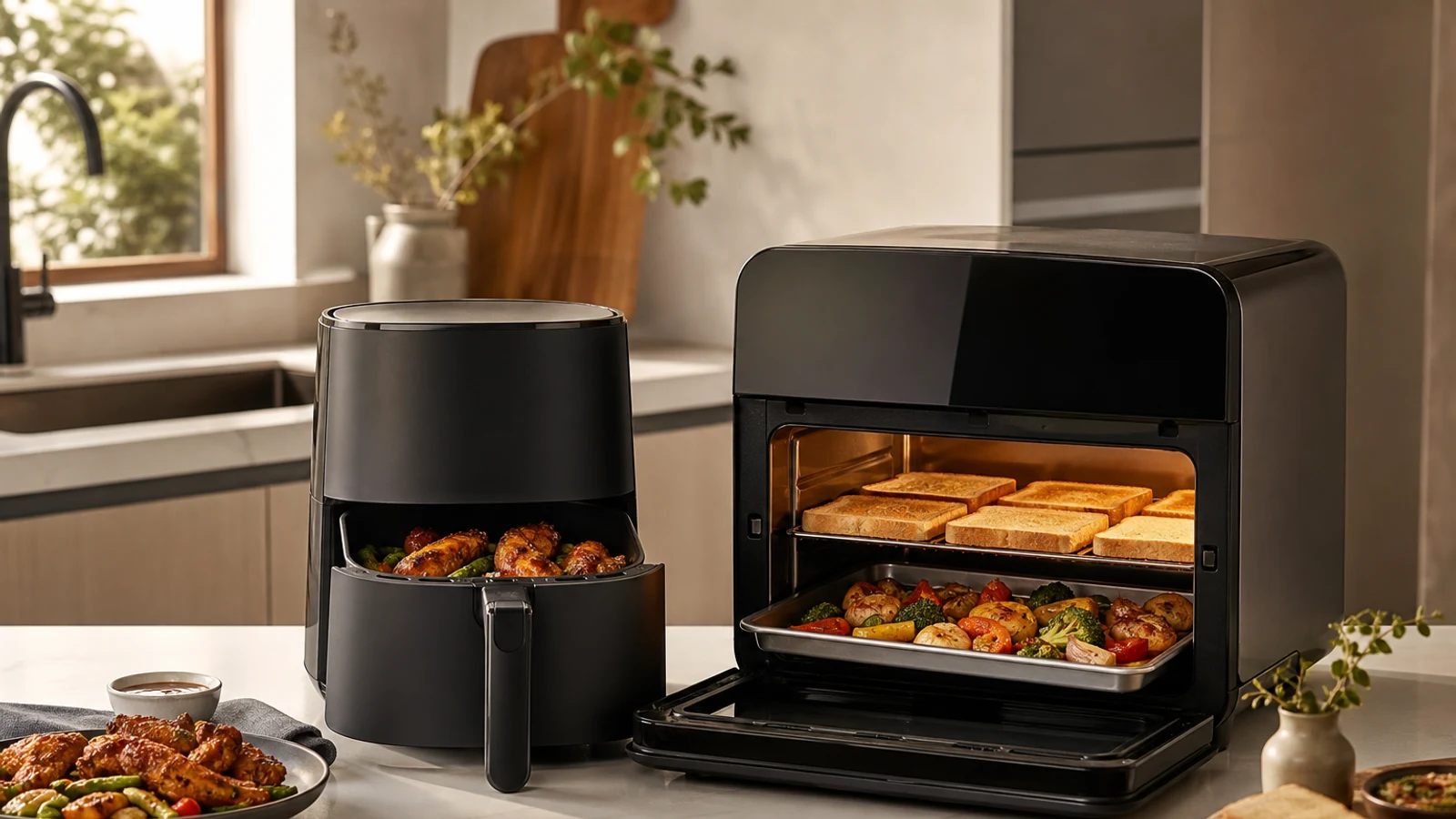
Basket Air Fryer vs Oven-Style Air Fryer At A Glance
| Decision Point | Basket Air Fryer | Oven-Style Air Fryer |
|---|---|---|
| Best At | Crisping fries, wings, frozen snacks, and small portions | Toast, bake, roast, reheat, and air-fry flatter foods |
| Cooking Space | Deep, compact basket; often best used as one layer | Wider rack or tray area; may offer multiple levels |
| Crisping | Usually more consistent for dedicated air-frying tasks | Can be good, but airflow and rack position matter more |
| Capacity Shape | Better for bite-size foods and compact portions | Better for pizza slices, toast, vegetables, and shallow pans |
| Cleanup | Usually fewer parts and a simpler cooking chamber | More surfaces, racks, trays, and door or interior areas to wipe |
| Countertop Use | Tall, compact footprint with a pull-out drawer | Usually wider or deeper, with front-door clearance |
| Versatility | Focused on air frying, roasting, and reheating | Often adds toast, bake, broil, dehydrate, or warming modes |
| Best Fit | Air frying is the main reason you are buying | You want a small countertop oven that also air-fries |
The short version is straightforward: a basket air fryer is usually the better specialist, while an oven-style air fryer is usually the more versatile countertop appliance. Both circulate hot air to brown food with little or no added oil, but their shapes change how that heat reaches the food and how you use the appliance day to day.
Basket models use a pull-out drawer with a perforated basket or crisping plate. Oven-style models resemble compact toaster ovens, with a front door, racks, trays, and sometimes a dedicated mesh air-fry basket. Neither design is automatically better for every kitchen.
The most useful question is not “Which one has more quarts?” It is “What do I want to cook in one batch, and what other appliance do I already own?” A small household that mostly reheats leftovers or cooks frozen foods may value speed and simplicity. Someone who wants toast, sheet-pan vegetables, open-faced sandwiches, or small baking projects may get more value from an oven-style model.
How The Two Designs Differ
A basket air fryer concentrates the heating element and fan around a relatively small cooking chamber. The compact space can help food brown quickly, especially when the basket is not overcrowded. Pulling out the drawer also makes it easy to shake fries, toss vegetables, or turn pieces during cooking.
An oven-style air fryer uses a shallower cavity and usually a rack or mesh tray. That makes loading and unloading more familiar: slide in a tray, place food on a rack, and remove it with an oven mitt. The trade-off is that the larger cavity, door opening, and rack position can make airflow less concentrated.
This difference is why dedicated basket models often have an advantage when the main goal is maximum crispness from foods such as wings, breaded chicken, French fries, and frozen snacks. Oven-style models can still produce good air-fried food, but results may depend more on the specific fan design, tray, rack height, and how much space you leave around the food.
Choose A Basket Air Fryer If Crisping And Speed Come First
A basket model makes the most sense when air frying is the appliance’s primary job. The compact chamber typically heats quickly, and the drawer is designed around foods that benefit from strong circulation on multiple sides.
It is especially practical for one or two people, or for households that prefer cooking a main item and a side in separate short batches. A basket can also be easier for a first-time user because the basic workflow is familiar: add food, set time and temperature, shake or turn if needed, and remove the drawer.
Choose this style if: • You mostly cook fries, wings, nuggets, vegetables, fish fillets, or reheated leftovers.
- You want the crispest and most repeatable air-frying results rather than many cooking modes.
- You have limited counter depth or need to store the appliance between uses.
- You prefer a removable drawer over reaching into a hot cavity.
- You are cooking for one to three people and do not mind occasional batches.
Choose An Oven-Style Air Fryer If Shape And Versatility Matter More
An oven-style model is a better fit when the foods you cook do not naturally belong in a deep drawer. A wide rack can accommodate toast, pizza slices, open sandwiches, vegetables spread in a shallow layer, or a small baking dish if the interior dimensions allow it.
Many oven-style models combine air frying with toast, bake, roast, broil, warm, or dehydrate settings. That can make the appliance useful throughout the day, not just for crispy food. It may also replace a separate toaster oven for some households.
The extra flexibility comes with more variables. You may need to choose a rack position, rotate a tray, or check whether food on an upper rack browns faster than food below it. Multiple racks can increase theoretical capacity, but filling every level does not guarantee even results. Air needs room to circulate, and some foods still need rotating or rearranging during cooking.
Compare Usable Capacity, Not Just Quart Numbers
Advertised capacity can be misleading because two appliances with similar stated volume may hold very different amounts of food in a useful single layer. Basket capacity is often deep and compact, while oven-style capacity is often wider but shallower.
For basket models, pay attention to the shape of the basket and the amount of flat cooking surface. A tall basket may hold a large volume of food, but stacking food too deeply can reduce browning and require more shaking or extra cooking time.
For oven-style models, measure the actual rack or tray dimensions. Ask whether your usual foods fit without touching the walls or heating elements. A model may technically fit a whole chicken, a small pizza, or multiple racks, but that does not mean it will cook those foods evenly in every configuration. Before buying, measure: • The appliance’s full footprint, including door clearance and ventilation space.
- The width and depth of the usable tray or rack.
- The height between racks and the top heating element.
- Whether your preferred pan, dish, or pizza size will fit.
- Whether the cooking space is easy to reach when hot.
Think About Your Daily Workflow
Basket models are built for quick, repetitive routines. You can often add food without pulling out a tray, and shaking the basket is faster than rearranging items on a rack. The drawer also keeps small foods contained, which is useful for loose fries, vegetables, and bite-size frozen foods.
Oven-style models feel more natural for foods that need to stay flat or remain undisturbed. A tray is easier to load with delicate fish, toast, or a small baking project. The front door also lets you see the food without lifting an entire basket, although opening the door can release heat and interrupt cooking.
Consider who will use the appliance. A basket may be easier for someone who wants minimal controls and a simple pull-out motion. An oven-style unit may be easier for someone who dislikes lifting a heavy, hot basket or wants to slide food directly onto a tray.
Cleaning And Maintenance Are Part Of The Decision
A basket air fryer usually has fewer removable cooking parts: the drawer, basket, and sometimes a separate crisper plate. That can make routine cleanup relatively simple, especially when the basket and plate are dishwasher-safe according to the manufacturer’s instructions. Food debris can still collect beneath a removable insert, so the parts should be separated and cleaned rather than wiped only from the top.
An oven-style model may have a rack, mesh air-fry tray, baking pan, crumb tray, interior walls, glass door, and more corners where grease can collect. Those parts may be easier to load than a deep basket, but there are more surfaces to maintain. A mesh tray can also be tedious if breading or melted cheese dries onto it.
Look for removable parts, clear care instructions, and an interior that you can comfortably reach. Do not assume that every accessory is dishwasher-safe or that a nonstick coating can tolerate abrasive scrubbers. If you expect to use the appliance every day, the easiest model to clean is often the one you will actually keep using.
Do Not Overlook Countertop Space And Ventilation
Basket air fryers often use a tall footprint, while oven-style units generally need more width or depth and space in front for the door. The best fit depends on your cabinets, outlets, and where you can safely operate the appliance.
Measure the appliance in its cooking position, not just its storage position. Make sure the door can open fully, the basket can be removed without hitting a wall, and the unit has the clearance required by its manual. Avoid placing either style directly under a cabinet if the manufacturer warns against it or if hot air vents upward.
A countertop appliance also needs a home between uses. If an oven-style model is too heavy or awkward to move, its extra functions may not matter. Conversely, if a basket model must be stored in a cabinet and is annoying to retrieve, its quick cooking advantage may disappear in practice.
When An Oven-Style Model Is Not The Better Upgrade
An oven-style air fryer can look like an upgrade because it offers more racks and cooking modes, but more functions do not automatically mean better air frying. If you already own a toaster oven that handles toast, baking, and reheating well, an oven-style air fryer may duplicate equipment while taking up more counter space.
It may also be the wrong choice if your main expectation is restaurant-style crispness from small portions. A basket model’s compact cooking chamber and easy shaking routine may be more useful than extra rack capacity.
Likewise, do not upgrade solely because a model advertises a larger quart number. Upgrade when your current appliance creates a specific problem: too many batches, food that will not fit flat, lack of toast or bake functions, difficult cleanup, or an inconvenient footprint.
When A Basket Model Is Not The Better Buy
A basket air fryer can be limiting when you regularly cook for a larger household or prepare foods that need a broad, flat surface. You may end up working in multiple batches, which can reduce the time savings and leave the first batch cooling while the second cooks.
A basket also may not replace a toaster oven for your routine. It is not the natural tool for toast, open-faced sandwiches, small casseroles, or foods that need a baking pan. Some basket models support accessories, but accessory compatibility and usable dimensions vary.
If you need two foods cooked at different temperatures, a dual-basket model may address that problem more directly than switching to an oven-style design. But dual-basket appliances still need counter space, and two cooking zones do not eliminate the need to avoid overcrowding.
What Features Matter More Than Extra Presets
Presets can be convenient, but they are not the main reason one design fits better than another. Focus on the physical details that affect daily use.
Prioritize: • A cooking surface that matches your normal portion size.
- A basket, tray, or rack that is easy to remove when hot.
- Controls that let you adjust time and temperature without guesswork.
- A clear end-of-cycle signal and automatic shutoff.
- Removable parts with practical cleaning instructions.
- A cord and vent placement that work in your kitchen.
- Replacement accessories or parts if the manufacturer offers them.
- A manual that explains rack positions, preheating, and food spacing.
For oven-style units, inspect the air-fry basket closely. A large oven cavity is not enough; the mesh tray and fan arrangement determine whether air-frying works well. For basket models, examine whether the basket separates easily from the drawer and whether the cooking surface is large enough for your most common foods.
Our Bottom Line
Buy a basket air fryer when you want a focused tool for fast, crisp food and straightforward cleanup. It is usually the stronger choice for small households, frequent frozen-food cooking, reheating, wings, fries, and other foods where concentrated airflow matters most.
Buy an oven-style air fryer when you want a countertop oven first and an air fryer second, or when you regularly need racks, trays, toast, baking, and wider cooking space. It can replace more functions, but it may require more attention to rack position, food spacing, and cleaning.
If you are undecided, write down the five foods you cook most often and the appliance you already own. If four of those foods are small, crispable portions and you already have a toaster oven, choose a basket. If several require a flat tray or another oven function, choose oven-style. For sizing, compare actual tray or basket dimensions using a guide such as the site’s air-fryer size resource rather than relying only on quart labels.
Go Deeper Before You Choose
For more context, see What Size Air Fryer Do I Need?.
For more context, see Best Air Fryer Features That Matter.
For more context, see Air Fryer vs Toaster Oven.
Relevant Product
One catalog product is directly relevant to this decision. It is shown as a reference point, not as a universal winner. Current price, seller and availability should always be confirmed on Amazon.

Research References
These sources informed the factual background for this guide. BuyingView applies its own editorial judgment to the purchase decision.
Questions & Answers
Useful follow-up questions that often change the buying decision.
Is a basket air fryer better than an oven-style air fryer?
Neither is universally better. Basket models usually have the edge for fast, crisp air-frying and simple cleanup. Oven-style models are better when you need a wider cooking surface, racks, toast, baking, or other countertop-oven functions.
Which type is better for a family?
It depends on the foods and portions. An oven-style model may fit more flat food or multiple racks, but a basket model can be faster for compact foods. Compare usable tray or basket dimensions and consider whether you are willing to cook in batches.
Do oven-style air fryers cook as crisply as basket models?
Some perform very well, but basket models often produce more consistent crisping because their smaller chambers concentrate airflow. Oven-style results depend heavily on the fan, mesh tray, rack position, and how much food is loaded.
Are oven-style air fryers easier to clean?
Not automatically. Their racks and trays may be easier to load, but they usually have more parts and interior surfaces to clean. Basket models often have fewer removable components, though greasy baskets and crisper plates still require regular washing.
Can an oven-style air fryer replace a toaster oven?
Often, yes, if its interior dimensions and functions match your needs. Check whether it can fit your preferred bread, pan, pizza, or baking dish and whether its controls provide the cooking modes you use. If you already own a toaster oven, the added value may be limited.
Should I choose based on quart capacity?
Use quart capacity as a rough starting point, not the final decision. Basket depth and tray dimensions determine how much food can cook effectively in one layer. Measure the usable cooking surface and compare it with your normal portions.