Cordless Vacuum vs Wet-Dry Vacuum: Which Cleans More of Your Home?
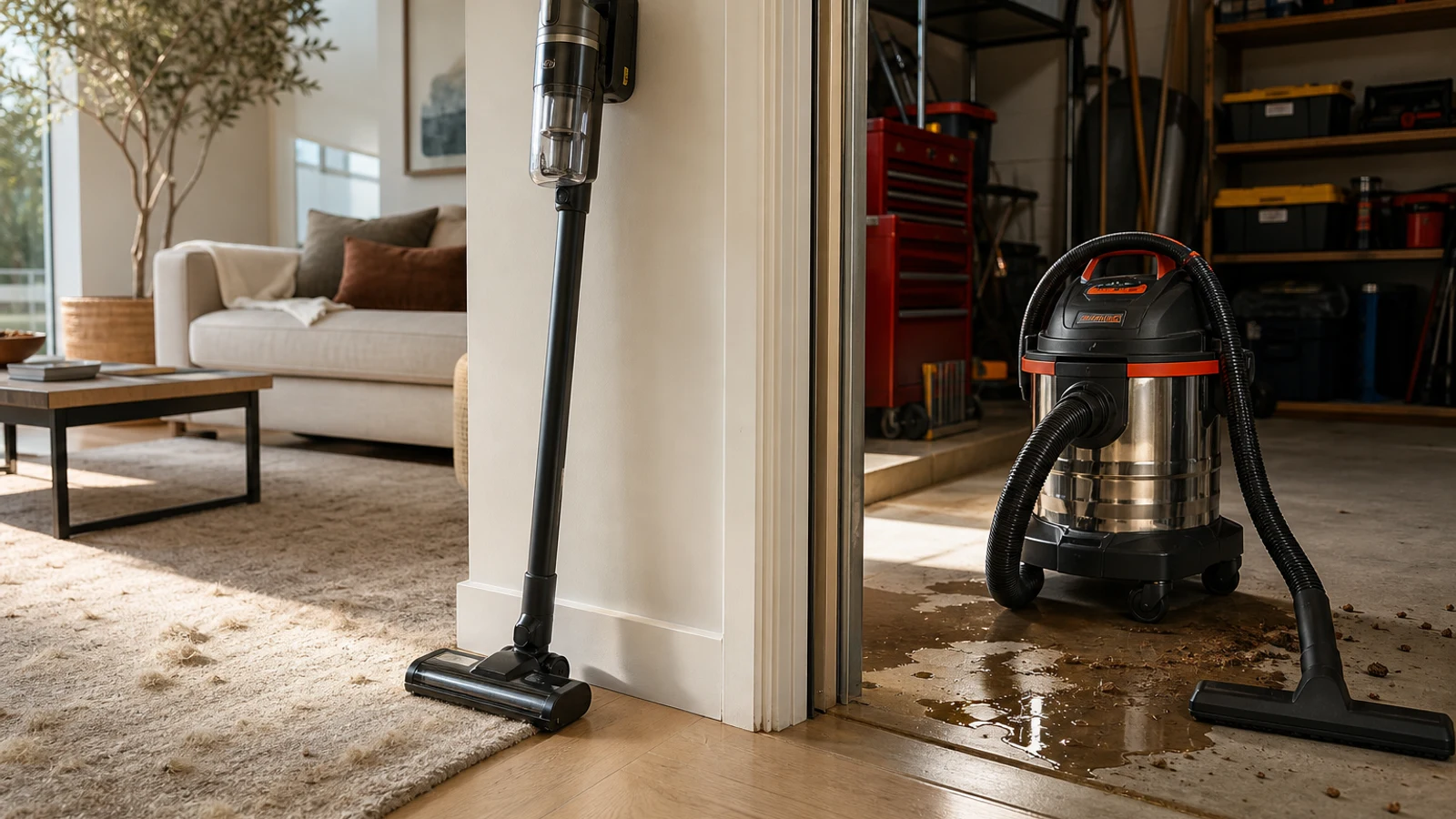
Cordless Vacuum Vs. Wet-Dry Vacuum At A Glance
| Decision Point | Cordless Vacuum | Wet-Dry Vacuum |
|---|---|---|
| Best primary role | Routine dry-floor and surface cleaning | Utility cleanup, spills, garages, workshops, and cars |
| Surfaces | Hard floors, rugs, carpet, stairs, upholstery | Hard floors, utility areas, garages, vehicles, and some outdoor-adjacent cleanup |
| Liquid pickup | Usually not designed for liquid | Designed to collect liquid when configured correctly |
| Convenience | Light, quick, cordless, easy to store | More equipment-like; often requires a hose, cord, or larger storage area |
| Large debris | Limited by the floor head, bin, and filter | Usually better suited to bulky or messy debris |
| Carpet cleaning | Generally the stronger fit, depending on model | Usually a poor substitute for a carpet-oriented vacuum |
| Maintenance | Charge battery, empty bin, clean brush roll and filters | Empty tank, clean hose and filter, dry components, change configuration |
| Best buying logic | Buy for the cleaning you do most often | Buy for messes ordinary household vacuums should not handle |
The short answer is that neither machine cleans more of your home in every situation. A cordless vacuum covers more of the daily indoor routine with less effort, while a wet-dry vacuum covers more unusual cleanup tasks, including liquids and heavier debris. They are complementary tools rather than direct substitutes.
For most households choosing one primary vacuum, a cordless model is the more practical starting point. It is easier to grab for crumbs, tracked-in dirt, pet hair, stairs, furniture, and quick passes across hard floors or rugs. Consumer Reports notes that modern cordless stick vacuums have improved considerably, but also identifies battery degradation, hair tangles, and clogs as recurring ownership concerns.
A wet-dry vacuum earns its space when your definition of cleaning includes spilled water, muddy entryways, garage dust, sawdust, renovation debris, vehicle interiors, or jobs where a hose and larger collection tank are more useful than a lightweight floor head. It can be dramatically more capable in those situations, but it is usually less pleasant for routine room-by-room cleaning.
What Each Vacuum Is Designed To Do
A cordless vacuum is a dry-cleaning appliance optimized for frequent use. Most models are shaped around a floor head, wand, dust bin, and rechargeable battery. Depending on the configuration, attachments may let you clean baseboards, upholstery, stairs, shelves, mattresses, and car interiors.
Its main advantage is workflow. You can pick it up without finding an outlet, move quickly between rooms, and store it in a closet or charging dock. That convenience can matter more than maximum suction because a vacuum that is easy to reach is more likely to be used often.
A wet-dry vacuum is a utility machine built to collect both dry debris and liquids, but the exact operating procedure varies by model. Manuals commonly require different filters or configurations for wet and dry pickup, and many units include a float or shutoff mechanism to prevent overfilling during liquid collection. It may also support blower functions or specialized attachments, which can be useful in garages, workshops, and vehicles.
Cordless Vacuum: Where It Wins
Everyday floor cleaning is the cordless vacuum’s strongest case. It is generally better suited to a home with a mix of hard flooring, low- or medium-pile rugs, carpeted stairs, and upholstery. A powered brush roll can help collect hair and embedded debris, although performance varies substantially by model and floor head.
Cordless models are also more convenient for small homes, apartments, and multi-level layouts. Carrying a compact vacuum upstairs is easier than moving a canister or wheeled wet-dry machine, and the absence of a power cord reduces setup time. Consumer Reports describes stick vacuums as particularly practical for smaller spaces and notes that current models can perform well on bare floors and pet hair, while full-sized uprights may still be preferable for extensive wall-to-wall carpet.
Choose a cordless vacuum if: • Most of your messes are dry crumbs, dust, hair, and tracked-in dirt.
- You clean living areas, bedrooms, stairs, and furniture more often than garages or workshops.
- You value fast, low-friction cleanup.
- Storage space is limited.
- You want one machine that can function as a floor vacuum and handheld cleaner.
- You are willing to manage battery charging and routine filter or brush-roll maintenance.
Cordless Vacuum: Where It Falls Short
The largest limitation is that cordless vacuums are usually dry-only appliances. Do not assume that a floor head can safely collect a puddle, spilled drink, pet accident, or wet mud. Liquid can damage components, create odors, or turn debris into a clog unless the manufacturer specifically designs the machine for wet pickup.
Battery runtime is another practical constraint. Advertised runtime often reflects a low-power mode or a configuration that does not represent your actual cleaning routine. High suction, motorized brush heads, and tool changes can reduce usable time. Consumer Reports reports that high-power operation may provide only a fraction of the headline runtime on some cordless stick vacuums, and its survey data identifies declining battery life and battery failure as common problems.
A cordless vacuum can also be a poor match for deep carpet cleaning if your home has thick wall-to-wall carpet, lots of embedded grit, or heavy shedding. In that situation, compare actual carpet-cleaning performance, brush design, battery availability, and whether a second battery can be purchased—not just motor wattage or claimed suction.
Wet-Dry Vacuum: Where It Wins
The wet-dry vacuum’s defining advantage is breadth of mess. It can handle jobs that would be unsafe, impractical, or destructive for a typical cordless stick vacuum: water on a basement floor, a tipped-over bucket, wet leaves near an entryway, sawdust, wood chips, workshop debris, and dirt inside a vehicle.
The larger tank and hose can also make it better for piles of debris or awkward areas. You can reach into corners, floor drains, car footwells, and utility spaces without pushing a floor head back and forth. Some models can blow debris away, though blowing creates its own dust and safety considerations.
Choose a wet-dry vacuum if:
- You have a garage, workshop, basement, hobby area, or frequently muddy entryway.
- You regularly clean vehicles or outdoor equipment.
- Liquid spills are common or would be difficult to mop quickly.
- You perform DIY, woodworking, painting, remodeling, or landscaping projects.
- You need a hose for corners, crevices, drains, or bulky debris.
- You can store a larger machine and accept more cleanup after use.
Wet-Dry Vacuum: Where It Falls Short
A wet-dry vacuum is not automatically a better everyday household vacuum. Many are bulky, noisy, corded, and awkward to carry up stairs. Their hoses can be excellent for utility work but cumbersome around furniture. A large tank also means more equipment to empty, rinse, dry, and store.
They may not provide the best floor-cleaning workflow for rugs, upholstery, stairs, and bedrooms. A wet-dry unit can collect dry dirt, but its floor tools and filtration system may be optimized for utility work rather than polished everyday cleaning. Fine dust can also require the correct filter or bag; using the wrong configuration can reduce performance or damage the machine.
Wet pickup requires discipline. Manufacturer instructions commonly call for removing or changing dry filters before collecting liquids, avoiding flammable or hazardous materials, and cleaning or drying the tank and accessories afterward. Do not use a household wet-dry vacuum for hot ashes, combustible liquids, toxic materials, or hazardous dust unless the specific machine and safety guidance clearly allow it.
Which One Cleans More Of Your Home?
If “more of your home” means the rooms you clean every day, the cordless vacuum usually wins. It is better aligned with bedrooms, living rooms, kitchens, stairs, rugs, furniture, and quick pet-hair cleanup. Its advantage is not necessarily that it can collect more types of material; it is that it makes frequent cleaning easier.
If “more of your home” includes the garage, basement, car, workshop, patio-adjacent areas, renovation projects, and liquid accidents, the wet-dry vacuum covers more categories of mess. It is the broader utility machine, but its extra capability may sit unused if your home rarely produces those jobs.
For a house with pets, the decision usually turns on floor plan and mess type. A cordless vacuum is more useful for daily hair and crumbs. A wet-dry vacuum becomes worthwhile when muddy paws, water bowls, litter-area cleanup, or garage projects create messes beyond dry surface debris. For allergy-sensitive households, pay attention to sealed filtration and filter maintenance rather than assuming that any vacuum labeled HEPA will perform identically. The EPA notes that HEPA filtration can help reduce some dust escaping from a vacuum, but filters must be maintained and vacuuming itself can stir settled particles into the air.
Space, Storage, And Maintenance
Storage often decides this comparison. A cordless vacuum can hang on a wall mount, stand in a closet, or occupy a small charging area. A wet-dry vacuum needs room for the main body, hose, wands, nozzles, filters, and possibly disposable bags. If those parts are scattered, setup becomes slower and the machine may be ignored.
The maintenance burden is different rather than simply higher or lower. Cordless ownership means charging, emptying a smaller dust bin more frequently, cutting hair from the brush roll, and washing or replacing filters according to the manual. Wet-dry ownership means switching between wet and dry configurations, emptying a larger tank, checking the hose for clogs, and allowing wet components to dry fully before storage.
Before buying either type, check:
- Whether replacement batteries, filters, brush rolls, bags, and hoses are available.
- How the machine stores its attachments.
- Whether the dust bin or tank is easy to empty without touching debris.
- Whether the charging dock requires wall mounting.
- Whether wet pickup requires filter removal or a special accessory.
- Whether the machine’s noise and weight fit your actual cleaning routine.
Should You Buy One Or Both?
Buy a cordless vacuum first when you need a primary household cleaner and your messes are mostly dry. The Dyson V8 Cordless Vacuum in the BuyingView catalog is directly relevant as an example of the lightweight cordless category, but the right model still depends on your floor mix, battery expectations, filtration needs, and attachment requirements.
Buy a wet-dry vacuum first when your main pain point is utility cleanup rather than daily floors. This is especially sensible for homeowners with a garage or workshop, people who do frequent DIY projects, or anyone who often deals with liquid and bulky debris. A wet-dry vacuum is less compelling for a small apartment with no garage, little carpet, and mostly routine crumbs and dust.
Buy both when each machine has a distinct job. Use the cordless vacuum for living spaces and frequent touch-ups; reserve the wet-dry vacuum for spills, cars, workshops, basements, and messy projects. That two-tool setup can reduce wear on the everyday vacuum and prevent you from using a delicate floor cleaner for jobs it was never designed to handle.
When Not To Buy Or Upgrade
Do not upgrade from a working cordless vacuum merely because a newer model advertises a higher suction number. Upgrade when the current vacuum no longer handles your floor type, battery performance has declined, parts are unavailable, filtration is inadequate for your needs, or its bin and brush design create repeated frustration.
Do not buy a wet-dry vacuum just because it sounds more powerful. If you rarely collect liquids or heavy debris, the extra size, noise, storage, and maintenance may make everyday cleaning worse. A conventional upright, canister, or cordless model may be a better primary vacuum for extensive carpet or a larger finished home.
Likewise, do not expect either category to replace specialized equipment in every case. A wet-dry vacuum is not necessarily a carpet washer, and a cordless vacuum is not necessarily a deep-cleaning upright. Match the tool to the material, surface, and frequency of the job.
The Bottom Line
For most households, choose a cordless vacuum as the everyday cleaner and a wet-dry vacuum only when your home produces utility-scale messes. The cordless model is easier for daily floors, stairs, rugs, pet hair, and quick pickups. The wet-dry model wins for liquid spills, garage debris, vehicles, workshops, basements, and projects.
If you are choosing only one, list the five messes you clean most often. If four or five are dry indoor debris, choose cordless. If several involve liquid, bulky debris, vehicles, or DIY work, choose wet-dry. The best answer is determined less by which machine sounds stronger and more by which one fits the cleaning workflow you will actually repeat.
Go Deeper Before You Choose
For more context, see Robot Vacuum Vs. Cordless Vacuum.
For more context, see Bagged Vs. Bagless Vacuum.
For more context, see Upright Vs. Canister Vacuum.
Relevant Product
One catalog product is directly relevant to this decision. It is shown as a reference point, not as a universal winner. Current price, seller and availability should always be confirmed on Amazon.

Research References
These sources informed the factual background for this guide. BuyingView applies its own editorial judgment to the purchase decision.
Questions & Answers
Useful follow-up questions that often change the buying decision.
Can a cordless vacuum pick up water or wet spills?
Usually no. Unless the manufacturer explicitly identifies the model as suitable for wet pickup, keep liquids away from the motor, filter, dust bin, and floor head. Use a towel, mop, or properly configured wet-dry vacuum instead.
Is a wet-dry vacuum better for pet hair?
Not automatically. A cordless vacuum with a motorized brush head is usually more convenient for daily pet hair on floors, rugs, stairs, and furniture. A wet-dry vacuum is more useful for muddy paws, liquid accidents, litter-area debris, or cleanup around a garage or utility space.
Can a wet-dry vacuum replace a regular vacuum?
It can collect dry debris, but it may not be the most convenient replacement for a household vacuum. Floor tools, filtration, weight, hose handling, noise, and storage can make it less suitable for bedrooms, stairs, rugs, and frequent room-by-room cleaning.
Which vacuum is better for a garage?
A wet-dry vacuum is usually the better fit because it can handle larger debris, liquid, vehicle interiors, and workshop messes. Confirm the filter, bag, hose, and safety instructions for the material you plan to collect.
Are cordless vacuums worth it if I have wall-to-wall carpet?
They can be, but compare carpet-cleaning performance and battery behavior carefully. For extensive or thick carpet, a full-sized upright or canister may provide a better primary cleaner, with a cordless model serving as a convenient secondary vacuum.
Do I need both a cordless and wet-dry vacuum?
Not necessarily. One may be enough if your cleaning needs are narrow. Owning both makes sense when you want a convenient daily cleaner for finished living spaces and a separate utility machine for liquids, cars, garages, workshops, or renovation debris.